Hydraulic pump testing is an important process for verifying pump performance before delivery, after repair, or before installation. To test a hydraulic pump with a test bench, the pump is driven at specified speeds and subjected to controlled hydraulic loads while pressure, flow, temperature, and other performance parameters are measured.
Unlike testing a pump directly on a machine, a dedicated test bench provides controlled and repeatable operating conditions. This helps engineers identify performance problems and determine whether a pump meets its specified operating requirements.
What Parameters Should Be Tested?
The required test parameters depend on the pump type, displacement, operating conditions, and testing purpose. Pressure and flow measurements are fundamental, while additional measurements may be necessary for more comprehensive performance evaluation.
| Test Parameter | Unidade | Testing Purpose |
|---|---|---|
| Outlet Pressure | bar / MPa | Evaluate performance under hydraulic load |
| Inlet Pressure | bar / kPa | Verify suitable inlet conditions |
| Caudal | L/min | Measure actual pump output |
| Rotational Speed | rpm | Verify operating speed |
| Drive Torque | N·m | Determine mechanical input power |
| Oil Temperature | °C | Maintain consistent testing conditions |
| Case Drain Flow | L/min | Assess internal leakage where applicable |
| Efficiency | % | Evaluate energy conversion performance |
For gear pumps, pressure and flow testing are often sufficient for basic performance verification. Piston pumps and variable displacement pumps may require additional measurements, including case drain flow and displacement control response.
For an overview of available testing functions, see our Hydraulic Pump Test Bench guide.
Hydraulic Pump Testing Procedure
Step 1: Test Preparation
Before testing, identify the pump model, displacement, rotational direction, rated speed, pressure limits, and recommended hydraulic fluid. Inspect the pump condition and confirm that the test bench, drive system, and measuring instruments are suitable for the required operating range.
Step 2: Pump Installation and Connection
Mount the pump securely and connect it to the drive motor using an appropriate, correctly aligned coupling. Prepare the inlet, outlet, and case drain connections where applicable, following the pump manufacturer’s requirements.
The pump must be correctly primed, and the housing filled where required. Ensure that the coupling guard, pressure protection devices, and emergency stop system are in place before operation.
Step 3: Low-Load Testing
Start the pump under the approved low-load conditions and monitor its initial operation. Check for abnormal noise, vibration, external leakage, and unsuitable inlet conditions.
Allow the oil temperature and operating parameters to stabilize before recording performance data. Abnormal operating conditions should be investigated before proceeding with loaded testing.
Step 4: Pressure and Flow Testing
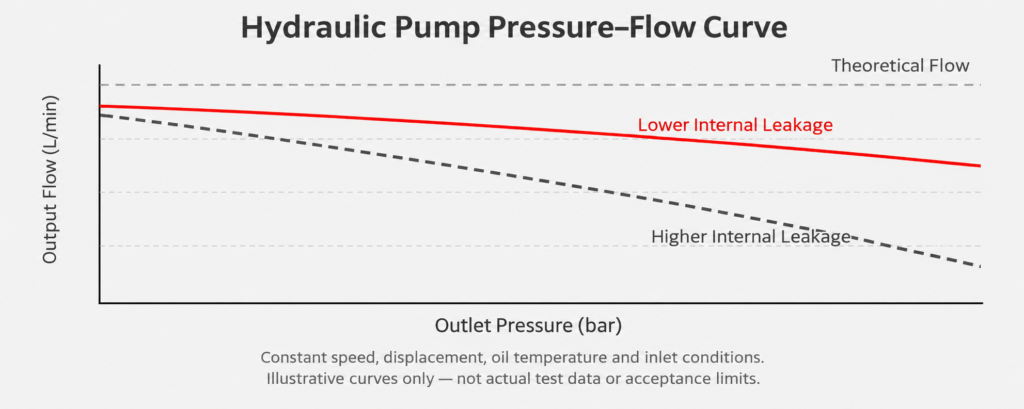
Operate the pump at the specified test speed and adjust the hydraulic load according to the approved test procedure. Record the actual delivery flow at different pressure points to evaluate pump performance across the required operating range.
Test pressure, speed, temperature, and inlet conditions must remain within the permitted limits. For variable displacement pumps, the displacement setting or control conditions should also be recorded.
Step 5: Additional Performance Measurements
Depending on the testing requirements, measure drive torque, case drain flow, and efficiency at the specified operating points. These measurements provide additional information about mechanical losses, internal leakage, and overall pump performance.
Step 6: Test Result Recording
Record the operating conditions, measured values, and inspection results. After testing, follow the approved shutdown procedure, isolate the drive system, and safely release stored hydraulic pressure before disconnecting the pump.
How to Evaluate Hydraulic Pump Test Results
Pump test results should be compared with the manufacturer’s performance data or agreed acceptance requirements under equivalent speed, pressure, temperature, and displacement conditions.
| Evaluation Item | Acceptance Basis |
|---|---|
| Outlet Pressure | Specified operating requirements |
| Delivery Flow | Expected flow at the specified speed and pressure |
| Case Drain Flow | Permitted leakage limits for the pump model |
| Efficiency | Specified performance requirements |
| Oil Temperature | Approved testing conditions |
| Noise & Vibration | Applicable inspection criteria |
| Final Result | PASS / FAIL according to agreed criteria |
Common Hydraulic Pump Testing Problems
Abnormal test results do not always indicate that the pump itself is defective. Incorrect test conditions, restricted oil supply, unsuitable fluid viscosity, or measurement errors can also affect the results.
| Test Symptom | Possible Causes |
|---|---|
| Insufficient Flow | Internal leakage, incorrect speed or displacement setting |
| Low Outlet Pressure | Excessive leakage, incorrect load setting or relief valve issues |
| Excessive Case Drain Flow | Internal wear or leakage in applicable pump designs |
| Abnormal Noise | Cavitation, aeration or mechanical problems |
| Excessive Oil Temperature | Internal losses, excessive loading or insufficient cooling |
| Unstable Flow or Pressure | Air in the circuit or control system problems |
These symptoms should be evaluated together with the measured data rather than treated as conclusive evidence of pump failure.
AISOAR Hydraulic Pump Testing Solutions
AISOAR designs customized Hydraulic Pump & Motor Test Benches for pump manufacturers, repair workshops, and industrial maintenance centers. Depending on project requirements, the equipment can incorporate variable-speed drive, hydraulic loading, pressure and flow measurement, torque measurement, case drain flow testing, efficiency calculation, and automatic data recording.
Need a hydraulic pump test bench for your testing requirements? Share your pump specifications, required pressure and flow range, rotational speed, and testing procedures with AISOAR. Our engineering team can help develop a suitable testing solution for your application.