Hydraulic systems often run hotter during summer, especially on construction machinery, agricultural equipment, waste handling machines, hydraulic presses, material handling equipment, and continuously operating industrial equipment.
As ambient temperature rises, the system becomes less able to release heat into the surrounding air. After operating for a period of time, a machine may show slower movement, unstable pressure, increased noise, foaming oil, temperature alarms, or automatic shutdowns.
Hot weather, however, is rarely the only cause of hydraulic system overheating. Internal leakage, valve throttling, continuous relief flow, pipe resistance, return-line backpressure, and actuator friction all convert input energy into heat.
When heat is generated faster than it can be removed, the oil temperature rises and may affect the entire hydraulic system.
Why Do Hydraulic Systems Overheat More Easily in Summer?
Hydraulic systems generate heat whenever energy is lost instead of being converted into useful mechanical work.
Common heat sources include worn pumps, leaking valves, excessive throttling, undersized pipes, high backpressure, continuous relief valve operation, and mechanical friction.
In cooler weather, the reservoir, piping, and cooler may still release enough heat to maintain an acceptable oil temperature. In summer, the temperature difference between the hot oil and surrounding air becomes smaller, reducing cooling efficiency.
A system that performs normally in spring or autumn may therefore overheat in summer even when its workload remains unchanged.
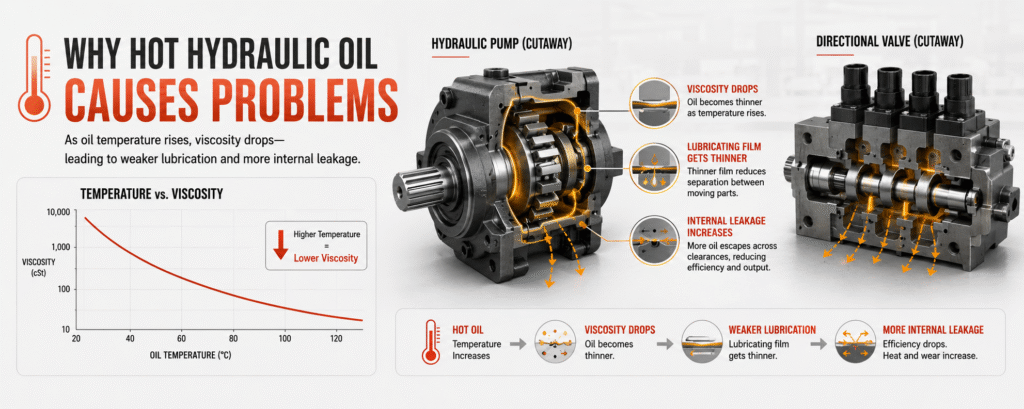
Hydraulic Oil Viscosity Decreases
High temperature causes hydraulic oil to become thinner.
Hydraulic oil must transmit pressure while providing lubrication, sealing, cooling, and corrosion protection. When viscosity becomes too low, the lubricating film between moving surfaces becomes weaker.
This may lead to poor pump lubrication, faster valve wear, increased friction, and higher internal leakage. Some machines therefore work normally after startup but gradually become slower or weaker as the oil heats up.
Oil selection should consider the pump requirements, working pressure, ambient temperature, duty cycle, and actual operating oil temperature. Simply using thicker oil may create cold-start or pump suction problems.
Internal Leakage Increases
Hydraulic pumps, valves, motors, and cylinders contain controlled internal clearances.
When hot oil becomes thinner, it passes more easily from high-pressure areas to low-pressure areas. The result may be:
- Reduced pump output flow
- Slower hydraulic cylinder movement
- Lower hydraulic motor speed
- Reduced force or torque
- Longer pressure build-up time
- Poor pressure-holding performance
- Load drifting or cylinder sinking
Internal leakage also creates additional heat, producing a repeating cycle:
Higher temperature → lower viscosity → more leakage → lower efficiency → more heat
If this cycle continues, the machine may lose performance or trigger a high-temperature alarm.
System Efficiency and Control Stability Decline
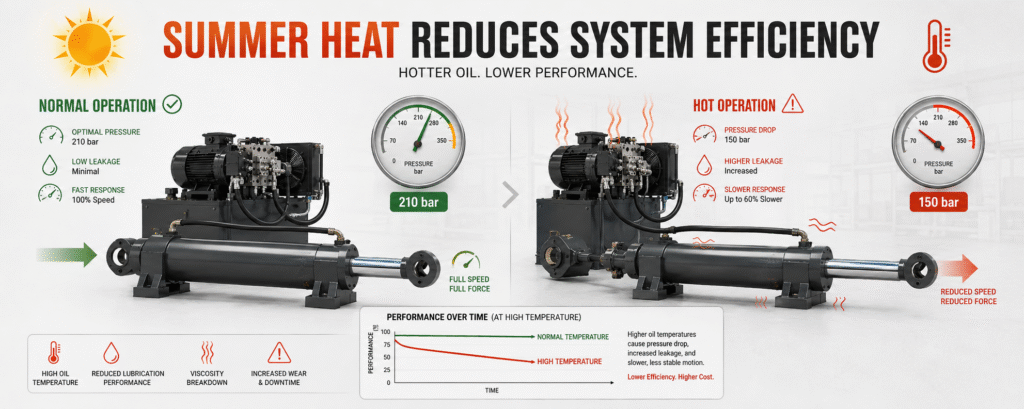
As leakage and pressure losses increase, less of the power supplied by the electric motor or engine reaches the actuator.
Typical symptoms include slower lifting, longer cylinder cycle times, weak movement under load, reduced hydraulic motor speed, increased motor current, and higher fuel consumption.
High oil temperature can also affect pressure valves, flow-control valves, directional valves, proportional valves, and servo valves.
Operators may notice fluctuating pressure, unstable actuator speed, delayed response, low-speed crawling, or clear differences between cold and hot operation.
Proportional and servo valves are particularly sensitive to oil viscosity, cleanliness, and temperature. When high temperature is combined with contamination, sludge, or varnish, control accuracy may deteriorate further.
Pump Wear and Cavitation Risk Increase
Hydraulic pumps depend on oil for lubrication, sealing, and cooling.
When the oil becomes too thin, the internal lubricating film weakens. Pump leakage, friction, and wear may increase, reducing output and generating additional heat.
Summer conditions can also expose suction-side problems such as:
- Low reservoir oil level
- Blocked suction strainers
- Undersized suction lines
- Loose fittings that allow air to enter
- Poor reservoir design
- Foaming or aerated oil
Possible symptoms include sharp pump noise, vibration, pulsating flow, foaming oil, and unstable actuator movement.
High temperature is not always the direct cause of cavitation, but it can make an already marginal suction system more likely to develop problems.
Hydraulic Oil, Seals, and Hoses Age Faster
Hydraulic oil oxidizes faster when it remains hot for long periods.
Oxidized oil may darken and produce an unusual odor, sludge, varnish, acids, or other deposits. These products can cause sticky valve movement, blocked passages, faster filter blockage, lower cooler efficiency, and shorter oil service life.
Simply adding fresh oil may not solve the problem if degraded oil, moisture, sludge, and contamination remain inside the system.
High temperature also affects hydraulic seals, O-rings, and hoses. Prolonged exposure may cause these materials to harden, soften, swell, crack, or lose elasticity.
Common failures include:
- Hydraulic cylinder rod seal leakage
- Leaking flange or manifold connections
- Hardened or deformed O-rings
- Cracked hose covers
- Hose swelling or blistering
- Leakage around hose fittings
Components installed near engines, exhaust pipes, furnaces, or hot materials may experience temperatures much higher than the average reservoir oil temperature.
Cooling and Reservoir Capacity May Be Insufficient
Air-cooled heat exchangers become less effective as ambient temperature rises.
Cooling performance may also be reduced by dirty fins, insufficient airflow, incorrect fan rotation, fan failure, poor ventilation, hot-air recirculation, scale inside a water cooler, or insufficient cooling-water flow.
However, installing a larger cooler does not always solve hydraulic system overheating.
If the system produces excessive heat because of pump wear, continuous relief flow, unnecessary throttling, or high return pressure, the heat source should be corrected first. A larger cooler only removes heat after it has already been generated.
Reservoir design also matters. A reservoir that is too small may not provide enough time for heat dissipation and air separation. Poor internal baffling may allow hot return oil to flow directly toward the pump suction port.
Low oil level further reduces the amount of oil available to absorb and release heat. It may also allow air to enter the suction line.
Why Does the System Work Normally When Cold but Fail When Hot?
Summer heat often reveals problems that already exist.
A worn pump may still deliver enough flow with cold, thicker oil. A leaking valve may hold pressure when cold but leak excessively after the oil becomes hot. An undersized cooler may work during mild weather, while an aged seal may begin leaking only after the system warms up.
For this reason, troubleshooting should compare cold and hot operating conditions.
Useful measurements include:
- Pump outlet pressure and actual flow
- Hydraulic cylinder or motor cycle time
- Electric motor current
- Reservoir oil temperature
- Pump and valve-block temperature
- Cooler inlet and outlet temperature
- Return-line pressure
- Pressure-holding performance
Measuring only the external temperature of the reservoir is usually not enough to locate the true source of heat.
How to Diagnose Hydraulic System Overheating
A practical overheating investigation should answer three questions.
Where is the heat being generated?
Check pump wear, internal valve leakage, continuous relief flow, excessive throttling, high pipe resistance, return-line backpressure, and actuator friction.
Can the system remove the heat?
Inspect the cooler, cooling fan, reservoir capacity, equipment ventilation, cooling-water supply, external heat sources, and heat exchanger cleanliness.
What changes after the system becomes hot?
Compare pressure, flow, movement speed, holding performance, noise, motor current, and cycle time before and after the system warms up.
These comparisons help determine whether the main problem is related to the pump, valve block, actuator, hydraulic oil, piping, reservoir, or cooling system.
Conclusion
Summer heat can cause a chain of performance and reliability problems in hydraulic systems.
As oil temperature rises, viscosity decreases, internal leakage increases, and system efficiency falls. Pressure and flow control may become unstable, while pumps, seals, hoses, and hydraulic oil experience faster wear and aging.
However, hydraulic system overheating should not automatically be blamed on hot weather or insufficient cooler capacity. The actual cause may be pump wear, valve leakage, continuous relief flow, excessive pressure loss, high return backpressure, poor reservoir design, or contaminated oil.
Effective troubleshooting requires identifying where heat is generated, checking whether the system can remove it, and comparing performance under cold and hot operating conditions.
AiSoar Hydraulics designs and manufactures hydraulic power units, valve manifolds, hydraulic cylinders, and complete hydraulic systems for mobile and industrial equipment.
For a technical evaluation, customers can provide the hydraulic schematic, working pressure, pump flow, motor power, reservoir capacity, duty cycle, ambient temperature, normal oil temperature, maximum oil temperature, and a description of the overheating symptoms.