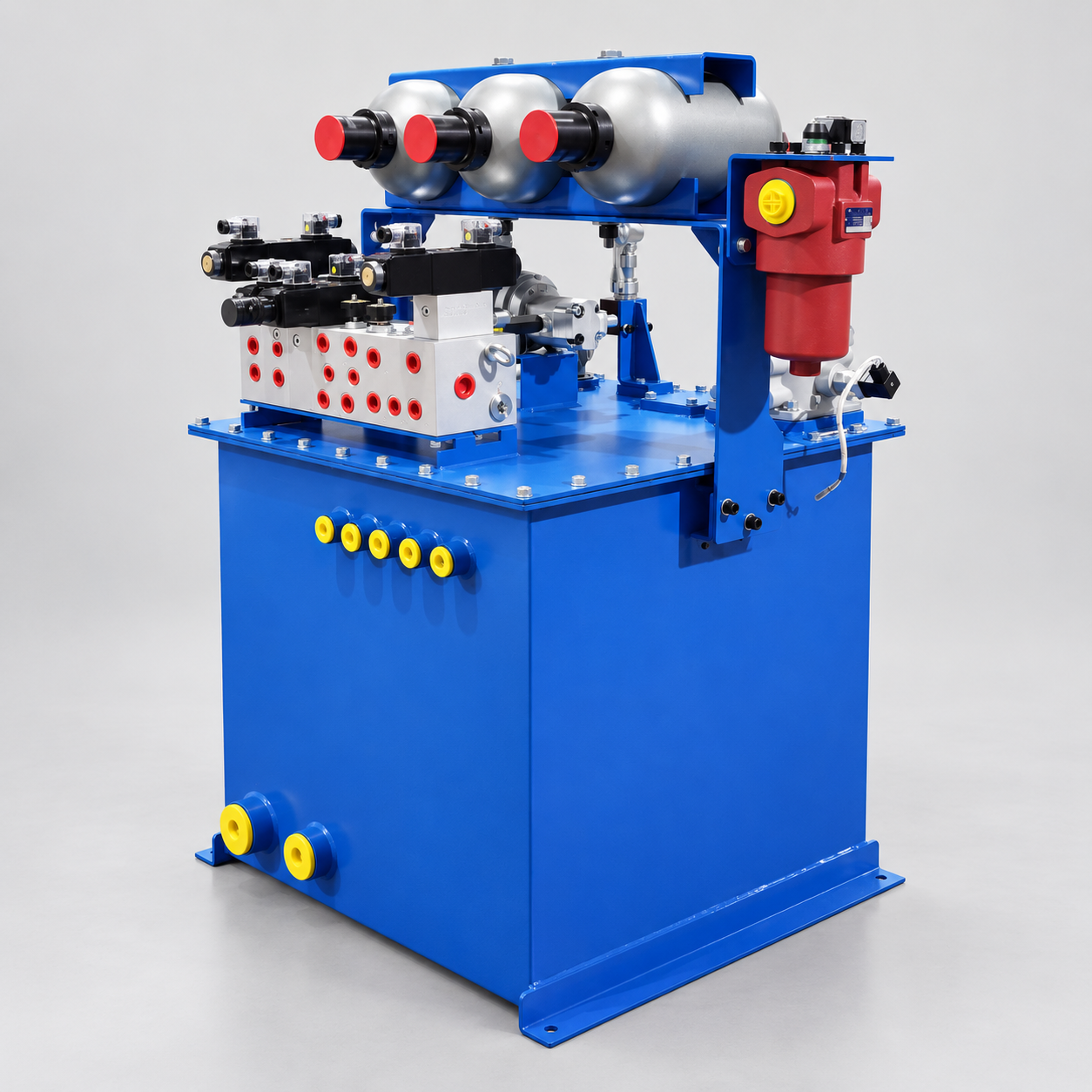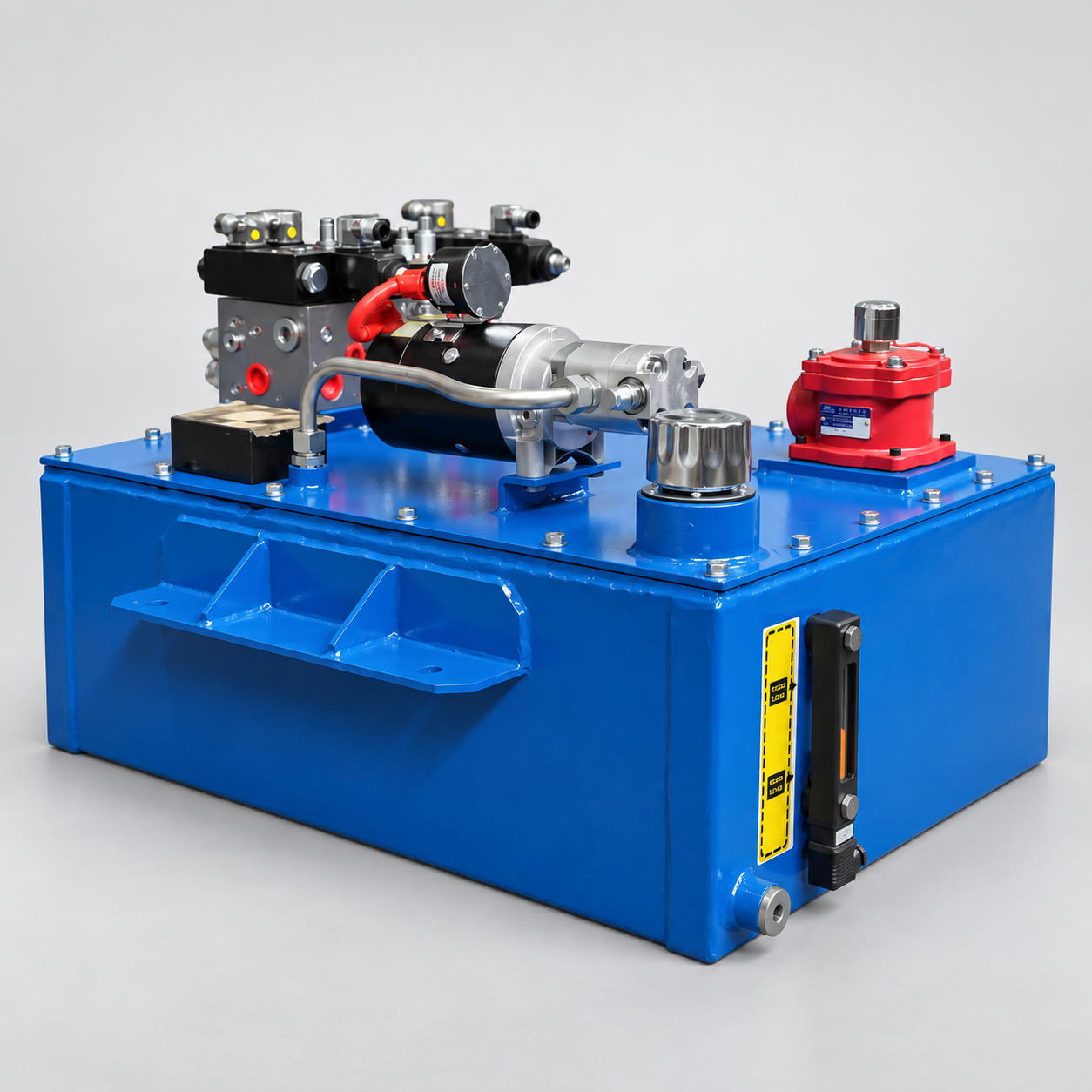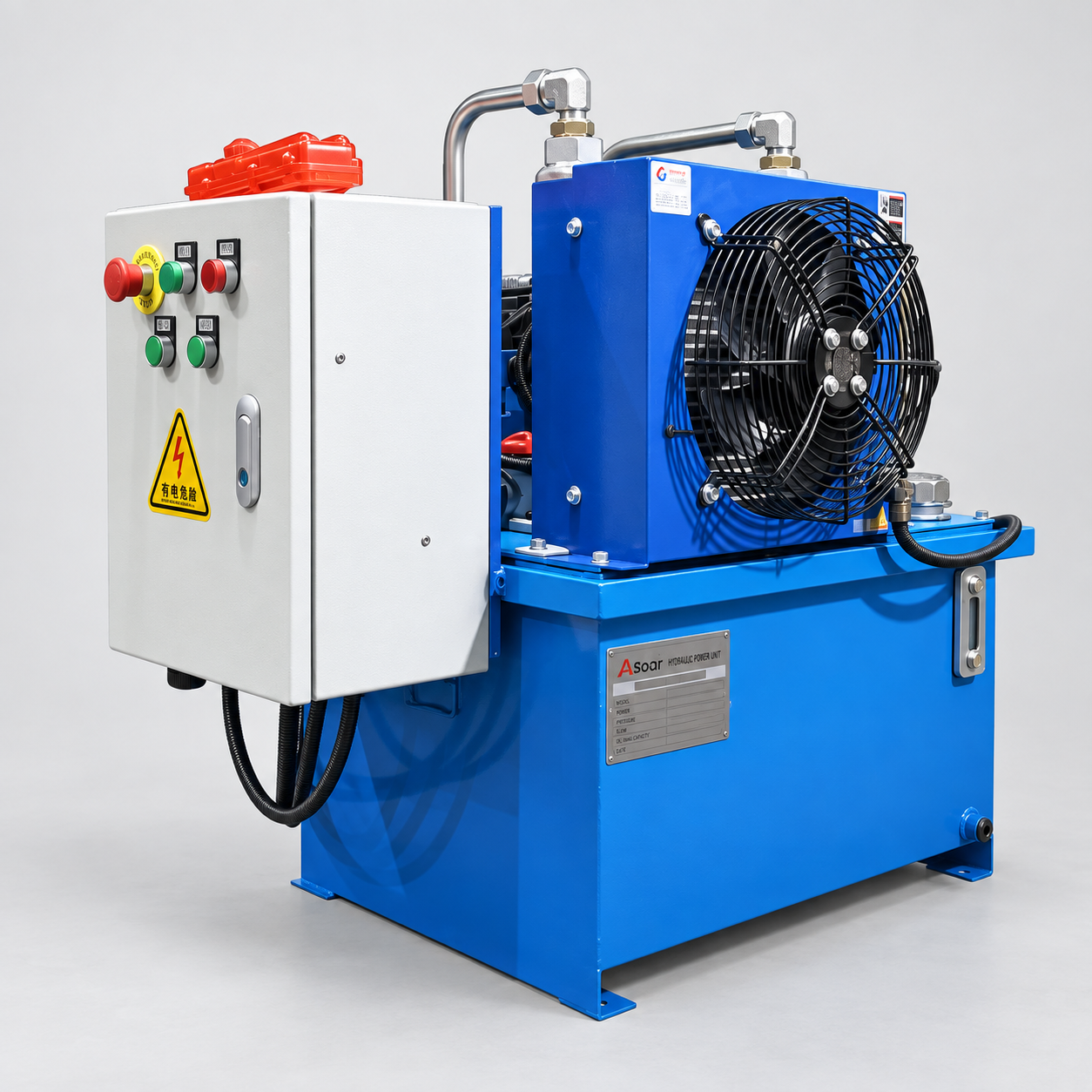
The hydraulic pump is one of the most important components in a hydraulic power unit. It converts mechanical energy from the motor into hydraulic flow, allowing cylinders, hydraulic motors, and other actuators to operate.
Selecting a pump is not simply about matching the maximum pressure shown in a catalog. The pump must also provide the required flow, match the motor speed, operate efficiently under the actual duty cycle, and remain compatible with the hydraulic oil and operating environment.
An incorrectly selected pump can cause slow movement, excessive noise, high oil temperature, motor overload, unstable pressure, or premature component failure.
This guide explains the main factors to consider when selecting a hydraulic pump for a power unit.
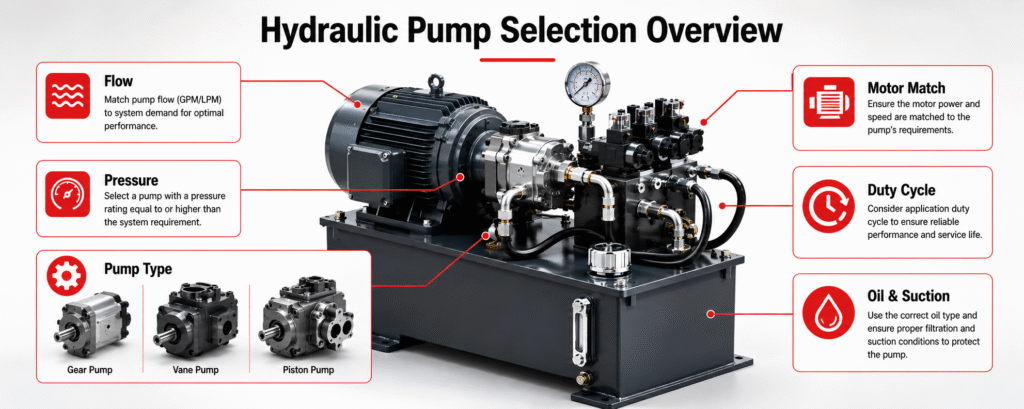
Define the Hydraulic System Requirements
Before selecting a pump type or displacement, define how the hydraulic system will operate.
The main information includes:
- Required working pressure
- Maximum system pressure
- Required flow rate
- Motor speed
- Type and number of actuators
- Required cylinder or motor speed
- Duty cycle
- Hydraulic oil type
- Operating temperature
- Noise requirements
- Installation space
The pump should be selected according to the actual operating cycle, not only the maximum theoretical requirement.
For example, a hydraulic press may need high pressure but relatively low flow during pressing. A lifting platform may need moderate pressure and higher flow during lifting. A continuously operating industrial system normally requires a more efficient and durable pump than an intermittently operated mini hydraulic power pack.
Determine the Required Pump Flow
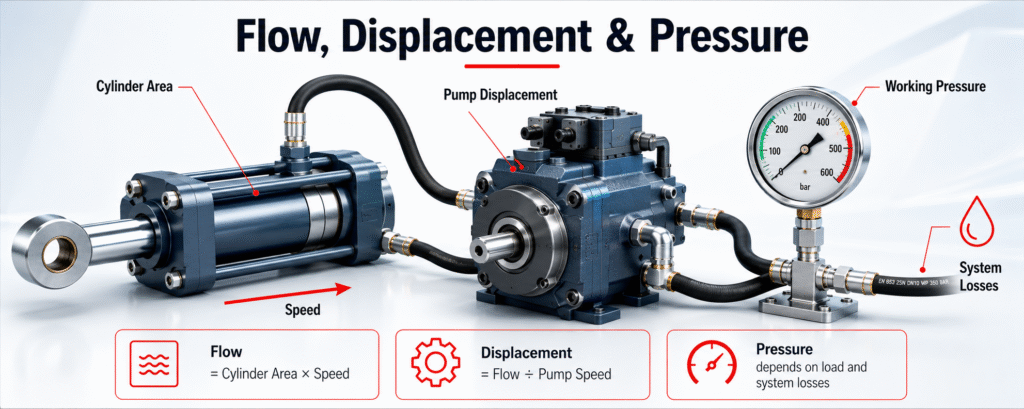
Pump flow determines how quickly a hydraulic cylinder or hydraulic motor moves.
For a hydraulic cylinder, the required flow can be estimated from the cylinder area and desired speed:
Flow = Cylinder area × Cylinder speed
When using metric units:
Q = A × v × 60
Where:
- Q = flow rate in L/min
- A = effective cylinder area in m²
- v = cylinder speed in m/s
For example, a cylinder with a 100 mm bore extending at 60 mm/s requires approximately 28.3 L/min of theoretical flow.
In practice, the selected pump should also allow for volumetric losses, internal leakage, valve losses, and changes in oil viscosity.
If several cylinders operate simultaneously, calculate the total flow based on the actual movement sequence.
Calculate the Required Pump Displacement
Once the required flow is known, pump displacement can be estimated from motor speed:
Pump displacement = Required flow × 1,000 ÷ Pump speed ÷ Volumetric efficiency
Where:
- Pump displacement is measured in cc/rev
- Flow is measured in L/min
- Pump speed is measured in rpm
Suppose a hydraulic power unit requires 30 L/min, the motor speed is 1,450 rpm, and the estimated volumetric efficiency is 90%.
The required displacement is:
30 × 1,000 ÷ 1,450 ÷ 0.90 = approximately 23 cc/rev
The final pump should be selected from an available standard displacement and checked against the manufacturer’s performance data.
Oversizing the pump is not always beneficial. A pump that is too large may require a bigger motor, produce excessive flow, and generate unnecessary heat.
Confirm the Pump Pressure Rating
The pump must be suitable for both the normal working pressure and the maximum system pressure.
These ratings should be clearly distinguished:
- Nominal pressure: suitable for normal continuous operation
- Maximum pressure: allowed for limited operating periods
- Peak pressure: temporary pressure caused by shock or valve switching
A pump should not operate continuously at its catalog peak pressure.
The selected pressure should also account for losses through valves, filters, hoses, manifolds, and coolers.
If an actuator requires 180 bar at the cylinder port, the pump may need to supply slightly higher pressure to compensate for these losses.
The relief valve setting must remain within the allowable range of the pump and other system components.
Choose the Right Hydraulic Pump Type
The three most common pump types used in hydraulic power units are gear pumps, vane pumps, and piston pumps.
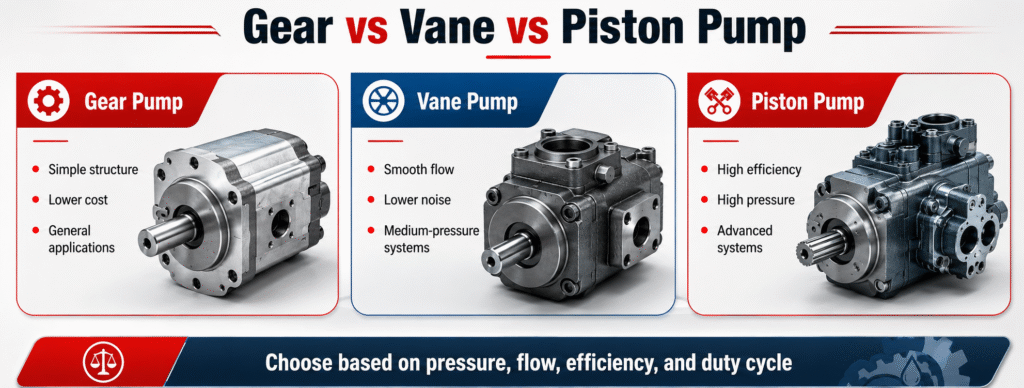
Gear Pumps
Gear pumps are widely used in mini hydraulic power packs and standard industrial hydraulic units.
Their advantages include:
- Simple construction
- Compact size
- Relatively low cost
- Good reliability
- Easy maintenance
- Suitable for fixed-displacement systems
They are commonly used in dump trailers, dock levelers, lifting equipment, agricultural machinery, and material handling systems.
However, gear pumps usually produce more noise and pressure pulsation than vane or piston pumps.
Vane Pumps
Vane pumps are often selected when lower noise and smoother flow are important.
Their advantages include:
- Smooth flow output
- Lower operating noise
- Good efficiency at medium pressure
- Suitability for industrial machinery
They are often used in machine tools, factory equipment, hydraulic presses, and indoor systems.
Vane pumps normally require cleaner oil and are more sensitive to unsuitable viscosity than basic gear pumps.
Piston Pumps
Piston pumps are normally used in high-pressure, high-efficiency, or continuously operating systems.
Their advantages include:
- High pressure capability
- High efficiency
- Variable-displacement options
- Accurate flow and pressure control
- Suitability for load-sensing systems
They are widely used in large hydraulic presses, heavy machinery, test benches, and advanced industrial systems.
Their disadvantages include higher cost, greater complexity, and stricter filtration requirements.
Fixed-Displacement vs Variable-Displacement Pumps
A fixed-displacement pump delivers nearly the same volume of oil per revolution.
It is suitable when:
- Flow demand is relatively constant
- The system is simple
- Cost control is important
- Operation is intermittent
A variable-displacement pump adjusts its output according to system demand.
It is suitable when:
- Flow demand changes during the machine cycle
- The system runs continuously
- Energy efficiency is important
- Pressure compensation or load sensing is required
- Heat generation must be reduced
For systems with changing flow demand, a variable pump can reduce the energy wasted through throttling or relief valves.
However, its higher cost and more complex control may not be necessary for a simple lifting or intermittent-duty application.
Match the Hydraulic Pump with the Motor
The pump and motor must be selected together.
Hydraulic power can be estimated as:
Hydraulic power = Pressure × Flow ÷ 600
Where:
- Pressure is measured in bar
- Flow is measured in L/min
- Power is measured in kW
For example, a system operating at 180 bar and 30 L/min requires:
180 × 30 ÷ 600 = 9 kW
Because the pump, motor, and coupling are not 100% efficient, the actual motor rating must be higher than the theoretical hydraulic power.
Motor selection should also consider:
- Starting under load
- Maximum pressure
- Voltage and frequency
- Duty cycle
- Ambient temperature
- Motor service factor
An undersized motor may overheat, trip the electrical protection, or fail to reach the required pressure.
Check Oil Viscosity, Suction Conditions, and Cleanliness
Hydraulic oil viscosity affects pump efficiency, lubrication, suction performance, and internal leakage.
Oil that is too thick can increase suction resistance and cause cavitation during startup. Oil that is too thin can increase internal leakage and reduce lubrication.
The suction line should be short, correctly sized, and free from unnecessary bends. A restricted suction pipe can cause noise, unstable flow, and premature pump damage.
Oil cleanliness is also important. Gear pumps generally tolerate contamination better than precision piston pumps, but all pumps require suitable filtration and clean assembly conditions.
Common Hydraulic Pump Selection Mistakes
Common mistakes include:
- Selecting the pump only by maximum pressure
- Oversizing the displacement
- Ignoring the duty cycle
- Using peak pressure as continuous pressure
- Ignoring suction conditions
- Selecting the pump separately from the motor
- Failing to consider oil temperature and viscosity
The pump, motor, tank, valves, filtration, and cooling system should always be designed as one complete hydraulic power unit.
Information to Provide to Your HPU Supplier
To receive an accurate recommendation, provide:
- Machine application
- Working and maximum pressure
- Required flow
- Motor voltage, frequency, and speed
- Cylinder or hydraulic motor specifications
- Required actuator speed
- Duty cycle
- Oil type
- Operating temperature
- Installation space
- Control method
- Noise or filtration requirements
Complete application data helps prevent the pump from being oversized, undersized, or unsuitable for the machine.
Conclusion
Selecting a hydraulic pump for a power unit requires more than choosing a pressure rating from a catalog.
The correct pump must provide the required flow at the available motor speed, operate safely at the working pressure, match the duty cycle, and remain compatible with the oil, filtration system, suction design, and operating environment.
Gear pumps are often suitable for compact and cost-effective systems. Vane pumps are useful when quieter and smoother operation is required. Piston pumps are normally selected for high-pressure, high-efficiency, or continuously operating equipment.
AiSoar designs and manufactures custom hydraulic power units based on customer pressure, flow, motor, tank, valve, control, and installation requirements. Providing complete operating data during the quotation stage helps ensure that the pump and the complete hydraulic system are correctly matched to the machine.