A hydraulic system intended for high-temperature service cannot be approved only through a short, unloaded test at room temperature.
Individual components may meet their pressure and temperature ratings, but the assembled system can behave differently after several hours of operation. As the oil becomes hotter and thinner, internal leakage may increase, pump output may fall, actuator speed may change, and load-holding performance may deteriorate. A cooler that appears adequate during commissioning may also be unable to maintain a stable oil temperature during the real production cycle.
Validation should therefore be carried out on the complete hydraulic system under conditions close to the actual application.
The test should confirm four points:
- The system reaches a stable operating temperature.
- Pressure, flow, and motion remain acceptable when the oil is hot.
- The cooling system can remove the heat generated during continuous operation.
- High-temperature operation does not cause permanent performance loss.
Establish a Cold-State Baseline
Before the heat test, record the system’s performance at a known ambient temperature with the oil near its normal starting temperature.
The baseline should include:
- Pump outlet pressure and actual flow
- Relief valve setting
- Actuator speed and complete cycle time
- Main return-line pressure
- Filter pressure drop
- Load-holding performance
- Motor current or engine load
- External leakage, noise, and vibration
Also record ambient temperature, reservoir oil temperature, pump outlet temperature, and cooler inlet and outlet temperatures.
Any abnormal condition found at this stage should be corrected before high-temperature testing. Existing problems such as excessive return pressure, unstable valve operation, poor holding performance, or external leakage will usually become more serious as oil temperature rises.
The cold-state data provides the reference for evaluating hot-state changes.
Reproduce the Actual Duty Cycle
The test cycle should represent how the machine will actually operate.
Running the pump unloaded for a few minutes may confirm basic function, but it does not validate the thermal design. The test should include the real movement sequence, actuator loads, pressure levels, speeds, simultaneous functions, idle periods, and pressure-holding time.
For example, if two cylinders normally operate together, they should also operate together during testing. If the equipment holds a load at high pressure for several minutes, that condition must be included.
Continuous operating time is equally important. A machine designed to operate for several hours cannot be validated by a short test that ends before the reservoir, valve manifold, and cooler reach their normal operating temperatures.
The test should continue until:
- Oil temperature becomes stable;
- The specified operating duration is completed;
- A defined temperature or performance limit is reached; or
- An abnormal condition requires shutdown.
Confirm Thermal Balance
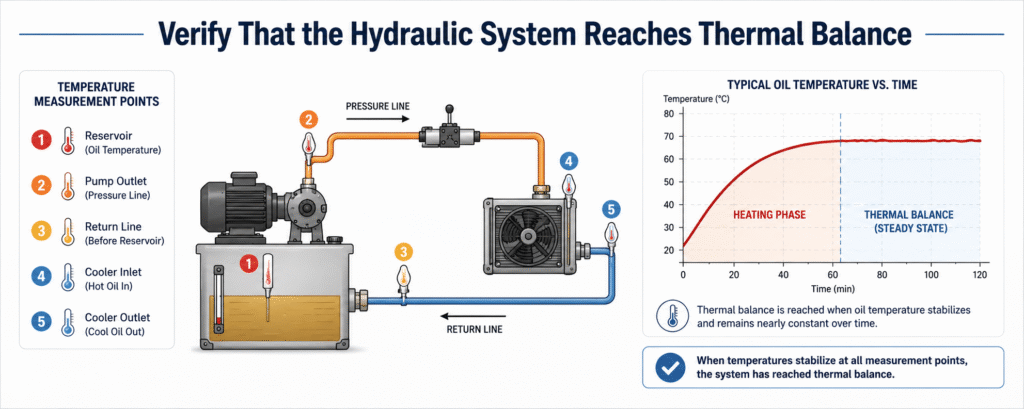
During operation, pumps, valves, filters, pipes, and actuators convert part of the input energy into heat.
Thermal balance is reached when system heat generation is approximately equal to the heat removed through the reservoir, piping, cooler, air, or cooling water. At this point, oil temperature should level off within the allowable range of the oil and system components.
Temperatures should be recorded at regular intervals at several locations:
- Reservoir
- Pump outlet
- Main return line
- Cooler inlet
- Cooler outlet
- Pump housing
- Valve manifold
- Machine enclosure
Reservoir temperature shows the general condition of the system, but local measurements are also necessary. A valve section may run much hotter than the reservoir because of throttling or internal leakage.
The rate of temperature rise is also important. A system that warms gradually and stabilizes may be acceptable. A rapid rise can indicate continuous relief flow, excessive throttling, high return backpressure, restricted filtration, or low pump efficiency.
If the temperature continues increasing without a clear stabilizing trend, heat generation is greater than the available cooling capacity.
Compare Cold and Hot Performance
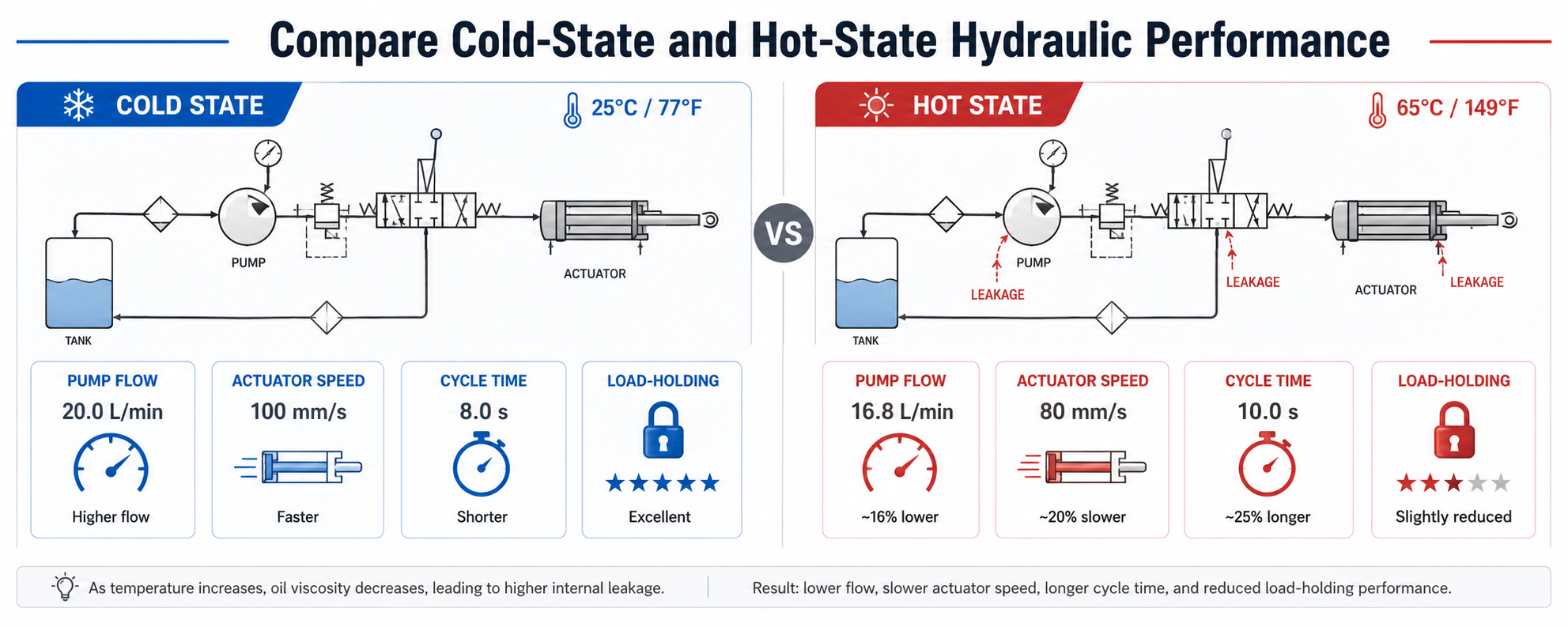
Temperature alone does not prove whether the system is reliable.
As viscosity decreases, internal leakage through the pump, valves, cylinders, motors, and load-control valves may increase. The system may remain below the alarm temperature while its operating performance has already deteriorated.
Repeat the main measurements after the system reaches its normal hot operating condition:
- Pump flow at the same pressure and speed
- Pump outlet and actuator pressure
- Main return pressure
- Actuator speed
- Complete cycle time
- Motor current or engine load
- Pressure decay during holding
- Load or cylinder displacement
A significant reduction in pump flow may indicate lower volumetric efficiency.
If pump outlet pressure is much higher than actuator load pressure, energy may be lost across valves, pipes, filters, or the return circuit.
If system pressure remains normal but actuator movement becomes slower, internal leakage may have increased in the pump, control valve, cylinder, or hydraulic motor.
Acceptance limits should be defined before testing. Confirming only that “the machine still operates” is not sufficient.
Test Load Holding With Hot Oil
Load-holding tests should be carried out after the oil reaches its normal operating temperature.
This is particularly important for lifting, clamping, pressing, and positioning systems. A cylinder that holds correctly with cold oil may drift after the oil becomes thinner.
Record:
- Initial holding pressure
- Pressure after the specified holding time
- Cylinder or load movement
- Pump restart frequency
- Valve and actuator temperature
- External leakage
Pressure decay alone may not identify the exact problem because oil compression, hose expansion, and temperature change can influence pressure. Actual load displacement is often a more useful measurement.
If the pump frequently restarts to restore pressure, internal leakage may exist in the cylinder, directional valve, check valve, or counterbalance valve.
If the pump operates continuously at high pressure during holding, the circuit itself may be producing unnecessary heat. An accumulator, hydraulic lock, counterbalance valve, or pressure-switch-controlled pump arrangement may be required.
Evaluate Cooling Performance
A rotating fan does not confirm that the cooler is correctly sized.
Cooling performance should be evaluated under normal load after the oil reaches a sufficiently high temperature.
For an air-cooled system, check:
- Cooler inlet and outlet oil temperature
- Oil-side pressure drop
- Fan rotation direction and speed
- Airflow through the cooler
- Fin cleanliness
- Inlet-air temperature
- Hot-air recirculation
For a water-cooled system, also check cooling-water inlet temperature, flow, and outlet temperature.
A temperature drop across the cooler shows that heat transfer is occurring. However, if reservoir temperature continues rising, the cooler is removing less heat than the system generates.
Before installing a larger cooler, check for avoidable heat sources such as continuous relief flow, excessive valve throttling, internal leakage, and high return pressure.
Cooling reserve should also be considered. A system tested in a 25°C workshop may not remain stable in a 40°C summer environment.
Verify Alarms and Protection
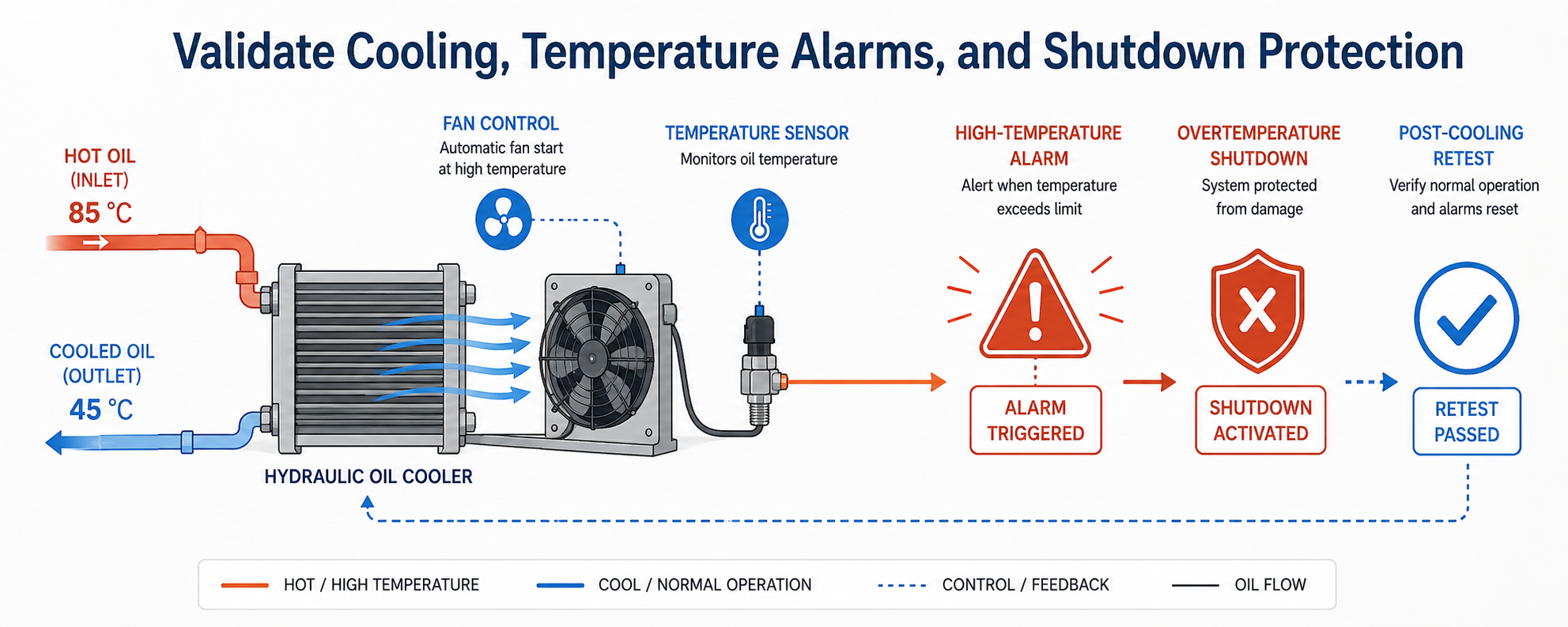
Temperature monitoring and protection should be tested as part of the complete hydraulic system.
Sensor readings should be compared with a calibrated reference where possible. The test should verify:
- Cooling fan start temperature
- Cooling-water valve operation
- High-temperature warning
- Reduced-duty or reduced-load operation
- Overtemperature shutdown
- Safe restart after cooling
- Response to a failed or disconnected sensor
Alarm and shutdown settings should be based on the lowest relevant continuous temperature limit among the oil, pump, seals, hoses, solenoid coils, motor, and electrical components.
An alarm set too low may cause unnecessary interruptions. An alarm set too high may allow oil oxidation, seal damage, or excessive leakage before protection is activated.
Cool Down and Retest
After the high-temperature run, allow the system to cool according to the normal shutdown procedure. Then repeat the main baseline measurements.
Check whether:
- Pump flow returns close to the original value
- Pressure remains stable
- Actuator speed and cycle time recover
- Holding performance remains unchanged
- New leakage has appeared
- Valves or actuators show sticking
- Noise or vibration has increased
- Oil color, odor, or foaming has changed
If the system does not return close to its original cold-state performance, high-temperature operation may have caused oil degradation, pump wear, seal damage, valve sticking, or permanent leakage.
Completing the hot test without shutdown does not mean the system has passed if permanent deterioration remains afterward.
Prepare an Engineering Test Report
The final report should contain measured data rather than only a “pass” statement.
It should record:
- Oil type and viscosity grade
- Ambient temperature
- Working pressure, flow, and load
- Cycle sequence and frequency
- Continuous operating time
- Temperature at each measurement point
- Cooler inlet and outlet temperatures
- Cold and hot pump flow
- Cycle-time variation
- Holding-pressure decay and load movement
- Motor current
- Leakage, noise, and vibration
- Alarm and shutdown results
- Cool-down inspection results
Temperature-versus-time graphs are especially useful because they show whether the system reaches thermal balance. Flow, cycle-time, and motor-current trends can reveal performance losses as the oil heats.
Conclusion
A high-temperature hydraulic system is reliable only when the complete system continues to perform correctly after it becomes hot.
Validation should reproduce the actual ambient conditions, pressure, flow, load, duty cycle, holding time, and continuous operating duration. Temperature trends must be evaluated together with pump flow, actuator speed, return pressure, load holding, and input power.
A successful system should reach a stable operating temperature, maintain acceptable hot-oil performance, operate its cooler and protection functions correctly, and return close to its original condition after cooling.
If oil temperature continues rising, flow falls significantly, local components overheat, or load holding deteriorates, the hydraulic circuit, pump and valve selection, piping, reservoir, and cooling system should be reviewed.
Raising the alarm setting or installing a larger cooler may hide the symptom, but it does not verify that the design is reliable.