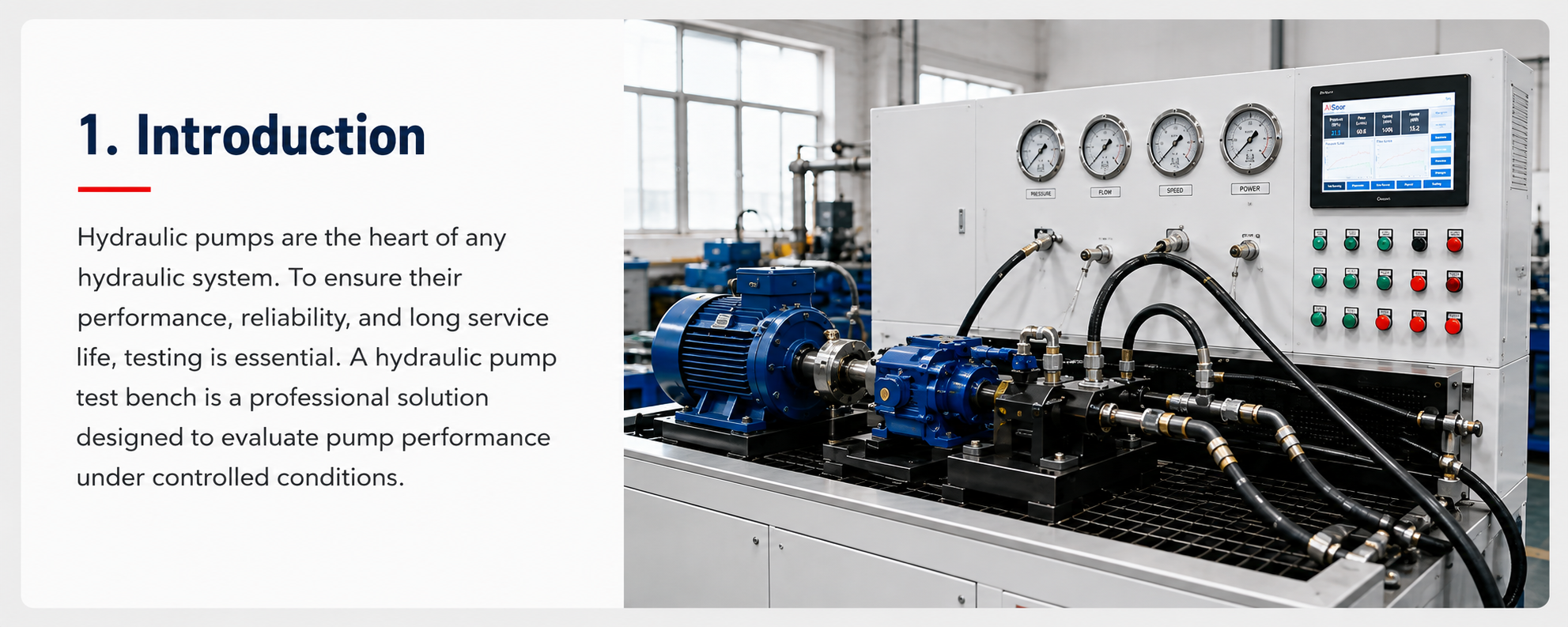
A hydraulic pump test bench is a specialized testing system used to evaluate the performance, pressure capability, flow output, efficiency, and operating condition of hydraulic pumps. It allows manufacturers, repair workshops, maintenance centers, and hydraulic system builders to test pumps under controlled conditions before delivery, after repair, or before installation on equipment.
Hydraulic pumps are the power source of hydraulic systems. They convert mechanical energy into hydraulic energy by delivering pressurized oil to cylinders, motors, valves, and actuators. If the pump cannot provide stable pressure and flow, the whole hydraulic system may suffer from weak movement, slow operation, overheating, noise, vibration, or complete failure.
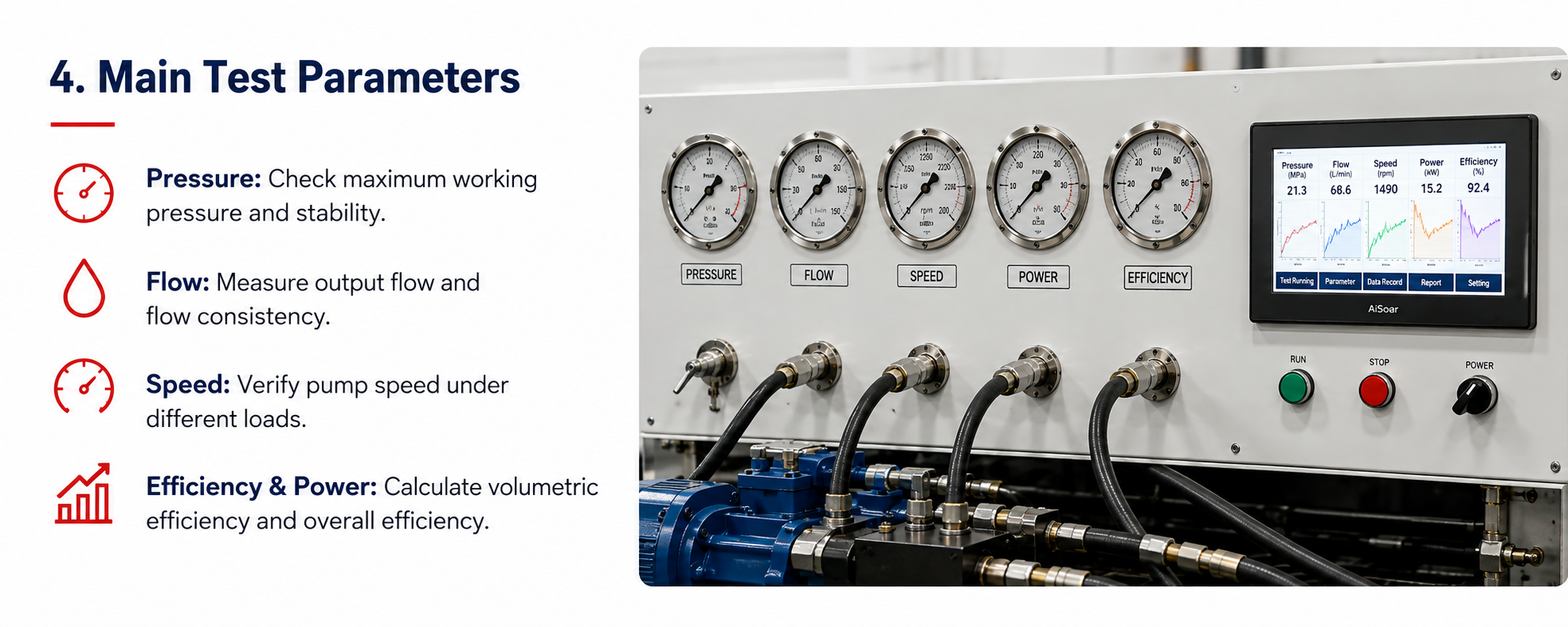
A hydraulic pump test bench helps identify these problems before the pump is used in a machine. It can measure key parameters such as pressure, flow rate, speed, temperature, leakage, and efficiency. Many hydraulic component test benches are designed to test pumps, motors, valves, and cylinders by measuring pressure, flow, efficiency, and overall function.
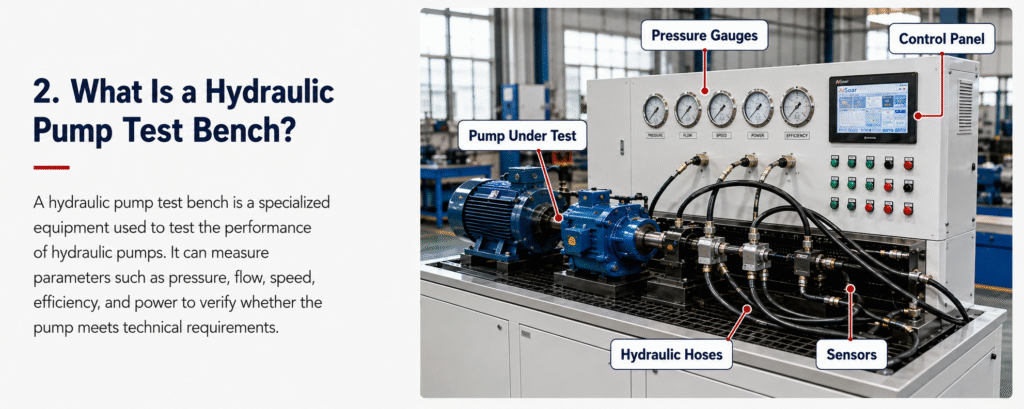
What Is a Hydraulic Pump Test Bench?
A hydraulic pump test bench is a hydraulic testing machine designed to run and evaluate hydraulic pumps under different operating conditions. The tested pump is connected to the test bench through mechanical coupling, hydraulic pipelines, sensors, and control valves. The bench drives the pump, loads the pump, measures oil flow and pressure, and records the operating data.
Depending on the pump type and testing requirements, the test bench can be designed for gear pumps, vane pumps, piston pumps, variable displacement pumps, open-loop pumps, closed-loop pumps, and load-sensing pumps. Some test benches can also test hydraulic motors and valves by changing the connection and test circuit.
A basic hydraulic pump test bench may be used for simple pressure and flow checking. A more advanced test bench may include variable speed drive, torque measurement, case drain flow measurement, temperature control, automatic loading, data acquisition, software monitoring, and report export.
Why Hydraulic Pump Testing Is Important
Hydraulic pump performance directly affects the performance of the complete hydraulic system. If the pump output is too low, the actuator may move slowly or fail to generate enough force. If the pump leaks internally, the system may lose efficiency and generate heat. If the pump cannot maintain pressure, the machine may become unstable or stop working.
Testing the pump before installation helps reduce risk. For new pump manufacturers, the test bench confirms whether each pump meets design and quality requirements. For repair workshops, the test bench verifies whether the repaired pump has recovered its pressure, flow, and efficiency. For equipment maintenance teams, testing helps determine whether a pump should be repaired, replaced, or reused.
A hydraulic pump test bench also helps avoid unnecessary replacement. Sometimes a hydraulic system problem may look like pump failure, but the real cause may be a valve, cylinder, filter, hose, or control issue. Testing the pump separately on a bench makes diagnosis more accurate.
Key Functions of a Hydraulic Pump Test Bench
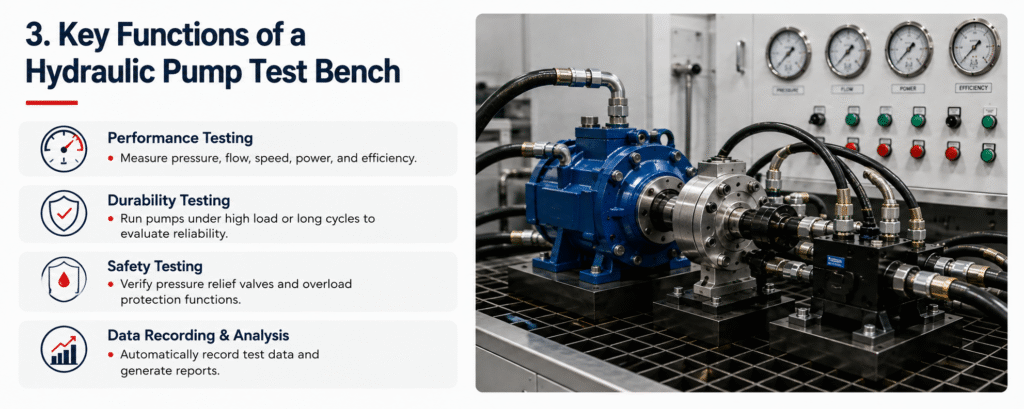
Flow Rate Testing
Flow rate testing is one of the most important functions of a hydraulic pump test bench. The pump is driven at a specified speed, and the test bench measures how much oil the pump delivers under different pressure conditions.
Flow rate is important because it determines actuator speed. If a hydraulic cylinder moves slowly or a hydraulic motor runs below the expected speed, insufficient pump flow may be one of the causes.
During flow testing, the measured flow can be compared with the pump specification. If the actual flow is much lower than expected, it may indicate internal wear, leakage, damaged gears, worn pistons, worn vanes, low volumetric efficiency, or incorrect pump rotation speed.
For variable displacement pumps, flow testing can also check whether the displacement control mechanism works correctly.
Pressure Testing
Pressure testing checks whether the hydraulic pump can build and maintain the required pressure. The test bench applies controlled loading to the pump outlet and measures the pressure response.
A healthy pump should be able to reach the required pressure range without abnormal noise, excessive vibration, overheating, or unstable output. If the pump cannot reach pressure, possible causes may include internal leakage, worn rotating parts, damaged seals, incorrect assembly, relief valve problems, or suction-side issues.
Pressure testing is especially important for pumps used in high-pressure hydraulic systems, construction machinery, presses, lifting equipment, mining equipment, and industrial power units.
Efficiency Testing
Efficiency testing evaluates how well the pump converts mechanical input power into hydraulic output power. A pump may still produce pressure and flow, but if efficiency is low, the system may waste energy and generate excessive heat.
Hydraulic pump efficiency is usually related to pressure, flow, speed, torque, and internal leakage. A test bench can measure these parameters and help evaluate the pump’s actual performance under different loads.
For repair workshops, efficiency testing is very useful. A repaired pump may pass a simple pressure test, but still have poor efficiency due to internal wear. Testing efficiency helps determine whether the pump is truly suitable for reuse.
Speed and Torque Measurement
Many hydraulic pump test benches include speed and torque measurement. Speed measurement confirms whether the pump is being tested under the correct operating condition. Torque measurement helps calculate input power and evaluate pump efficiency.
This is especially useful for piston pumps, variable displacement pumps, and high-power industrial pumps. If the required torque is too high, it may indicate mechanical friction, internal damage, incorrect assembly, contamination, or bearing problems.
Case Drain Flow Testing
For piston pumps and some other pump types, case drain flow is an important diagnostic parameter. Excessive case drain flow often indicates internal leakage or wear inside the pump.
By measuring case drain flow, technicians can judge the internal condition of the pump more accurately. This is especially useful for variable displacement piston pumps used in excavators, loaders, cranes, agricultural machinery, and industrial equipment.
If case drain flow increases significantly under pressure, the pump may have worn pistons, cylinder block wear, damaged valve plate, seal failure, or internal leakage problems.
Temperature Monitoring
Hydraulic pump testing should also monitor oil temperature. Temperature affects oil viscosity, leakage, lubrication, and test accuracy. If the oil temperature rises too quickly during testing, it may indicate excessive internal leakage, low efficiency, high friction, or poor cooling.
A professional hydraulic pump test bench usually includes oil temperature monitoring and cooling. This helps keep test conditions stable and prevents the oil from overheating during long test cycles.
Noise and Vibration Observation
Although noise and vibration may not always be measured automatically, they are important indicators during hydraulic pump testing. Abnormal noise may be caused by cavitation, air in the oil, bearing damage, misalignment, suction restriction, internal wear, or mechanical failure.
Vibration may indicate coupling problems, shaft misalignment, unstable pressure, damaged rotating parts, or poor installation. During the test, the operator should observe whether the pump runs smoothly at different speeds and pressures.
Load Simulation Testing
A hydraulic pump test bench can simulate different working loads by adjusting pressure and flow conditions. This helps evaluate how the pump performs under real operating conditions.
For example, a pump may work normally at low pressure but fail when pressure increases. Load simulation helps reveal such problems before the pump is installed on the machine.
This is important for pumps used in heavy-duty equipment, mobile machinery, hydraulic presses, lifting systems, and continuous industrial applications.
Data Recording and Report Export
Modern hydraulic pump test benches can be equipped with sensors, PLC control, software monitoring, data acquisition, and report export functions. The system can record pressure, flow, speed, torque, temperature, case drain flow, test time, and efficiency data.
Test records are useful for production quality control, customer inspection, warranty management, and repair documentation. For pump manufacturers and repair centers, a test report can show that the pump has been tested under defined conditions before shipment or reuse.
Software-controlled hydraulic test benches can also display real-time curves, store historical test data, and make comparison easier between different pumps or different repair batches.
Common Hydraulic Pumps Tested on a Test Bench
A hydraulic pump test bench can be configured for different pump types, including:
- Gear pumps
- Vane pumps
- Axial piston pumps
- Radial piston pumps
- Variable displacement pumps
- Fixed displacement pumps
- Open-loop hydraulic pumps
- Closed-loop hydraulic pumps
- Load-sensing pumps
Different pumps require different test methods. Gear pumps are usually tested for flow, pressure, leakage, and noise. Vane pumps require attention to flow stability, pressure performance, and internal wear. Piston pumps often require more detailed testing, including case drain flow, efficiency, speed, control response, and load performance.
Applications of Hydraulic Pump Test Benches
Pump Manufacturing
Hydraulic pump manufacturers use test benches for final inspection before delivery. Each pump can be tested according to a defined procedure to confirm that it meets pressure, flow, and performance requirements.
Repair Workshops
Repair workshops use pump test benches to diagnose faults and verify repair results. After replacing seals, bearings, rotating groups, valve plates, or other internal parts, the pump must be tested before it is returned to the customer.
Equipment Maintenance
Maintenance teams use pump testing to determine whether a machine problem is caused by the pump or by another hydraulic component. This helps reduce unnecessary replacement and improves maintenance efficiency.
Hydraulic Power Unit Production
A hydraulic pump is the core component of a hydraulic power unit. Testing the pump helps confirm whether the power unit can provide the required pressure and flow before the complete system is delivered.
OEM Equipment Development
OEM manufacturers use pump testing during machine development and system validation. The pump must match the flow demand, pressure demand, duty cycle, and control logic of the equipment.
How to Choose a Hydraulic Pump Test Bench
Before choosing or customizing a hydraulic pump test bench, several technical details should be confirmed.
The first is the pump type. Gear pumps, vane pumps, piston pumps, variable pumps, and closed-loop pumps may require different test circuits and connection methods.
The second is the required pressure and flow range. A small gear pump may only need a compact test bench, while a high-power piston pump may require a larger drive motor, stronger cooling system, higher-pressure circuit, and more accurate sensors.
The third is the pump speed range and drive method. The test bench should be able to drive the pump at the required speed and rotation direction.
The fourth is the required test items. Some users only need pressure and flow testing, while others need torque, efficiency, case drain flow, temperature, automatic loading, and report export.
The fifth is the control method. Manual control may be enough for basic repair testing, while PLC or software control is better for production testing, repeatable test procedures, and data traceability.
AiSoar Hydraulic Pump Test Bench Solutions
AiSoar Hydraulics provides standard and customized hydraulic testing machine solutions for hydraulic pumps, motors, cylinders, hydraulic power units, valve blocks, and complete hydraulic systems. AiSoar’s testing machine solutions can be configured according to product type, test pressure, flow rate, oil tank capacity, cooling method, filtration requirements, control system, and testing process.
For hydraulic pump testing, AiSoar can customize the test bench according to the pump type, pressure range, flow range, speed range, motor power, measurement requirements, automation level, and report export needs.
Available configurations can include pressure testing, flow testing, efficiency testing, case drain flow measurement, temperature monitoring, cooling and filtration, PLC control, software monitoring, data recording, and test report export.
A properly designed hydraulic pump test bench helps improve pump quality control, reduce repair risks, verify pump performance, and ensure more reliable hydraulic systems.
If you need to test hydraulic pumps under controlled pressure, flow, speed, temperature, and load conditions, AiSoar can help design a suitable hydraulic pump test bench according to your technical requirements and testing process.