High temperature rarely damages only one part of a hydraulic system. In most cases, the first change occurs in the hydraulic oil. As the oil becomes hotter, its viscosity falls, the lubricating film becomes thinner, and internal leakage increases. If the temperature remains high, oxidation accelerates and the oil begins to form varnish, sludge, and other deposits.
The result is a chain reaction. Pumps and motors lose volumetric efficiency, valves become less stable, cylinders hold loads less effectively, seals and hoses age faster, and filters become restricted more frequently. A component may be replaced, but if the original heat source remains, the same failure often returns.
A high-temperature inspection should therefore not begin by asking only, “Which part has failed?” A better question is, “Which change in oil condition or system efficiency started the failure pattern?”
Table of Contents
ToggleHydraulic Oil Is Usually the Starting Point
Hydraulic oil does more than transmit pressure. It lubricates moving surfaces, seals internal clearances, removes heat, protects metal components, and carries contamination toward the filters.
When oil temperature rises, viscosity decreases. Below the range recommended for the pump and valves, leakage through internal clearances increases and the lubricating film becomes less reliable. High temperature also accelerates oxidation, reducing oil life and creating deposits that affect narrow valve passages and filter elements.
Oil temperature should therefore be evaluated together with viscosity. A temperature acceptable for one fluid may be unsuitable for another, which is why pump specifications normally include both limits. Danfoss, for example, states that fluid temperature and viscosity requirements must be satisfied at the same time, rather than considered as separate limits.
Signs of deterioration include darkening, burnt odor, persistent foam, varnish, short filter life, and a growing difference between cold and hot performance. Replacing the oil without finding the heat source usually provides only temporary improvement.
Pumps, Valves, and Motors Lose Efficiency Before They FaiL
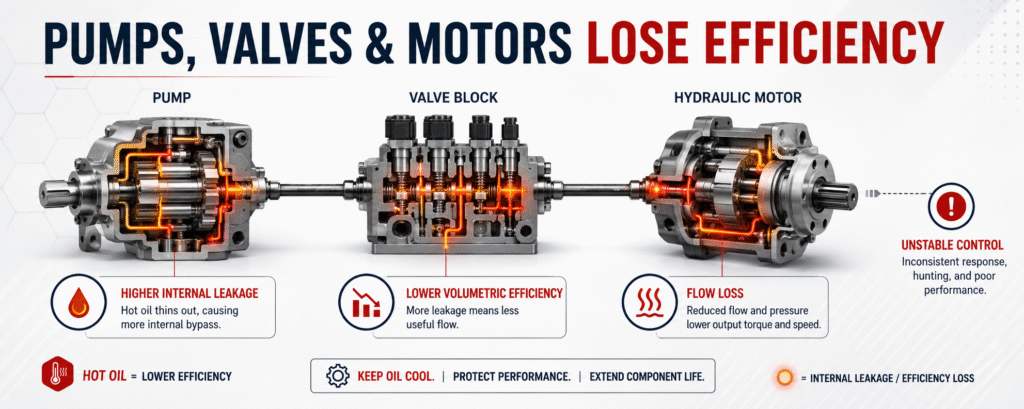
Pumps, control valves, and hydraulic motors contain close internal clearances. Their performance depends on the oil maintaining sufficient viscosity.
A pump may still build pressure when hot but deliver less flow. Checking only the pressure gauge can therefore be misleading. A better test is to compare pump flow at the same speed and pressure with cold and hot oil. If hot-state flow drops significantly, or case-drain flow rises, internal leakage is increasing.
A pump housing that runs hotter than nearby pipework may indicate internal leakage, poor inlet conditions, excessive loading, or wear. The reading becomes useful when compared with flow, case-drain volume, inlet vacuum, and system pressure.
Valves show a similar pattern. Thin oil leaks more easily across spool, poppet, and seat clearances. The result may be poor pressure holding, unstable actuator speed, or slower directional response. Proportional and servo valves are more sensitive because small control orifices can also be affected by varnish and contamination.
Hydraulic motors may lose torque or speed as leakage increases. Low-speed, high-load operation is particularly demanding because the motor depends on a stable oil film while internal contact loads remain high. Excessive oil temperature is also listed by Danfoss as a possible cause of increased internal leakage in motors and valves.
If several actuators become slower after warm-up, check the pump and main valve block first. It is unlikely that several cylinders or motors developed the same fault at the same time.
Cylinders, Seals, and Hoses Show Leakage and Material Aging
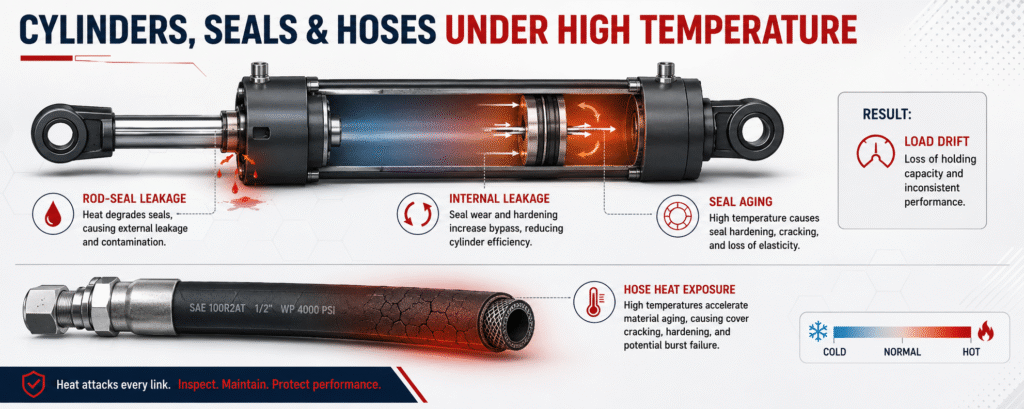
Hydraulic cylinders are affected by both hot oil and changing seal properties.
As viscosity falls, leakage across the piston seal becomes more noticeable. A cylinder that holds correctly when cold may begin to drift when hot. However, cylinder drift does not automatically prove piston-seal failure. Leakage through a directional valve, counterbalance valve, or pilot-operated check valve can produce the same symptom.
Compare pressure decay with actual load movement, then isolate the cylinder from the control circuit where the machine design allows it. If the cylinder holds after isolation, the problem is more likely in the valve circuit.
Rod-seal leakage often worsens when high temperature is combined with side loading, a damaged rod surface, excessive guide clearance, or return pressure. Heat may not be the original cause, but it reduces the margin available to the seal and makes existing wear more visible.
Seals and O-rings should not be selected only by maximum temperature rating. Fluid compatibility, pressure, speed, surface finish, extrusion clearance, and continuous exposure time also matter. A seal may survive a short peak but harden, soften, shrink, or lose elasticity during continuous operation. Elevated fluid temperatures can reduce lubricity and seal life even when individual components have apparently suitable ratings.
Hoses have the same limitation. Local hose temperature near an engine, exhaust pipe, or furnace may be much higher than reservoir oil temperature. High pressure and high temperature together can shorten hose life. Inspection should include hardening, cracking, blistering, swelling, discoloration, and deformation near fittings.
The hose’s published maximum temperature should not be treated as a recommended continuous target. Parker notes that the combination of high temperature and high pressure can reduce hose life.
Filters, Coolers, and Reservoirs Are Often Affected Indirectly
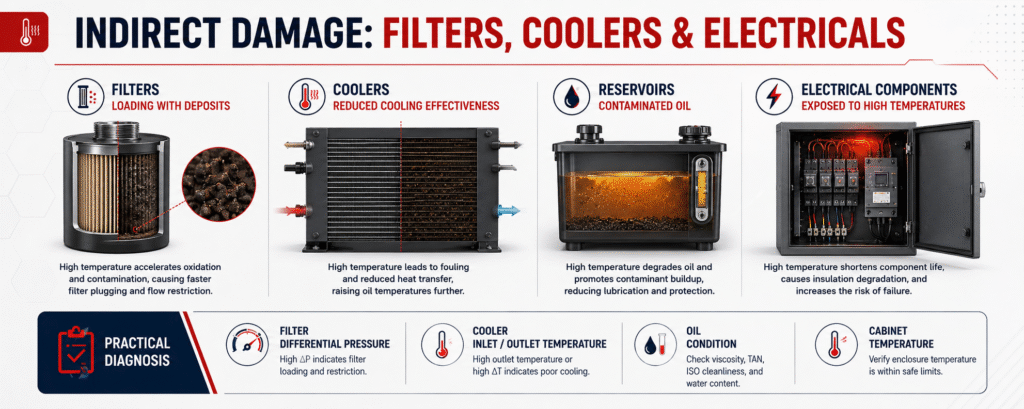
Filters are not usually damaged directly by heat. They are affected by what heat does to the oil.
Oxidation products, sludge, and varnish load the filter element and raise differential pressure. A bypass valve may then open, allowing contaminated oil to circulate. The resulting wear increases internal leakage and generates more heat.
An unusually short filter service interval should therefore be treated as a system condition, not only as a filter problem. Oil condition, reservoir cleanliness, breather performance, and operating temperature should all be reviewed. Hydraulic-fluid cleanliness is directly related to system reliability, efficiency, and component service life.
Coolers can also appear to be the failed component when the real problem lies elsewhere. A blocked air cooler, incorrect fan direction, poor ventilation, hot-air recirculation, insufficient water flow, or internal scale will reduce heat rejection. A cooler may still show an inlet-to-outlet temperature drop and yet be too small for the actual heat load.
If reservoir temperature continues to rise, long-term relief flow, valve throttling, pump leakage, and high return backpressure should be checked before installing a larger cooler. Cooler capacity depends on oil flow and the temperature difference between the oil and the cooling medium, not simply on the hydraulic pump’s maximum flow.
The reservoir supports heat dissipation, air release, and contaminant settling. Poor baffles, high return velocity, low oil level, or hot return oil entering the suction zone can reduce stability. A blocked or unsuitable breather may cause pressure fluctuations and admit dust or moisture.
Electrical Components May Reach Their Limit First
Hydraulic power units often place the motor, solenoid coils, sensors, relays, and controller inside the same enclosure as the hydraulic components.
In a closed cabinet, the air temperature around the electrical equipment may be higher than the reservoir oil temperature. The oil may still be below its alarm level while a solenoid coil or motor winding is already near its continuous limit.
Symptoms include intermittent valve operation, sensor drift, motor thermal trips, controller derating, or repeated alarms during long cycles.
Check enclosure temperature, ventilation, fan performance, motor current, coil duty rating, and external heat sources. Adding a fan will not help if discharged hot air remains trapped inside the enclosure.
How to Identify the Component That Is Actually Being Affected
Comparing cold-state and hot-state performance is one of the most useful diagnostic methods.
| Observed condition | Measurements to take | Components to inspect first |
|---|---|---|
| Flow falls after warm-up | Pump flow at equal speed and pressure; case-drain flow | Pump |
| Several actuators slow down | Pump flow, main valve pressure drop, return pressure | Pump and main valve block |
| One cylinder drifts | Pressure decay, cylinder movement, isolation test | Cylinder seal and load-holding valve |
| Pressure is high but useful load pressure is lower | Pressure before and after valves, filters, and return components | Valve block, piping, filters |
| External leakage increases when hot | Local temperature, return pressure, seal and hose condition | Seals, hoses, fittings |
| Filters clog repeatedly | Differential pressure, oil condition, reservoir inspection | Oil, reservoir, breather |
| Cooler has a temperature drop but oil keeps heating | Airflow or water flow, heat load, system losses | Cooler and circuit efficiency |
| Electrical trips occur before oil alarm | Cabinet temperature, motor current, coil temperature | Motor, coils, enclosure ventilation |
Temperature measurements should be taken under comparable loads. A component that is hotter than nearby parts may have excessive leakage, restriction, or friction, but temperature alone is not enough.
Pressure, flow, motor current, case-drain volume, filter differential pressure, and actual actuator movement provide the evidence needed to locate the fault. Comparing machine behavior before and after warm-up is generally more useful than relying on one temperature reading or replacing the hottest component first.
Conclusion
Long-term high temperature normally creates a system-wide loss of operating margin rather than one isolated failure.
The process often begins with lower oil viscosity and faster oxidation. Pumps, valves, and motors lose efficiency; cylinders and load-holding circuits leak more; seals and hoses age faster; filters collect oxidation products; and coolers and reservoirs struggle to maintain thermal balance.
Replacing the visibly damaged component without correcting the heat source often leads to repeated failure.
A professional inspection should compare cold and hot performance, verify oil condition, measure pump flow and case drain, check valve and return-line pressure losses, inspect load holding, evaluate cooler performance, and confirm that electrical components are not operating in trapped hot air.
The objective is not only to identify what high temperature has damaged. It is to determine why the system became hot and which performance change appeared first. That is the information needed to prevent the same failure from returning.