Requesting a hydraulic power unit quotation without enough technical information can lead to inaccurate pricing, repeated revisions, or an unsuitable configuration.
To prepare an accurate industrial hydraulic power unit quote, the supplier needs to understand what the machine must do, what cylinders or motors it operates, how fast it must move, and how often it runs. Electrical requirements, installation limits, drawings, schematics, and photos also help confirm the correct configuration.
Clear project information helps the manufacturer avoid incorrect pump sizing, unsuitable valve functions, insufficient cooling, and layout changes later in the project.
Why Is Technical Information Needed for a Quotation?
An industrial hydraulic power unit cannot be selected by motor power or reservoir size alone. Its configuration must match the machine’s required force, speed, operating sequence, working time, and installation conditions.
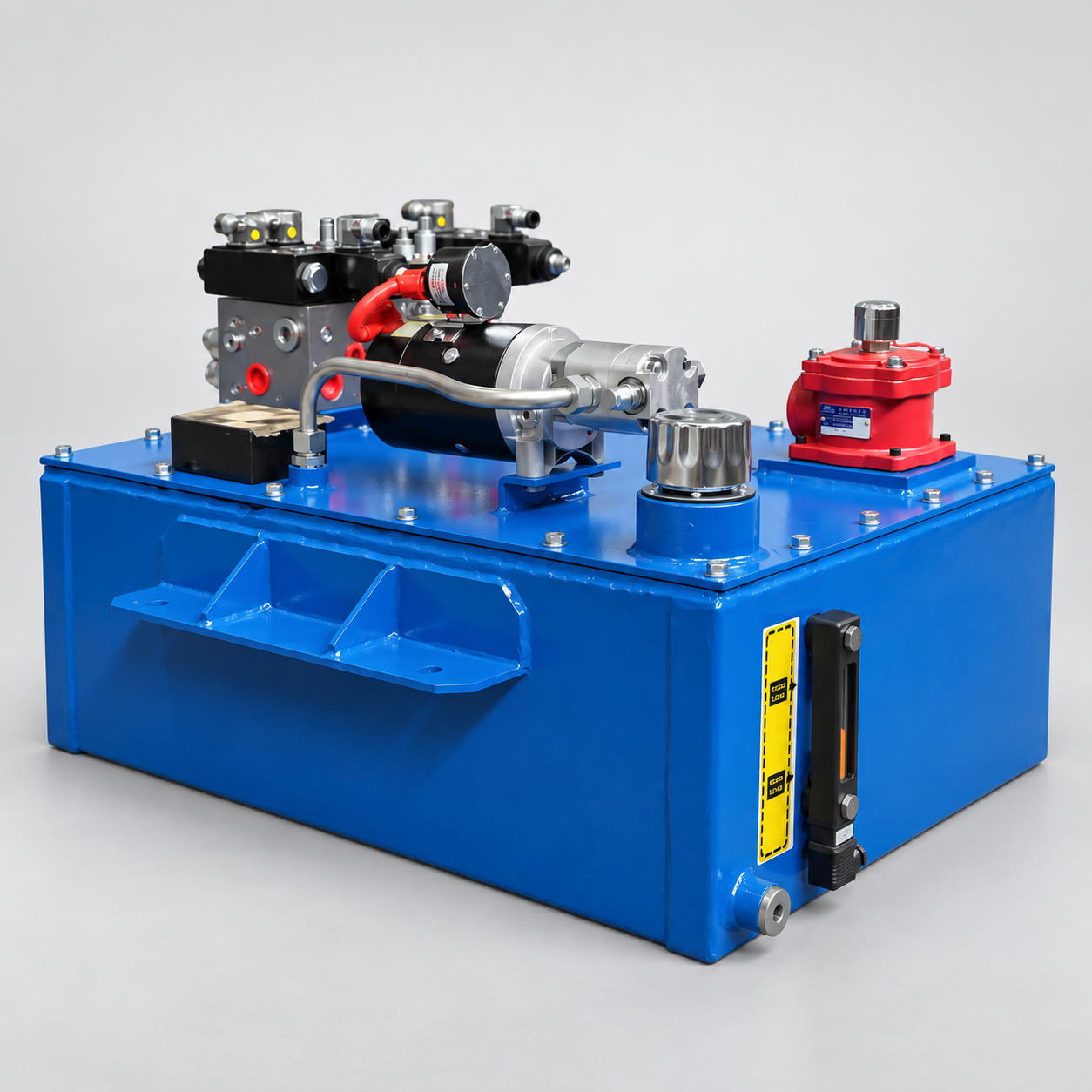
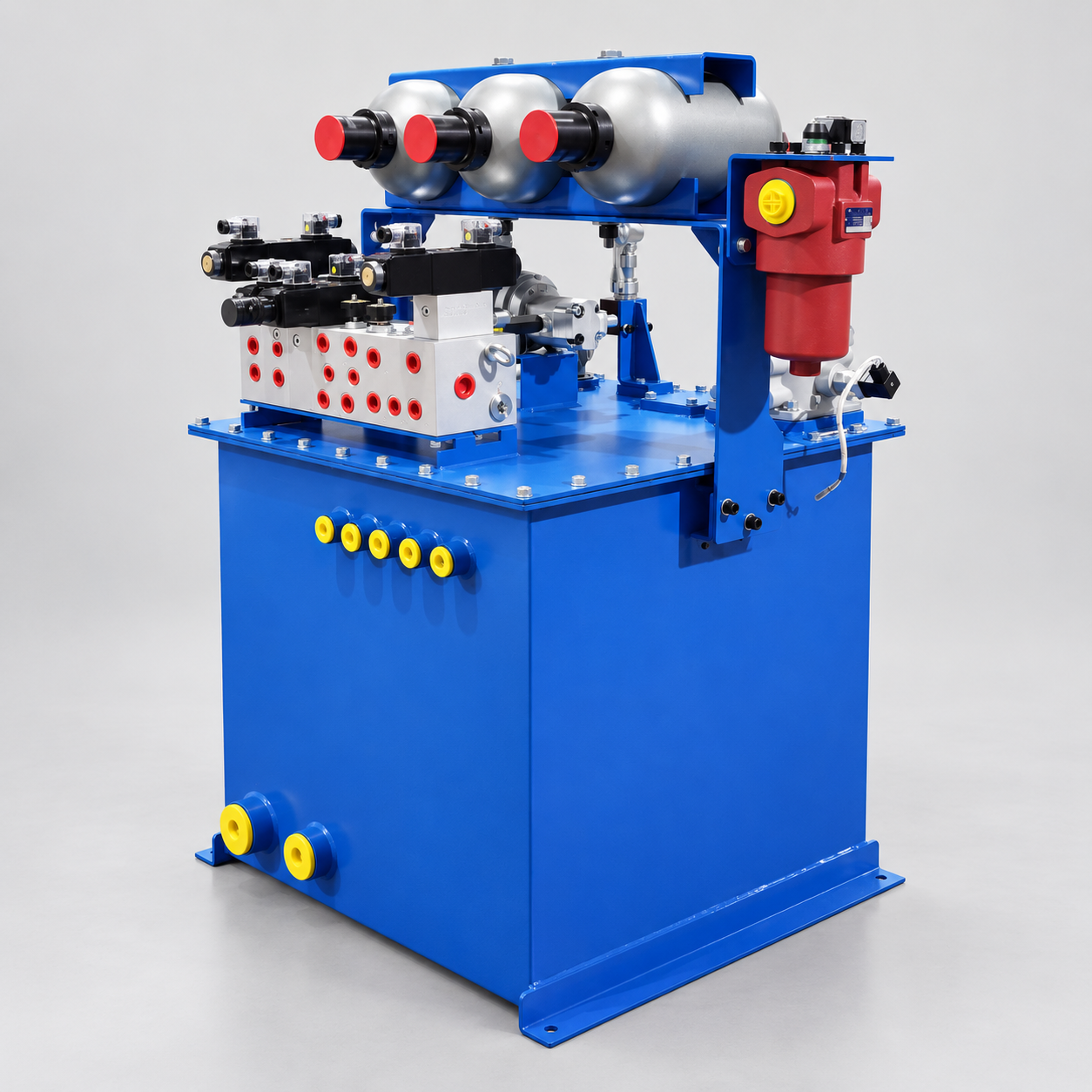
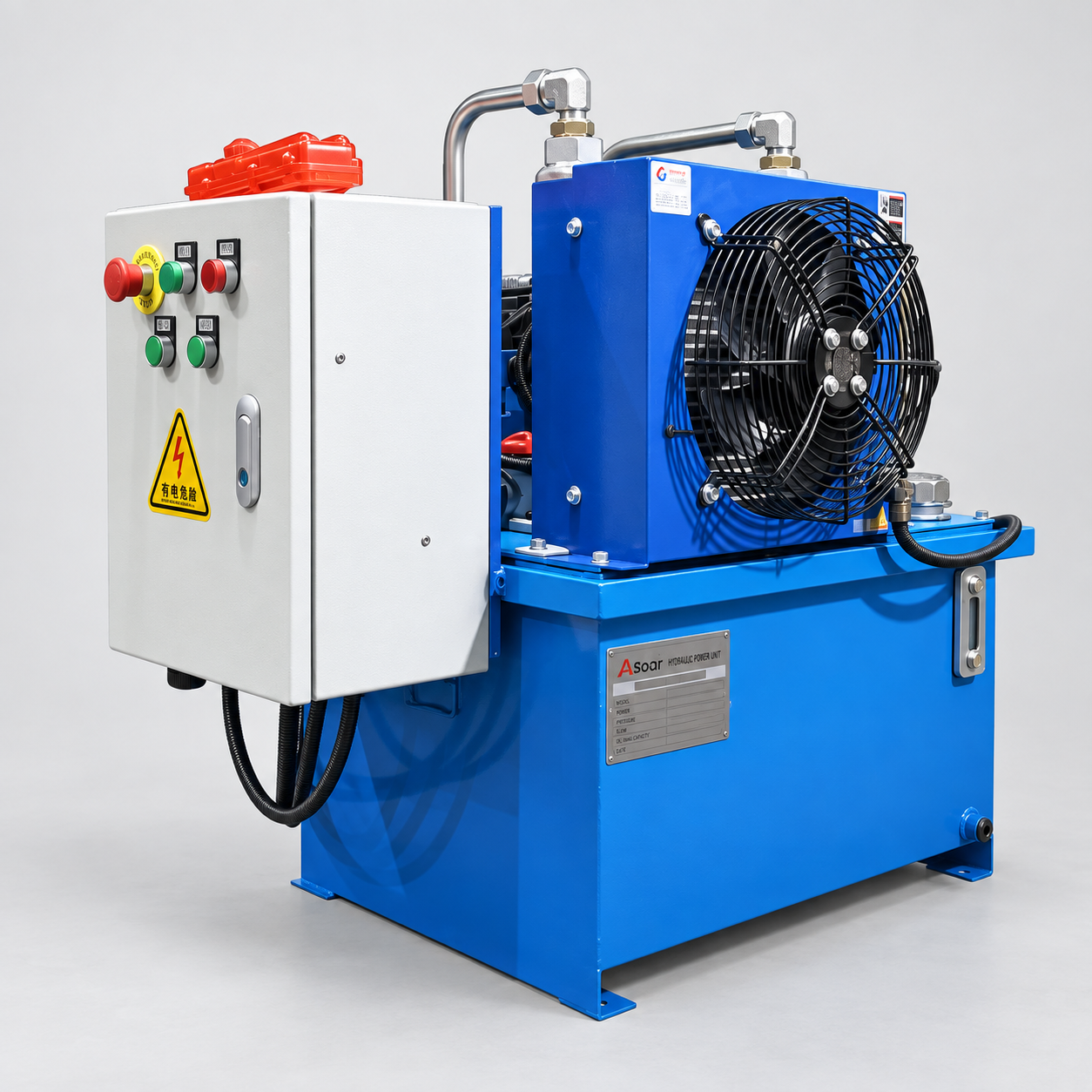
Two units may look similar from the outside but use different pump displacements, valve circuits, filtration levels, and cooling arrangements. Those differences affect not only price, but also cycle speed, oil temperature, and service life.
A request such as “Please quote a 2.2 kW hydraulic power unit” is therefore not enough to confirm whether the unit can provide the required pressure, flow, and duty cycle.
Start with the Machine Application
The supplier will normally ask for the following basic information:
Useful information includes:
- Machine or equipment type
- Main hydraulic functions
- Number of hydraulic movements
- Required operating sequence
- New project or replacement project
- Indoor or outdoor installation
The same motor and pump combination will not suit every machine. A press may need stable pressure holding and controlled approach speed, while lifting equipment must hold the load safely during stopping and lowering. Repeated high-load cycles may also change the reservoir, cooling, and filtration requirements.
Provide Cylinder or Hydraulic Motor Data
When the power unit drives hydraulic cylinders, send the bore, rod diameter, stroke, quantity, load, and required movement time. These values allow the supplier to calculate force, oil volume, and pump flow.
| Actuator Information | Why It Is Needed |
|---|---|
| Cylinder bore | Used to calculate force and oil demand |
| Rod diameter | Affects retraction force and speed |
| Stroke | Determines the oil volume per movement |
| Number of cylinders | Affects total flow demand |
| Required movement time | Used to calculate pump flow |
| Load condition | Helps determine working pressure |
| Cylinder orientation | Helps determine load-holding and lowering-control requirements |
If several cylinders operate together, clarify whether they move simultaneously or in sequence.
For hydraulic motor applications, the supplier will need the motor displacement, target speed, required torque, rotation direction, and operating time. It is also important to confirm whether several motors start together or whether the motor must start under load.
What Pressure, Flow, and Operating Cycle Information Is Needed?
At minimum, confirm the normal operating load, expected working pressure, maximum pressure, and whether the actuator must hold force or remain stationary under load.
Working pressure should not be confused with the relief-valve setting. The maximum pressure rating alone does not show whether the unit can maintain the required pressure continuously.
Instead of providing only a target flow rate, buyers can also provide:
- Cylinder extension and retraction time
- Hydraulic motor speed
- Required machine cycle time
- Whether several actuators move at the same time
Duty cycle can change the entire power unit design. A unit that runs for only a few seconds at a time may not need additional cooling, while continuous or high-frequency operation can cause rapid oil-temperature rise. In that case, the reservoir size, motor rating, pump loading, and cooler capacity must be reviewed together.
What Electrical and Control Information Is Required?
The motor and electrical controls must match the available power supply and machine control system.
Provide:
- AC or DC power
- Voltage
- Frequency
- Single-phase or three-phase
- Control voltage
- Manual, relay, or PLC control
- Required sensor or signal interface
- Local electrical standard
Describe the required movements in the order they occur. For example: extend, hold pressure for five seconds, retract, and return to neutral. This is often more useful than sending only a list of valve names.
An operating sequence is often more useful than simply listing valve names.
Installation Space Can Change the Design
A hydraulically correct unit can still create problems if it does not fit the machine or leaves no access for filter replacement, pressure adjustment, or oil filling.
Useful installation information includes:
- Maximum overall dimensions
- Horizontal or vertical mounting
- Mounting-hole positions
- Reservoir shape restrictions
- Motor and valve manifold position
- Port direction
- Hose connection direction
- Indoor, outdoor, dusty, humid, or corrosive environment
For compact equipment, even a simple installation sketch with dimensions can prevent later changes. It allows the supplier to confirm the tank shape, motor position, port orientation, hose direction, and maintenance clearance before production.
What Drawings or Reference Materials Are Helpful?
Technical documents reduce misunderstandings and shorten the quotation process.
Buyers can provide:
- Hydraulic schematic
- Machine layout drawing
- Cylinder drawing
- Existing hydraulic unit photos
- Pump, motor, or valve nameplates
- Installation dimensions
- Previous technical specification
- Reference sample
For replacement projects, clear photos of the complete unit and major components can help identify the existing configuration.
What If Some Technical Data Is Missing?
Not every buyer has a complete hydraulic schematic or detailed calculation.
In that case, start with what is available. Machine photos, cylinder dimensions, the load being moved, required travel time, local voltage, and available installation space are often enough for an initial review. The supplier can then identify which values still need confirmation.
However, key operating conditions should still be confirmed before production.
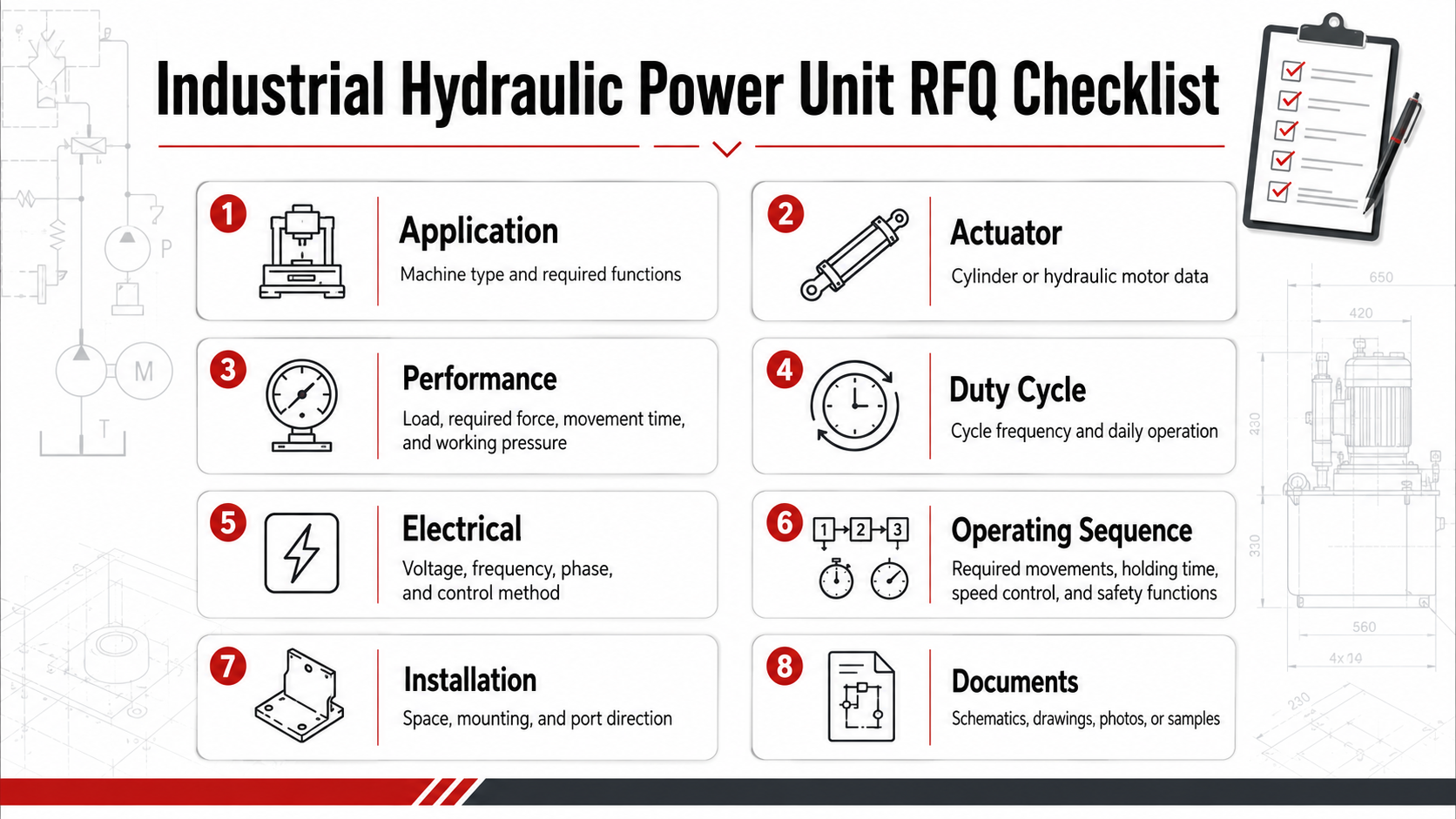
Industrial Hydraulic Power Unit RFQ Checklist
| Category | Information to Provide |
|---|---|
| Application | Machine type and hydraulic functions |
| Actuator | Cylinder or hydraulic motor data |
| Performance | Working pressure, speed, and load |
| Operation | Cycle time and daily working hours |
| Electrical | Voltage, frequency, phase, and control |
| Valve functions | Movement, holding, and sequence requirements |
| Installation | Space, mounting, ports, and hose direction |
| Environment | Temperature, dust, moisture, or corrosion |
| Documents | Schematic, drawings, photos, or samples |
How AiSoar Supports Hydraulic Power Unit Quotations
AiSoar reviews the machine application, actuator data, operating cycle, electrical supply, control requirements, and installation conditions before confirming the configuration.
A complete hydraulic schematic is helpful but not always necessary at the first stage. Existing-unit photos, cylinder drawings, machine dimensions, or a simple description of the working cycle can be used to begin the review. Any missing information will be listed before the final design and quotation are confirmed.
Conclusion
An accurate industrial hydraulic power unit quotation should be based on the machine’s actual operating requirements, not only on motor power or reservoir capacity.
The clearer the machine requirements are at the beginning, the fewer changes will be needed later. Even when some data is missing, photos, drawings, actuator dimensions, and cycle requirements usually give the supplier enough information to start the technical review.