Hydraulic overheating is often treated as a cooling problem. In practice, contamination can be just as important as cooler size, airflow, or reservoir capacity.
Air, water, solid particles, wear debris, sludge, and varnish affect the system in different ways, but they have one thing in common: they reduce hydraulic efficiency. More input power is then lost through leakage, friction, pressure drop, and unstable flow. That lost power becomes heat.
The relationship also works in reverse. As oil temperature rises, viscosity falls, oxidation accelerates, and the lubricating film becomes less reliable. Contaminants then cause damage more quickly.
Contamination increases wear and energy loss. Energy loss raises oil temperature. Higher temperature makes contamination more damaging.
For that reason, a system with both overheating and contamination problems should not be diagnosed by checking the cooler alone. Oil condition, contamination sources, component efficiency, and pressure losses must be evaluated together.
Why Heat and Contamination Reinforce Each Other
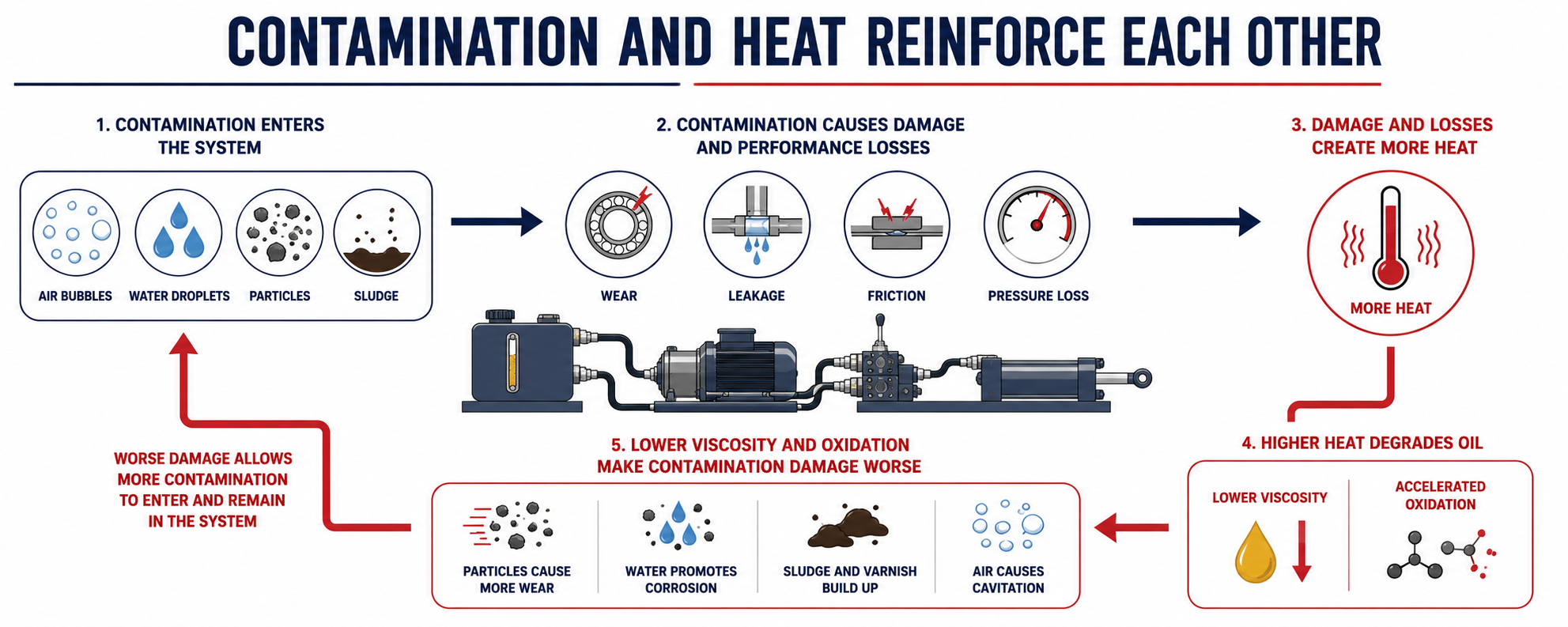
A hydraulic system generates heat whenever useful power is lost. Common losses include internal leakage through pumps and valves, throttling across restricted passages, friction between moving surfaces, and backpressure in filters, coolers, and return lines.
Contamination increases several of these losses at the same time.
Particles scratch precision surfaces and increase internal clearances. Water weakens lubrication and promotes corrosion. Air interrupts the oil film and reduces the consistency of pressure transmission. Oxidation products restrict filters, small valve passages, and cooler surfaces.
Once the oil becomes hot, its viscosity may fall below the preferred operating range of the pump and control valves. Internal leakage rises further, while the thinner oil film provides less protection against abrasive particles.
This is why two systems with the same cooler and nominal load can behave differently. The cleaner system may reach a stable oil temperature, while the contaminated system continues to heat because its internal efficiency has already deteriorated.
Air and Water Affect the Oil in Different Ways
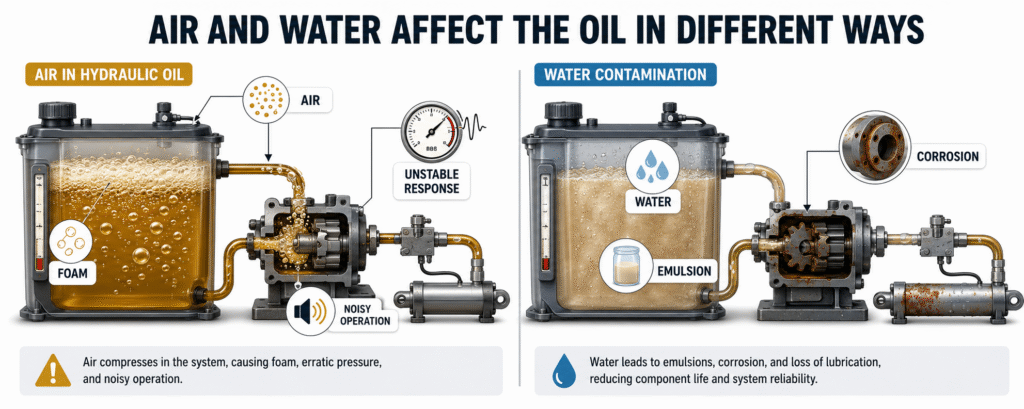
Air contamination is normally caused by suction-side leaks, low reservoir level, poor return-line design, excessive turbulence, or incomplete bleeding after maintenance.
Aerated oil may look foamy in the reservoir, but visible foam is only one sign. The pump may also become noisy, actuator response may feel weak or spongy, and pressure may fluctuate. These symptoms often become more noticeable after the oil warms because hot oil releases dissolved air more easily and has lower viscosity.
Air can also create local high-temperature events. When small bubbles are compressed rapidly in a high-pressure zone, their temperature rises. The resulting local heat can damage oil, seals, and nearby surfaces even when the average reservoir temperature appears acceptable.
Water creates a different problem. Free, dissolved, or emulsified water can reduce oil-film strength, promote rust, interfere with additives, and accelerate oxidation. It may enter through condensation, damaged cooler tubes, poor storage, washdown, or an unsuitable breather.
Cloudy or milky oil suggests emulsified water, but clear oil is not proof that the system is dry. Dissolved water may still be present and should be confirmed by testing.
When pump noise, reservoir foam, and unstable movement appear together, check for air ingress before replacing the pump. When oil appears cloudy, corrosion is present, or water collects at the bottom of the reservoir, identify the source before changing the oil.
Particles Turn Wear Into Heat
Solid particles can enter during manufacturing, assembly, maintenance, oil filling, or operation. Common sources include dust, welding residue, seal fragments, paint flakes, corrosion products, and wear debris from pumps, valves, cylinders, or motors.
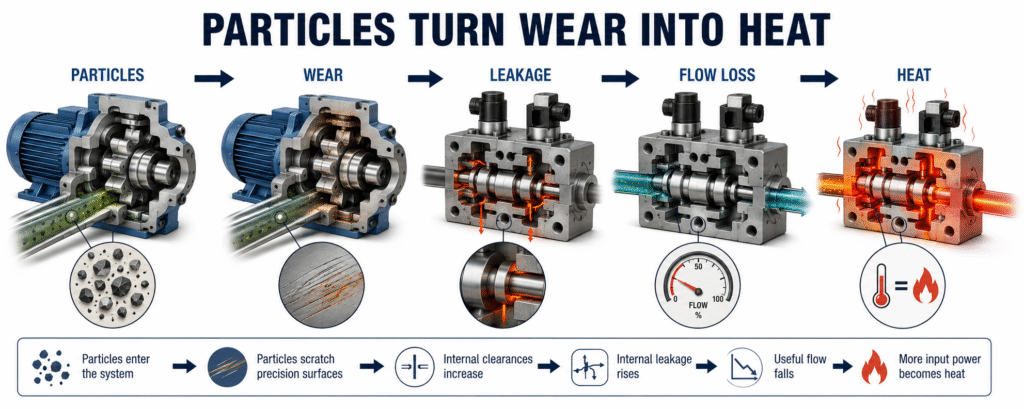
The most damaging particles are not always the largest. Particles close to the size of internal clearances can pass into pumps and valves, where they cause abrasive wear, spool sticking, erosion, and leakage.
The typical progression is straightforward:
Particles damage a precision surface. Internal clearance increases. Leakage rises. Useful flow falls. The pump must deliver more energy to achieve the same machine output. More of that energy becomes heat.
Wear debris then becomes a secondary contaminant. A worn pump or valve can release additional metal particles, which circulate through the system and accelerate damage elsewhere.
This is why repeatedly replacing filters without identifying the debris source may not solve the problem. The filter may be doing its job while an internal component continues to generate contamination.
Cold- and hot-state flow comparison is useful. If pump flow falls after warm-up and case-drain flow increases, internal wear may already be reducing volumetric efficiency. If several actuators slow down at the same time, inspect the pump and main valve block before assuming that each actuator has failed independently.
Oxidation Products Restrict Filters and Coolers
High temperature accelerates oil oxidation. Air, water, and catalytic metals such as copper and iron can make the process faster.
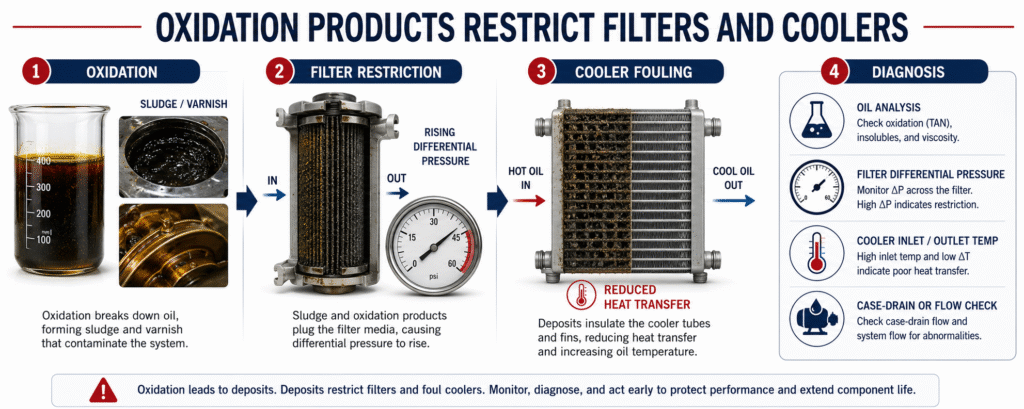
Oxidation can produce acids, sludge, and varnish. Varnish may form on valve spools, servo components, narrow control passages, and bearing surfaces, increasing friction and changing valve response.
Sludge loads filter elements and may settle in the reservoir, pipes, and cooler passages. As filter differential pressure rises, the bypass valve may open, allowing contaminated oil to circulate.
Deposits on oil-side cooler surfaces act as an insulating layer. The cooler may still have oil flow and the fan may still rotate, but heat transfer becomes less effective. Restricted passages can also increase pressure drop and add more heat to the circuit.
A declining temperature difference across an air cooler may indicate poor airflow, dirty fins, or internal fouling. However, temperature difference must be considered together with oil flow, ambient temperature, reservoir temperature, and cooler pressure drop.
If the cooler removes some heat but the reservoir temperature continues rising, the system is still generating more heat than the cooler can reject. The cause may be inadequate cooling capacity, but it may also be leakage, throttling, filter restriction, or return backpressure.
How to Confirm That Contamination Is Driving the Overheating
Diagnosis should be based on measurements, not only on oil appearance or the temperature of the hottest component.
| Observed condition | Measurements to take | Likely issue |
|---|---|---|
| Pump becomes noisy after warm-up | Reservoir foam, oil level, suction vacuum and suction joints | Air ingress or restricted suction |
| Oil appears cloudy or water collects in the tank | Water-content test and reservoir-bottom sample | Water contamination or condensation |
| Filters block repeatedly | Filter differential pressure and debris inspection | Wear debris, sludge or oxidation products |
| Hot-state flow falls | Pump flow and case-drain flow at the same pressure and speed | Pump wear and internal leakage |
| Valve block has a local hot spot | Pressure drop across the valve and thermal inspection | Throttling, sticking or leakage |
| Cooler performance declines | Inlet/outlet temperature, airflow or water flow and oil-side pressure drop | Fouling or restricted heat transfer |
| Oil darkens quickly | Viscosity, acid number, water, particle count and wear metals | Accelerated oxidation or active wear |
Useful oil tests may include viscosity, water content, particle count, acid number, elemental analysis, and membrane patch inspection.
Trend data is more valuable than one isolated sample. A gradual increase in particle count, acid number, filter differential pressure, or case-drain flow can reveal deterioration before the system reaches a high-temperature alarm.
The measurements should also be taken under comparable operating conditions. Pump flow measured at different pressures, or cooler temperature differences recorded at different oil flows, may lead to the wrong conclusion.
Correct the Source Before Replacing Oil or Filters
Oil replacement and new filters may temporarily improve the system, but they will not prevent recurrence if contamination continues to enter or a worn component continues producing debris.
A practical repair sequence is:
- Identify the contamination source, including suction leaks, damaged breathers, water entry, poor filling practices, or internal wear.
- Check whether the pump, valves, motors, or cylinders have already suffered measurable efficiency loss.
- Clean the reservoir, accessible piping, and cooler where deposits are present.
- Filter, dehydrate, or replace the oil according to the test results.
- Replace filter elements and confirm that bypass valves and differential-pressure indicators work correctly.
- Run the machine through the same duty cycle and compare oil temperature, pump flow, return pressure, filter pressure drop, and cooler performance.
The repair is complete only when oil cleanliness and thermal performance remain stable under the real operating cycle.
A system that runs cooler immediately after an oil change but begins overheating again after several days still has an unresolved contamination source, internal wear problem, or cooling restriction.
Conclusion
Contamination makes hydraulic overheating worse because it increases friction, leakage, pressure loss, and flow instability. These losses generate additional heat. The higher temperature then reduces viscosity, accelerates oxidation, and weakens the oil’s ability to protect components.
Air, water, particles, sludge, and varnish affect the system differently, but they often become part of the same failure cycle.
A professional diagnosis should combine oil analysis with cold- and hot-state performance measurements, filter differential pressure, case-drain flow, cooler temperatures, and pressure-drop checks.
The objective is not only to clean the oil or lower the temperature temporarily. It is to identify the contamination source, determine whether component efficiency has deteriorated, and restore stable thermal balance.