Some hydraulic machines operate normally immediately after startup. Pressure, speed, and noise may all appear acceptable. After 30 minutes, one hour, or longer, however, the oil temperature may keep rising. The machine may then move more slowly, lose efficiency, trigger a high-temperature alarm, or shut down automatically.
This does not always mean that a component has suddenly failed. In many cases, the system is generating heat faster than the reservoir, piping, and cooler can remove it.
The final operating temperature depends on two factors:
- Heat generated per unit of time
- Heat dissipated per unit of time
When heat generation remains higher than heat dissipation, the temperature continues to rise until the system reaches a new thermal balance. If that balance temperature is above the acceptable range, the system overheats.
Heat Builds Up Gradually
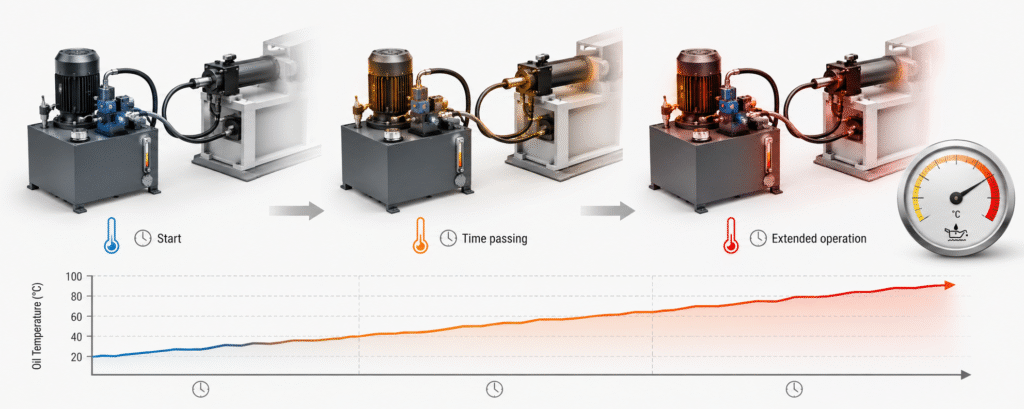
A hydraulic system does not reach its maximum temperature immediately after startup. The oil, reservoir, pump, valve block, pipes, and actuators absorb part of the heat during the early operating period.
At the same time, the tank, pipes, hoses, and cooler transfer heat to the surrounding air or cooling water. This is why a machine may perform normally during a short test.
As operation continues:
- The oil keeps absorbing heat
- Pumps and valves become warmer
- The average reservoir temperature rises
- The machine enclosure becomes hotter
- The cooler approaches its heat-rejection limit
If heat is generated faster than it can be removed, temperature continues to accumulate. A system may therefore pass several no-load tests but overheat after one hour of production.
Cycle Frequency Is Too High
Every hydraulic movement creates pressure loss, friction, and internal leakage. These losses are converted into heat.
When the machine completes more cycles per minute, the pump, valves, piping, cylinders, and hydraulic motors generate more heat in the same period.
High thermal loads are common when:
- Cylinders extend and retract frequently
- Hydraulic motors start and stop repeatedly
- Several actuators operate together
- The machine changes speed or direction frequently
- There is little idle time between cycles
- Production speed exceeds the original design condition
For example, increasing a machine from three to five cycles per minute raises the thermal load even if working pressure remains unchanged. If the pump, reservoir, and cooler are not upgraded, the oil temperature may rise rapidly during continuous operation.
The Pump Runs Without Doing Useful Work
Many systems use fixed-displacement pumps. As long as the motor or engine is running, the pump continues delivering flow.
The machine may not need full flow during waiting periods, low-speed movement, or actuator stops. Excess oil may return to the reservoir through a relief valve, unloading valve, directional valve center passage, flow-control valve, or bypass circuit.
If the system does not unload correctly, or the unloading pressure is too high, the pump keeps consuming power without producing useful output. Much of that power becomes heat.
This problem is common in machines with short working strokes and long waiting periods. The system may be cool at startup but become hot because the pump spends most of its time operating under unnecessary pressure or throttling conditions.
Long Pressure-Holding Periods Generate Heat
Hydraulic presses, clamping fixtures, lifting platforms, and cylinders supporting static loads may need to hold pressure for long periods.
If the pump continues supplying oil to maintain pressure, it must compensate for internal leakage in valves, pipes, and actuators. The leakage may be small, but over several hours the energy loss can generate substantial heat.
The problem becomes more severe when:
- The pump remains in high-pressure standby
- A small flow continuously passes across the relief valve
- The accumulator is missing or undersized
- Check, counterbalance, or load-holding valves leak internally
- The cylinder piston seal leaks
- A proportional valve continuously corrects position
More efficient solutions may include an accumulator, pressure-switch-controlled pump operation, a variable-displacement pump with low-flow standby, or an optimized load-holding circuit.
Hot Oil Increases Internal Leakage
As oil temperature rises, viscosity normally decreases. Thinner oil passes more easily through internal clearances in pumps, valves, motors, and cylinders.
This can create a self-reinforcing cycle:
Oil temperature rises → viscosity decreases → internal leakage increases → efficiency falls → more energy becomes heat → temperature rises further
Cold oil may temporarily hide wear in a pump or valve. Once the system becomes hot, leakage becomes more obvious.
Typical symptoms include:
- Slower actuator movement
- Longer pressure build-up time
- Poorer pressure-holding performance
- Continuous pump or motor operation
- A hot pump housing or valve block
- Lower pump flow when the oil is hot
When performance and temperature deteriorate together, pump flow and leakage should be compared under both cold and hot operating conditions.
The Cooler Reaches Its Capacity Limit
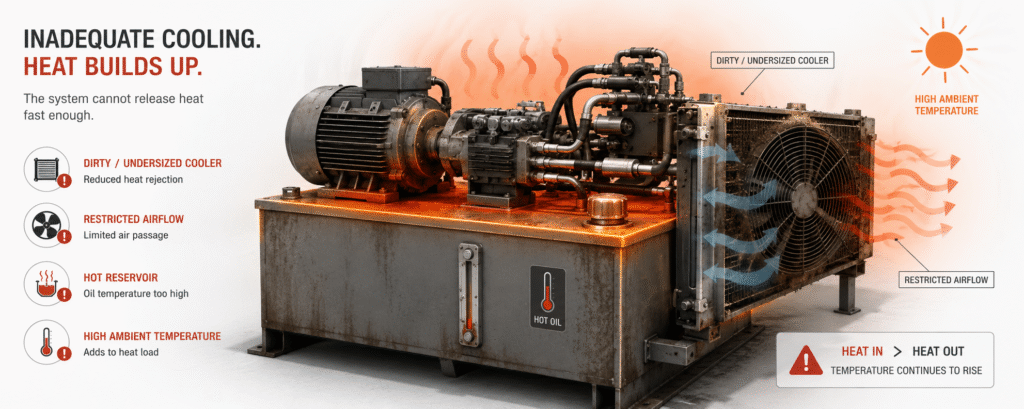
A hydraulic cooler cannot remove unlimited heat. Its performance depends on oil temperature, ambient temperature, airflow, cooling-water temperature, cleanliness, and installation conditions.
Cooling may become insufficient when:
- The cooler is undersized
- Continuous operating time exceeds the design condition
- Ambient temperature is higher than expected
- Cycle speed, pressure, or flow has increased
- Cooling fins are blocked
- Fan airflow is insufficient
- Hot discharge air recirculates
- Cooling-water flow is too low
- Cooling-water temperature rises
- Oil-side pressure loss is excessive
A short test cannot confirm whether a cooler is correctly sized. Cooling performance should be evaluated after the machine approaches thermal equilibrium under its real working cycle.
The Reservoir Is Too Small
The reservoir helps dissipate heat, release entrained air, and allow contaminants to settle.
If its effective volume is too small, hot return oil may be drawn back into the pump before it has enough time to cool or release air.
Possible results include:
- Short oil residence time
- Faster average temperature rise
- Poor air separation
- Hot return oil entering the suction zone
- Reduced system heat capacity
- Greater load on the cooler
Low oil level creates a similar problem because less oil is available to absorb and release heat.
A reservoir that was adequate for the original machine may become too small after pump flow, cycle frequency, or continuous operating time is increased.
Valves and Piping Create Continuous Pressure Loss
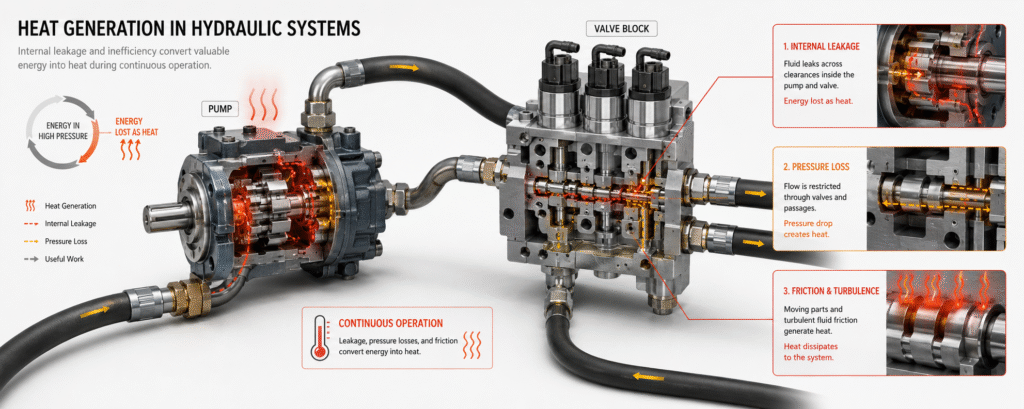
Oil loses pressure whenever it passes through valves, pipes, filters, fittings, quick couplings, and coolers. That pressure loss is converted into heat.
Common high-loss locations include:
- Partially closed flow-control valves
- Proportional valves used continuously for speed control
- Undersized directional valves
- Small return lines
- Restrictive quick couplings
- Clogged filters
- Excessive pipe bends
- High-resistance coolers
If one valve block, filter housing, fitting, or pipe section is much hotter than nearby components, it may indicate a continuous pressure drop at that location.
The Surrounding Environment Becomes Hotter
The air around the hydraulic system may also become hotter during continuous operation. Motors, engines, hydraulic components, and nearby equipment release heat into the same space.
Common problems include:
- Hydraulic power units installed inside closed cabinets
- Poor ventilation around the reservoir and cooler
- Cooler exhaust air being drawn back into the fan
- Reservoirs installed near engines or exhaust pipes
- Equipment exposed to direct sunlight
- Furnaces or hot materials located nearby
In these conditions, the cooler may be functioning correctly but still be unable to reject enough heat because the surrounding air is already too warm.
How to Diagnose a Hydraulic Heat-Balance Problem
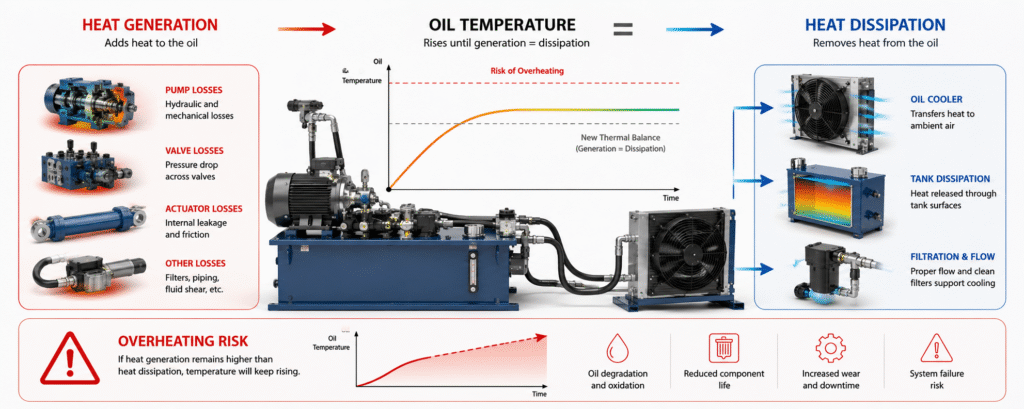
A single oil-temperature reading is not enough. The system should be monitored under actual production conditions.
Record the following data at fixed intervals:
- Ambient or machine-enclosure temperature
- Reservoir oil temperature
- Pump outlet and return-line temperatures
- Cooler inlet and outlet temperatures
- Working, standby, and pressure-holding pressures
- Pump flow under cold and hot conditions
- Complete machine cycle time
- Time before alarms or performance loss appear
If the oil temperature rises and then stabilizes within the acceptable operating range, the system has probably reached a normal thermal balance.
If the temperature continues rising without a clear stabilization point, heat generation is still greater than heat dissipation. The inspection should focus on cycle frequency, continuous relief flow, standby pressure, pump and valve leakage, reservoir volume, pressure losses, cooler capacity, and ventilation.
Conclusion
When hydraulic oil temperature keeps rising during continuous operation, the root cause is usually accumulated heat rather than one isolated component failure.
Frequent cycling, continuous pump operation, long pressure-holding periods, internal leakage, throttling losses, a small reservoir, and insufficient cooling can all increase heat generation. Rising temperature then reduces oil viscosity and increases internal leakage, creating a cycle of lower efficiency and further temperature rise.
Diagnosis should therefore be carried out during the real working cycle, not only during startup. By recording temperature, pressure, flow, and cycle time, operators can determine whether the system reaches a safe thermal balance.
Reducing unnecessary energy losses and improving reservoir capacity, cooler performance, and equipment ventilation are the most effective ways to keep a hydraulic system stable during long periods of continuous operation.