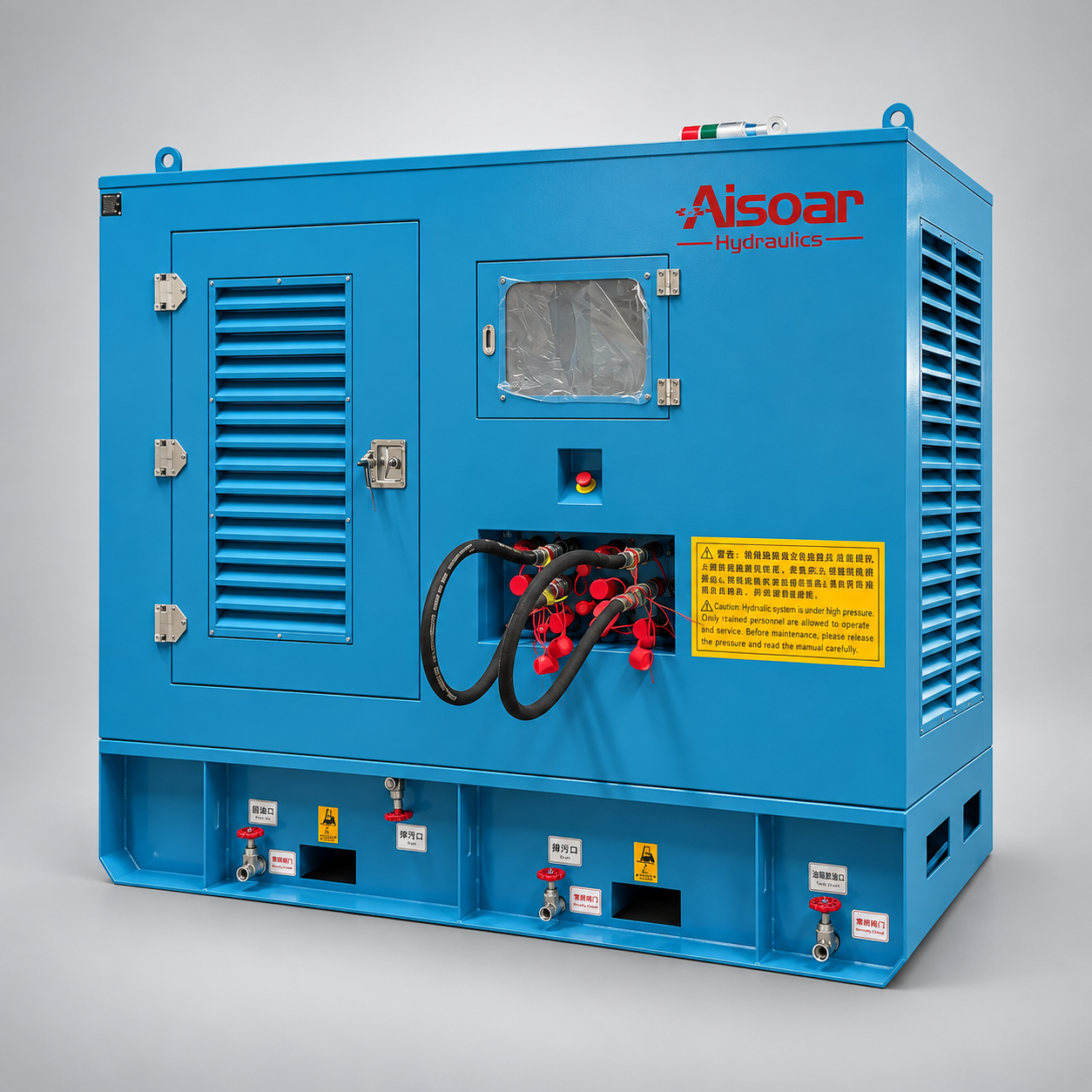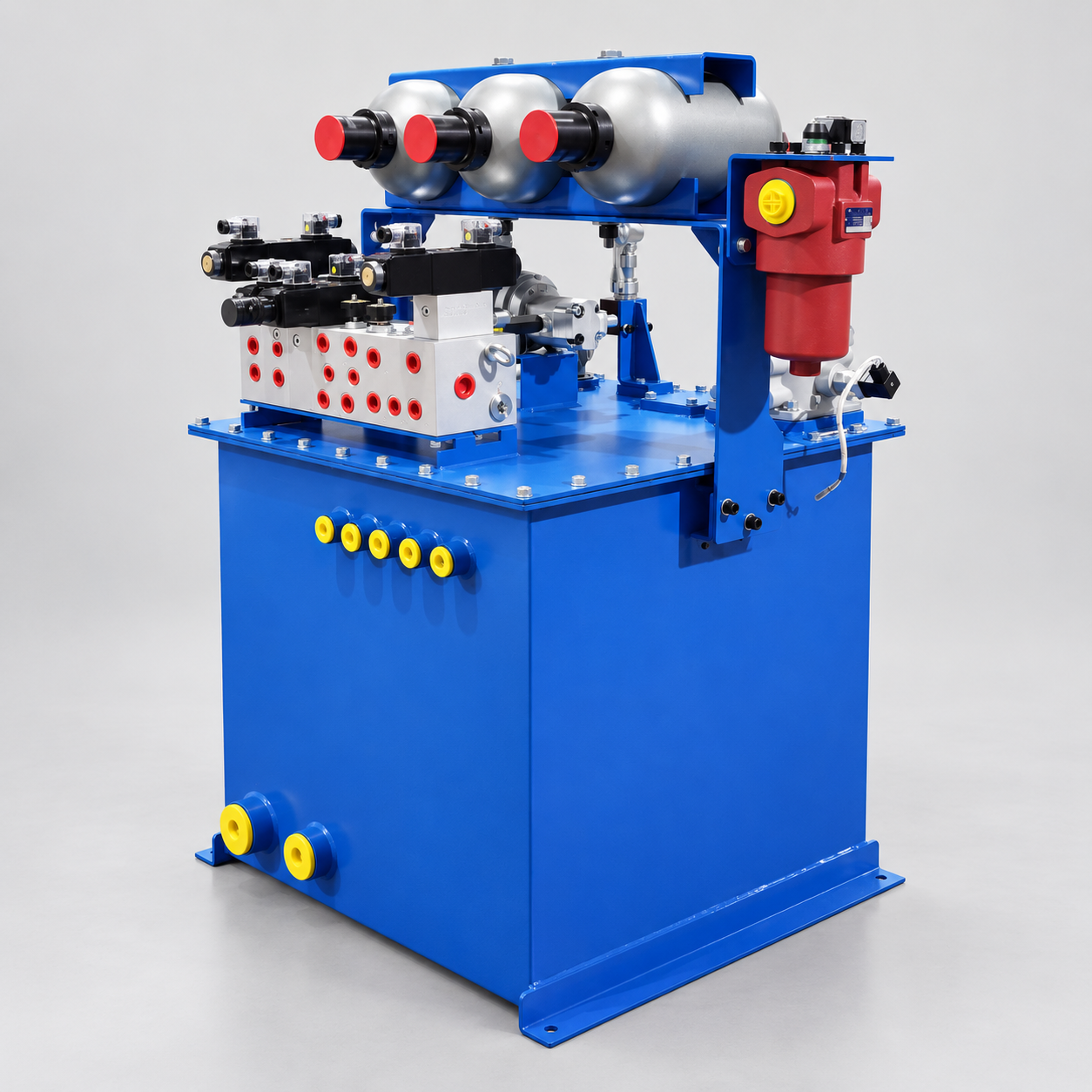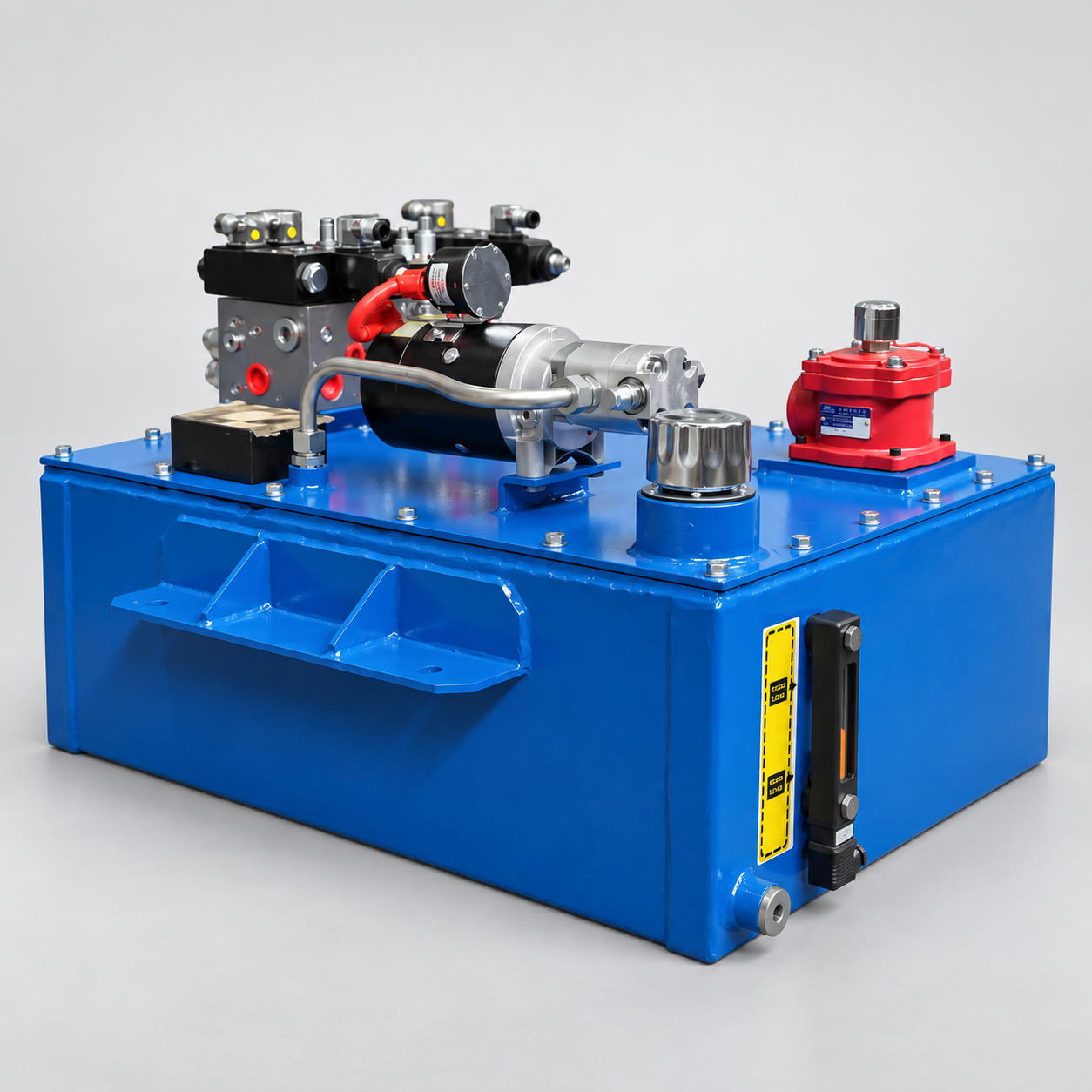
A certain increase in temperature is normal when a hydraulic system operates.
Hydraulic pumps, control valves, pipes, hoses, and actuators all create friction, internal leakage, and pressure losses while transmitting pressure and flow. Part of the power supplied by the electric motor or engine is therefore converted into heat.
The real concern is whether the system generates more heat than the reservoir, piping, and cooler can remove.
When heat generation remains higher than heat dissipation, the hydraulic oil temperature continues to rise. The machine may then experience high-temperature alarms, slower movement, reduced efficiency, unstable pressure, accelerated oil aging, or automatic shutdown.
Most hydraulic system overheating problems can be divided into three categories:
- Excessive heat generation inside the system
- Insufficient heat dissipation
- Incorrect hydraulic oil selection or poor oil condition
Understanding which category is responsible is the first step toward an effective solution.
The Relief Valve Operates Continuously
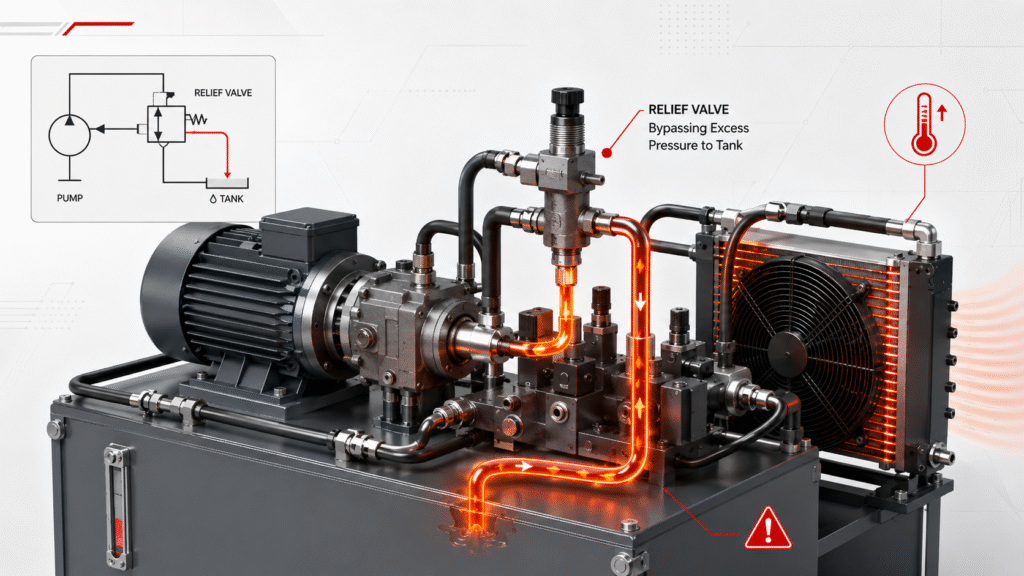
A relief valve is one of the most common sources of heat in a hydraulic system.
When system pressure reaches the relief valve setting, excess pump flow passes from the high-pressure side back to the reservoir. The large pressure drop across the valve converts hydraulic energy into heat.
Under normal conditions, the relief valve should mainly protect the system from excessive pressure. It should not continuously control or unload the full pump flow.
Continuous relief flow may occur when:
- The cylinder reaches the end of its stroke while the pump continues supplying oil
- The load exceeds the system capacity
- The relief pressure is set too low
- The valve spool is contaminated, worn, or unable to close completely
- A fixed-displacement pump system has no effective unloading circuit
- The operator holds the control valve in an operating position for too long
If the relief valve and nearby return line are significantly hotter than the rest of the system, continuous relief flow should be investigated.
Excessive Throttling Creates Heat
Hydraulic systems often control actuator speed through throttle valves, flow-control valves, proportional valves, or small control orifices.
Whenever oil passes through a restricted opening, pressure is lost. If the flow is high, the valve opening is small, or the pressure difference is large, a significant amount of hydraulic energy is converted into heat.
For example, if the pump delivers much more flow than the actuator requires, the excess flow must pass through a throttling valve or relief valve. The actuator speed may be controlled, but the overall system efficiency becomes poor.
Common causes include:
- An oversized hydraulic pump
- A flow-control valve adjusted too far closed
- A proportional valve controlling large flow through a small opening
- Several valve restrictions acting in series
- Lack of a variable-displacement pump or load-sensing control system
If one valve block is much hotter than surrounding components, it may contain a continuous throttling point.
Internal Leakage in Pumps and Valves
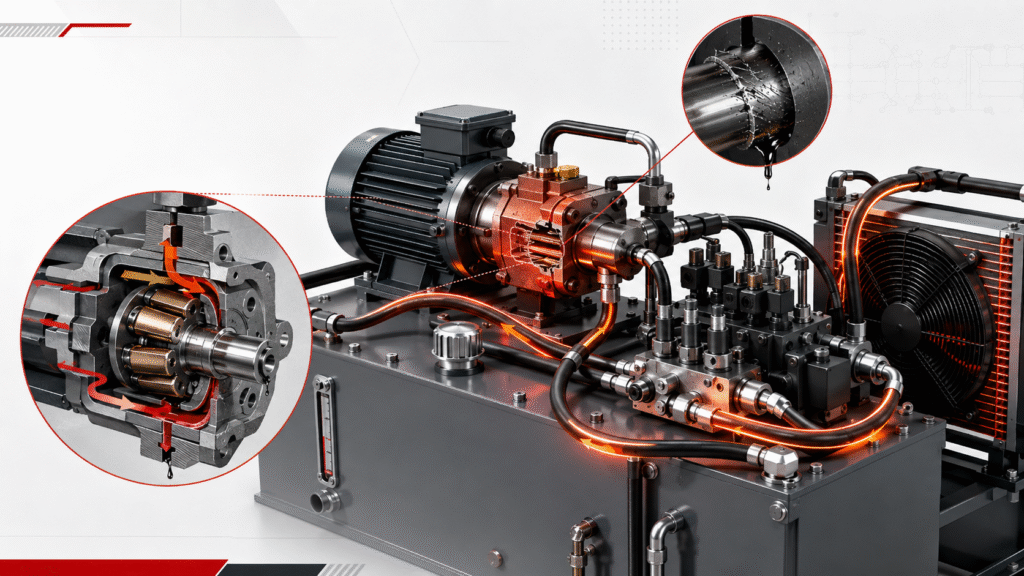
Hydraulic pumps and control valves contain controlled internal clearances.
As components wear, or as hydraulic oil becomes thinner at high temperature, more oil can leak internally from high-pressure areas to low-pressure areas.
The pump may continue consuming motor or engine power while producing less effective output flow. The lost energy is converted into heat inside the pump or valve.
Typical symptoms include:
- Normal operation when cold but slower movement when hot
- Abnormally high pump casing or valve block temperature
- Poor pressure-holding performance
- Weak actuator movement despite continuous pump operation
- Actual pump output below the expected flow rate
If pump flow drops significantly after the system warms up, pump efficiency and valve leakage should be checked.
Excessive Pipe Pressure Drop and Return Backpressure
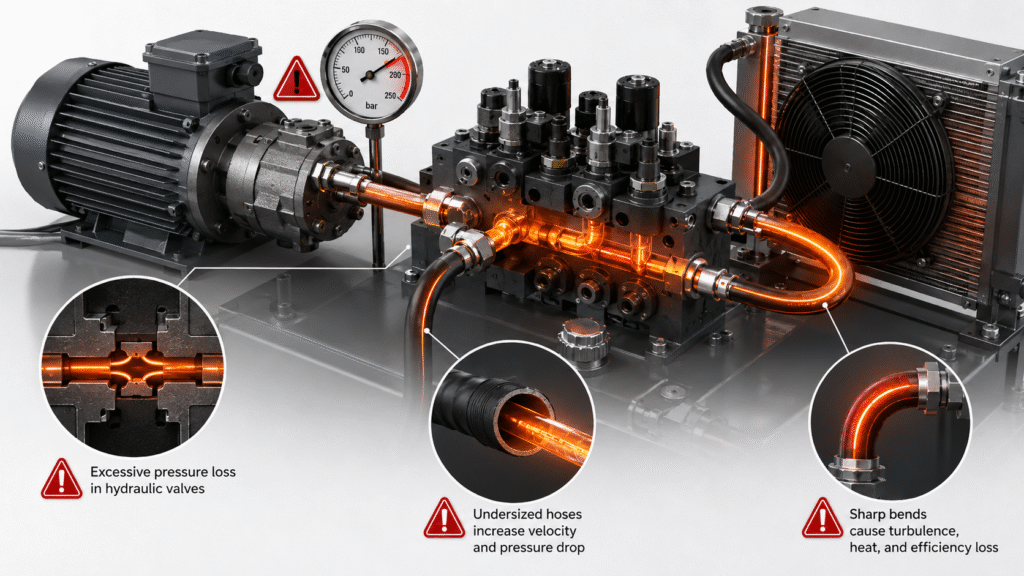
Hydraulic oil experiences resistance as it passes through pipes, hoses, fittings, filters, quick couplings, valves, and coolers.
If a line is too small, too long, sharply bent, or partially blocked, the pump must produce additional pressure to maintain the required flow. This extra pressure loss becomes heat.
Problem areas may include:
- Undersized pressure or return lines
- Long or sharply bent hoses
- Quick couplings with insufficient flow capacity
- Blocked or overloaded filters
- Coolers with excessive flow resistance
- Flattened or internally damaged hoses
- Restrictive fittings or adapters
High return-line backpressure can also increase actuator resistance and affect the operation of hydraulic motors, valves, and cylinders.
Return pressure and filter differential pressure should be measured under the machine’s actual working flow.
High Cycle Frequency or Continuous High-Pressure Operation
The more frequently a hydraulic system operates, the more hydraulic energy it transfers per unit of time.
The following operating conditions may cause oil temperature to rise continuously:
- Frequent cylinder extension and retraction
- Several actuators operating at the same time
- Long periods of pressure holding
- Continuous machine operation
- Frequent acceleration and deceleration
- Cycle frequency higher than the original design requirement
- Increased actuator speed without upgrading the cooling system
Some hydraulic systems remain cool during a short test but overheat after continuous operation.
This usually means that the system can meet the instantaneous pressure and flow requirements, but its long-term thermal balance is insufficient.
Reservoir Size or Design Is Inadequate
A hydraulic reservoir does more than store oil. It also helps release heat, separate air, settle contaminants, and provide stable pump suction conditions.
If the reservoir is too small, the oil circulates too quickly and does not remain inside long enough to release heat or entrained air.
Poor internal design may also allow hot return oil to flow directly toward the pump suction area.
Common reservoir problems include:
- Insufficient effective oil volume
- Return and suction ports positioned too close together
- Poorly designed internal baffles
- Low oil level
- Installation near an engine or external heat source
- Dust or oil covering the reservoir surface
Adding more oil alone may not solve the problem. The return-flow path, suction arrangement, air separation, and reservoir ventilation should also be checked.
Cooling Capacity Is Insufficient
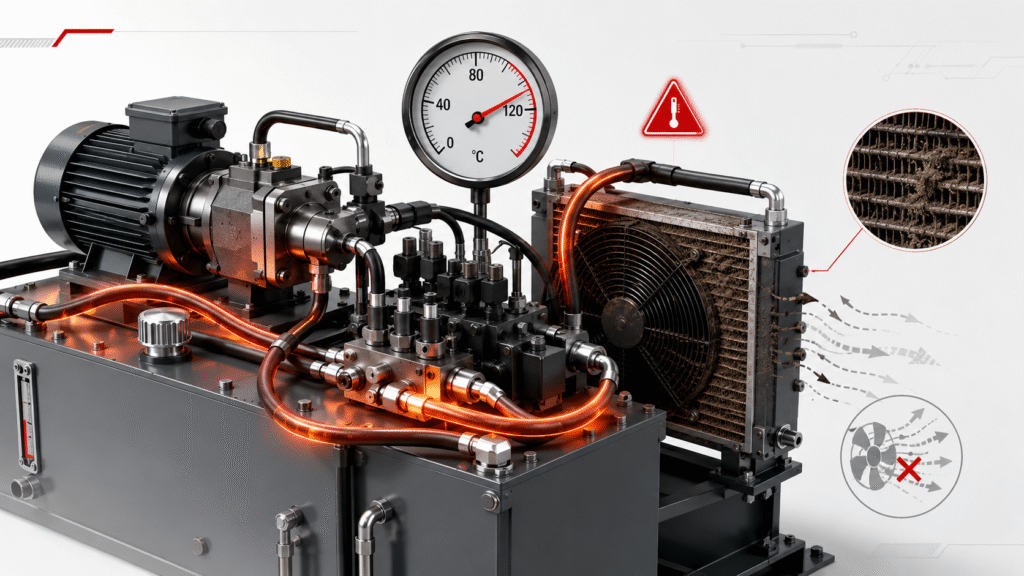
When natural heat dissipation from the reservoir and piping is not enough, the system requires an air-cooled or water-cooled heat exchanger.
In summer, the temperature difference between the oil and the surrounding air becomes smaller, reducing air-cooler performance.
Cooling efficiency may also decrease because of:
- An undersized oil cooler
- Dust or oil blocking the cooling fins
- Incorrect fan rotation
- Insufficient airflow
- Fan motor or temperature-switch failure
- Poor ventilation around the cooler
- Hot discharge air returning to the cooler inlet
- Scale inside a water-cooled heat exchanger
- High cooling-water temperature or insufficient water flow
A cooler can only remove heat that has already been generated.
If the system contains continuous relief flow, severe internal leakage, or excessive throttling, installing a larger cooler may reduce temperature but will not correct the underlying efficiency problem.
Hydraulic Oil Is Incorrect or Degraded
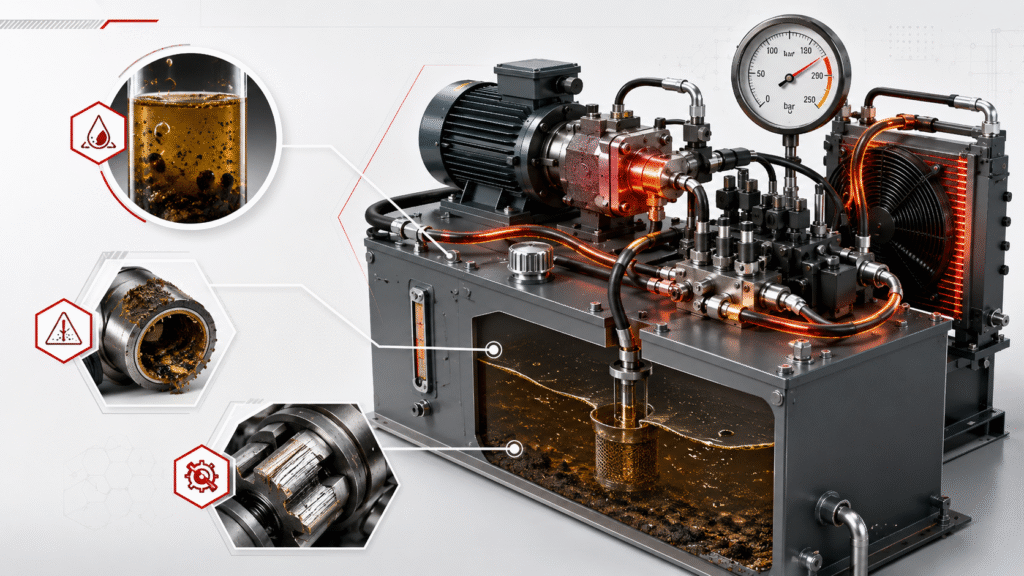
Both excessively high and excessively low oil viscosity can contribute to overheating.
Oil that is too thick creates additional resistance in suction lines, filters, valves, and return pipes. Oil that is too thin increases internal leakage in pumps, valves, motors, and cylinders.
Common oil-related problems include:
- Incorrect viscosity grade for the ambient temperature
- Mixing different hydraulic oil types or grades
- Oxidized or aged oil
- Water, fuel, or chemical contamination
- An unsuitable viscosity index for large temperature changes
- Poor filtration or excessive particle contamination
Hydraulic oil should be selected according to the pump type, expected operating temperature, ambient conditions, working pressure, and equipment manufacturer’s recommendations.
Oil should not be changed only according to the season without considering the complete system requirements.
External Heat Sources Affect the System
High ambient temperature reduces the ability of the reservoir and cooler to release heat.
The actual temperature around the hydraulic system may be much higher than the outdoor temperature when the equipment is installed inside an enclosed compartment or near a heat source.
Common external heat sources include:
- Engines and exhaust pipes
- Furnaces and heating equipment
- Hot materials or production processes
- Direct sunlight
- Trapped hot air inside enclosed machinery
- Hot air discharged from the cooler
Possible solutions include improving ventilation, installing heat shields, relocating components, adding insulation, or redesigning the airflow path.
How to Identify the Main Heat Source
A practical overheating investigation should compare temperature, pressure, flow, and machine performance.
Temperature
Measure the reservoir, pump casing, valve block, pressure line, return line, and cooler inlet and outlet temperatures. A local hot spot often indicates internal leakage, throttling, or excessive pressure loss.
Pressure
Check pump outlet pressure, actual load pressure, return-line pressure, and filter differential pressure. This can reveal continuous relief flow, excessive throttling, high backpressure, or blockage.
Flow
Measure actual pump output and compare cold and hot flow rates. A significant reduction after warm-up may indicate pump wear or valve leakage.
Performance
Compare actuator speed, cycle time, pressure-holding ability, noise, and motor current before and after the oil heats up.
If pump pressure is much higher than the pressure required by the load, check for throttling, backpressure, and relief valve losses.
If flow, speed, or holding performance falls after warm-up, check oil viscosity, pump efficiency, and internal leakage in the valves and actuators.
Conclusion
Hydraulic system overheating is rarely caused by a single component.
Continuous relief flow, excessive throttling, pump and valve leakage, restrictive piping, high return backpressure, insufficient reservoir capacity, poor cooling performance, and degraded hydraulic oil can all generate or retain excessive heat.
Summer temperatures further reduce heat dissipation, making systems that already operate close to their design limits more likely to overheat.
The correct solution is not simply to monitor reservoir temperature or install a larger cooler.
Effective troubleshooting should first identify where heat is generated, determine why it cannot be removed, and compare pressure, flow, and actuator performance under cold and hot operating conditions.
Once the main heat source has been identified, the pump, valves, piping, reservoir, hydraulic oil, and cooling system can be optimized to reduce operating temperature and improve long-term reliability.
AiSoar Hydraulics provides hydraulic power units, valve manifolds, hydraulic cylinders, and complete hydraulic system design and optimization services for mobile and industrial equipment.
For technical evaluation, customers can provide the hydraulic schematic, working pressure, pump flow, motor power, reservoir capacity, duty cycle, ambient temperature, normal oil temperature, maximum oil temperature, and a description of the overheating symptoms.