Testing a large-bore or long-stroke hydraulic cylinder is more demanding than testing a standard industrial cylinder. The cylinder may require higher oil volume, greater reaction force, longer support length and more careful restraint during extension and retraction.
For heavy-duty cylinders, the test bench must therefore do more than generate pressure. The complete test arrangement needs to manage pressure, flow, cylinder support, mounting, movement, leakage measurement and operator safety as one system.
A practical large-cylinder testing process normally includes dimensional and visual checks, low-pressure cycling, functional testing, proof-pressure testing, pressure holding, leakage inspection and test-data recording.
Why Large Hydraulic Cylinders Need a Different Test Setup
A large-bore cylinder contains significantly more oil than a small cylinder. This affects the flow required to achieve a practical test speed and the amount of oil that must be handled during cycling.
Long-stroke cylinders create another challenge. As the piston rod extends, the effective length of the cylinder increases and the center of gravity changes. Without suitable supports, the cylinder and rod may sag, shift or create unwanted side load on the seals and guide components.
Cylinder weight also becomes important. A heavy cylinder cannot simply be placed on a standard workbench or restrained only by hydraulic hoses. The test structure, supports and mounting points must safely withstand both the cylinder weight and the reaction forces generated during testing.
For these reasons, large-cylinder testing should be planned according to the actual bore, rod diameter, stroke, closed length, extended length, weight, mounting type and test pressure.
Prepare the Hydraulic Cylinder Before Testing
Before applying hydraulic pressure, the cylinder should be inspected and its main specifications confirmed.
The tester should verify the bore, rod diameter, stroke, mounting configuration, port size, rated working pressure and required test pressure. External surfaces, welds, rod condition, ports and mounting points should also be checked for visible damage.
The hydraulic fluid used for testing should be compatible with the cylinder and sufficiently clean for the components being tested. Test hoses, fittings and adapters must have pressure ratings appropriate for the planned test pressure.
For repaired cylinders, special attention should be given to assembly condition, gland installation, piston nut security and seal replacement before the cylinder is connected to the test bench.
Support and Restrain Long-Stroke Cylinders Correctly
Mechanical support is one of the most important differences between standard and long-cylinder testing.
The cylinder body should be supported at suitable points to prevent rolling, excessive deflection or movement during cycling. For very long cylinders, several heavy-duty saddles or cradles may be required along the barrel.
The rod also needs support as it extends. A movable rod-support trolley or guided support can help reduce sag and side loading during long strokes.
The mounting end should be securely restrained using a fixture that matches the cylinder mounting type, such as eye, clevis, pin, flange or trunnion mounting.
A typical long-cylinder arrangement may therefore include:
Fixed-End Restraint → Cylinder Supports → Anti-Roll Protection → Rod Support → Safe Extension Area
For cylinders that exceed the length of a conventional test frame, a split-type or external testing arrangement may be used. In this case, the supports, restraints, hose routing and safety zone become even more important.
Hydraulic Cylinder Testing Procedure for Large-Bore & Long-Stroke Cylinders
Step1:Connect the Cylinder to the Hydraulic Test System
The test circuit should provide controlled hydraulic flow to both cylinder chambers while allowing pressure to be monitored accurately.
For a double-acting cylinder, the cap-end and rod-end ports are connected to the test system through appropriately rated hoses or rigid piping. Pressure sensors or gauges should be located where they can measure the actual pressure applied to the cylinder.
The test system should also provide pressure-relief protection so that the cylinder cannot accidentally be exposed to pressure above the intended test value.
For long cylinders tested some distance from the main hydraulic power unit, hose length and pressure loss should also be considered. Long hoses should have suitable pressure ratings and should be routed so that they are protected from mechanical damage during testing.
Step2:Perform Low-Pressure Cycling First
Before applying full test pressure, the hydraulic cylinder should normally be cycled several times at relatively low pressure.
Low-pressure cycling helps remove trapped air, distribute hydraulic oil through the cylinder and confirm that the piston and rod move smoothly throughout the stroke.
During this stage, the tester should watch for abnormal noise, jerky movement, binding, unexpected resistance or leakage around the gland and ports.
For long-stroke cylinders, rod alignment and support movement should also be observed carefully. The support arrangement should allow the rod to extend and retract without introducing excessive side load.
If the cylinder does not move smoothly during low-pressure cycling, the cause should be investigated before proceeding to proof-pressure testing.
Step3:Test Working Pressure, Proof Pressure and Pressure Holding
After functional cycling is confirmed, the cylinder can be tested at the required pressure.
The exact test pressure and holding time should be determined by the applicable cylinder specification, customer requirement or internal test procedure. The pressure should be increased gradually rather than applied suddenly.
During pressure testing, the system should monitor whether the cylinder can reach and maintain the required pressure without abnormal pressure decay or external leakage.
A typical sequence may include:
| Test Stage | Main Purpose |
|---|---|
| Low-pressure cycling | Remove air and confirm smooth movement |
| Functional pressure test | Verify normal extension and retraction |
| Proof-pressure test | Verify structural pressure capability |
| Pressure-holding test | Check pressure stability |
| Leakage inspection | Detect internal and external leakage |
Both the cap end and rod end should be tested where required because the pressure-loaded components and effective areas are different in each direction.
Step4:Check Internal and External Leakage
External leakage is normally inspected around the rod seal, gland, welded joints, ports, fittings and other pressure-containing areas.
Internal leakage is more difficult to observe because oil may bypass the piston seal without appearing outside the cylinder.
Depending on the test method, internal leakage can be evaluated by monitoring pressure decay, measuring leakage flow or isolating one side of the cylinder while applying pressure to the opposite chamber.
A cylinder that reaches pressure but cannot hold it may have internal leakage through the piston seals or another internal sealing problem.
Leakage acceptance criteria should be defined before testing so that the result can be recorded consistently as PASS or FAIL.
Step5:Control Safety During Large-Cylinder Testing
Large hydraulic cylinders can store significant hydraulic and mechanical energy. Safety therefore needs to be considered as part of the test design rather than as an additional accessory.
Operators should remain outside the direct movement and potential failure zones during high-pressure testing. Emergency-stop functions should be accessible, and remote operation is useful when the test arrangement requires the operator to remain away from the cylinder.
Hoses and fittings should not be touched or adjusted while they are pressurized. The cylinder should also be restrained so that unexpected movement cannot cause the assembly to roll, shift or move away from its supports.
For external or very long-cylinder testing, a clearly defined safety zone and operating procedure are particularly important.
Step6:Record Hydraulic Cylinder Test Data
For production or professional repair testing, the result should be documented rather than relying only on visual inspection.
A hydraulic cylinder test report may include:
- Cylinder identification or job number
- Bore, rod diameter and stroke
- Test pressure
- Pressure-holding time
- Leakage result
- Functional test result
- Pressure-time data
- Final PASS / FAIL result
PLC-controlled test benches can automate parts of the test sequence and record pressure, temperature and other measured values. This is especially useful for cylinder manufacturers that require repeatable testing and traceability across production batches.
What to Confirm When Selecting a Test Bench for Large Cylinders
A large-cylinder test bench should be selected according to more than maximum test pressure.
The actual cylinder envelope is equally important. Maximum bore, outside diameter, closed length, stroke, extended length and weight should all be compared with the test structure and handling system.
Pressure and flow requirements must also be considered together. A system may have sufficient pressure capacity but still cycle a large cylinder too slowly if available flow is insufficient.
Fixture flexibility is another important factor because large cylinders may use different mounting styles. Long-cylinder projects may also require customized supports, extended hoses, movable rod supports or an external testing arrangement.
The correct test system therefore depends on both the hydraulic test requirements and the physical characteristics of the cylinder.
Conclusion
Testing large-bore and long-stroke hydraulic cylinders requires a combination of hydraulic capacity, mechanical support and safe operating procedures.
The basic process is:
Cylinder Inspection → Secure Support & Restraint → Hydraulic Connection → Low-Pressure Cycling → Functional Test → Proof Pressure → Pressure Holding → Leakage Test → Data Recording
For large or very long cylinders, the support system, rod guidance, hose arrangement and safety zone are just as important as pressure and flow.
A properly designed hydraulic cylinder test bench makes it possible to verify cylinder performance safely and consistently while producing reliable test data for manufacturing, repair and quality control.
Need a Hydraulic Test Bench for Large Cylinders?
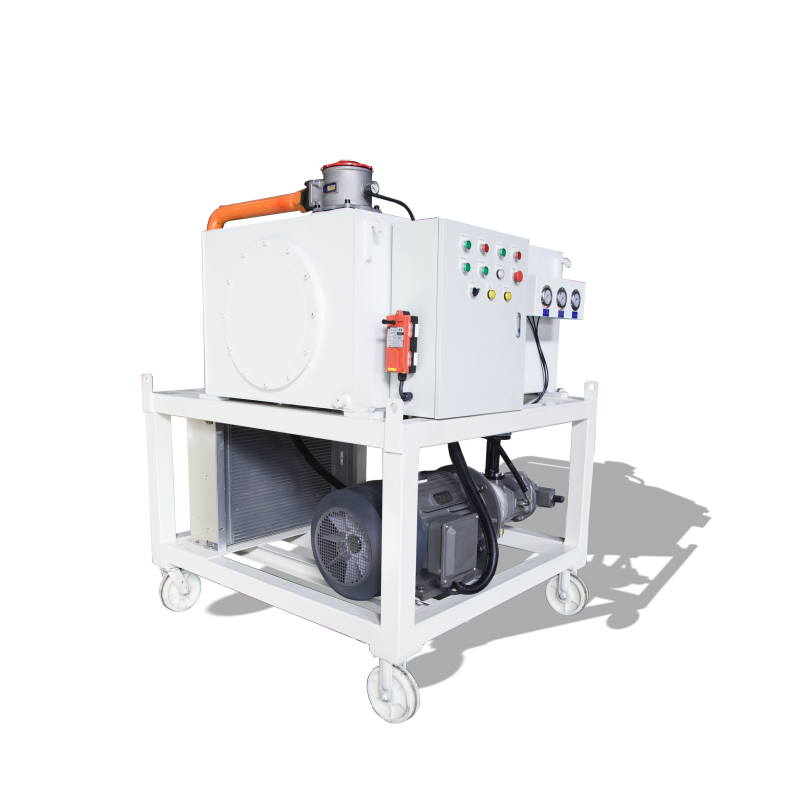
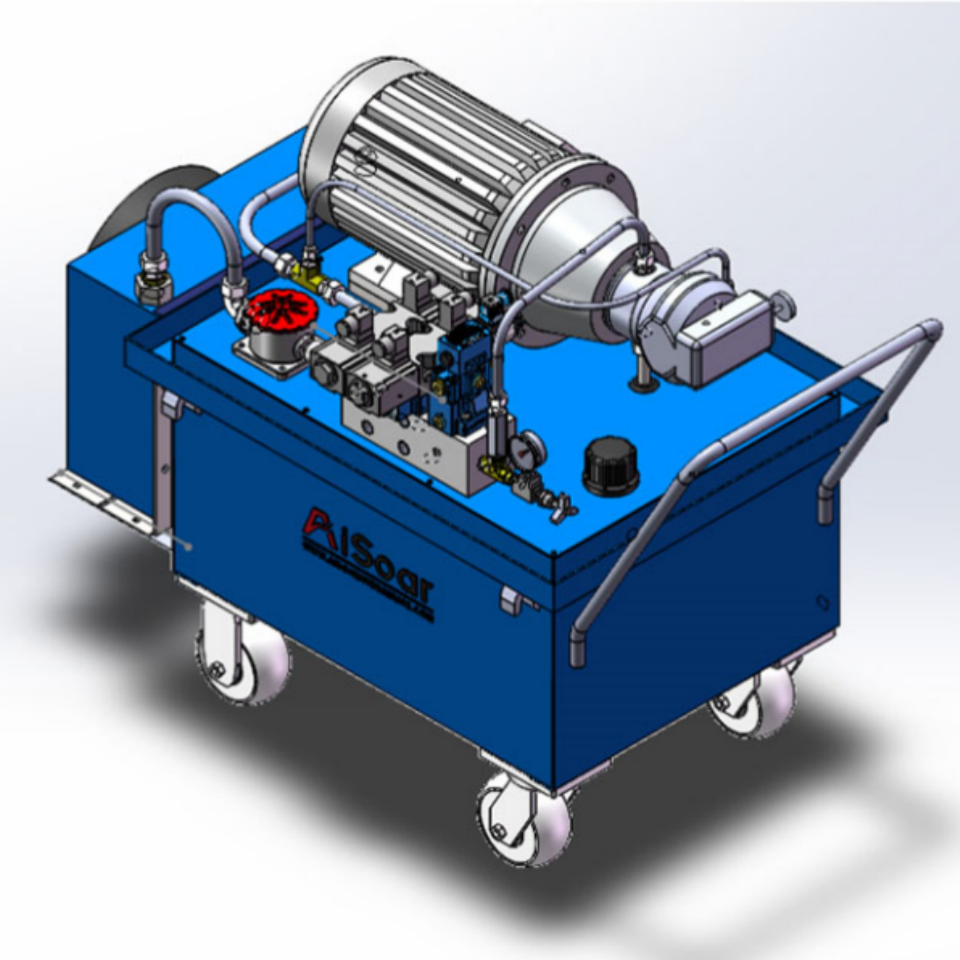
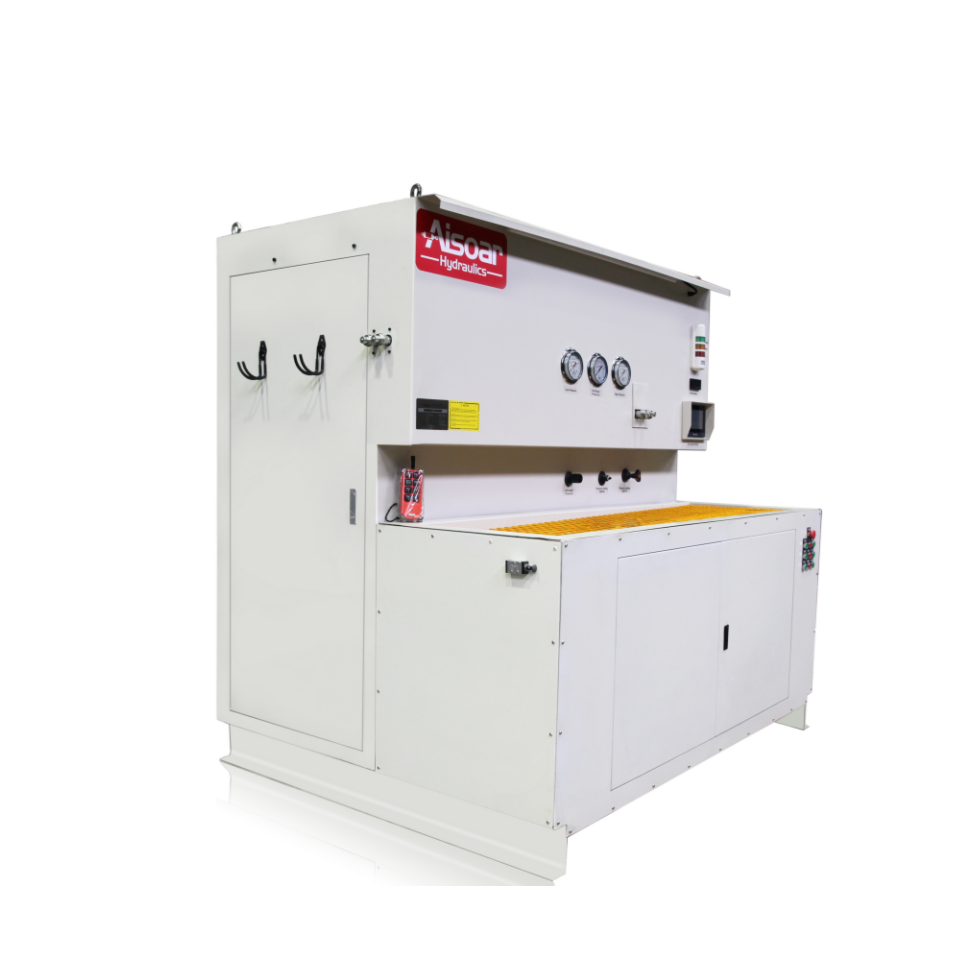
AISOAR provides customized hydraulic cylinder test bench solutions for cylinder manufacturers, repair workshops and industrial service facilities.
Test systems can be configured according to cylinder bore, rod diameter, stroke, overall length, weight, working pressure, test pressure, required flow, mounting type and automation requirements.
For a large-cylinder testing project, providing cylinder drawings and the required test procedure can help our engineering team evaluate the test-frame size, hydraulic system, fixtures, supports and control configuration.