A hydraulic cylinder test bench is a specialized testing system used to inspect the performance, sealing condition, pressure resistance, and movement quality of hydraulic cylinders. It helps manufacturers, repair workshops, and maintenance teams confirm whether a cylinder can work safely and reliably before delivery, reinstallation, or use on equipment.
Hydraulic cylinders are widely used in agricultural machinery, construction equipment, dump trailers, presses, lifting platforms, mining equipment, special vehicles, and industrial machines. Because they often work under high pressure and heavy load, even a small internal defect may cause oil leakage, weak force, unstable movement, or complete equipment failure. A hydraulic cylinder test bench helps detect these problems before the cylinder is installed on the machine.
A standard hydraulic cylinder test procedure usually includes function testing, proof pressure testing, and internal bypass testing. For example, one published cylinder test procedure describes cycling the cylinder through its full stroke, holding pressure after extension and retraction, checking for external leakage or deformation, and testing piston seal bypass on double-acting cylinders.
What Is a Hydraulic Cylinder Test Bench?
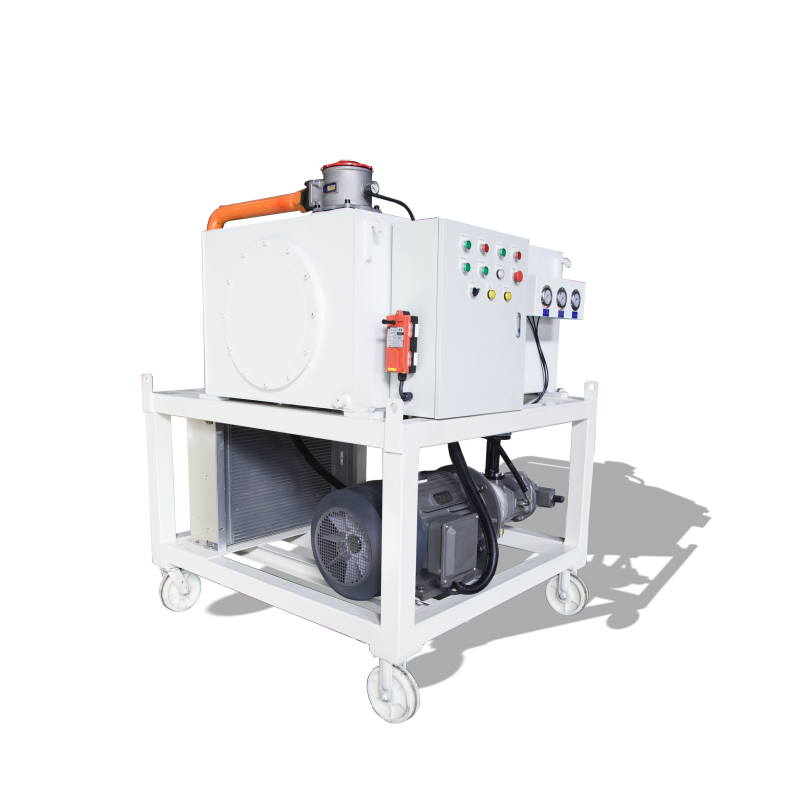
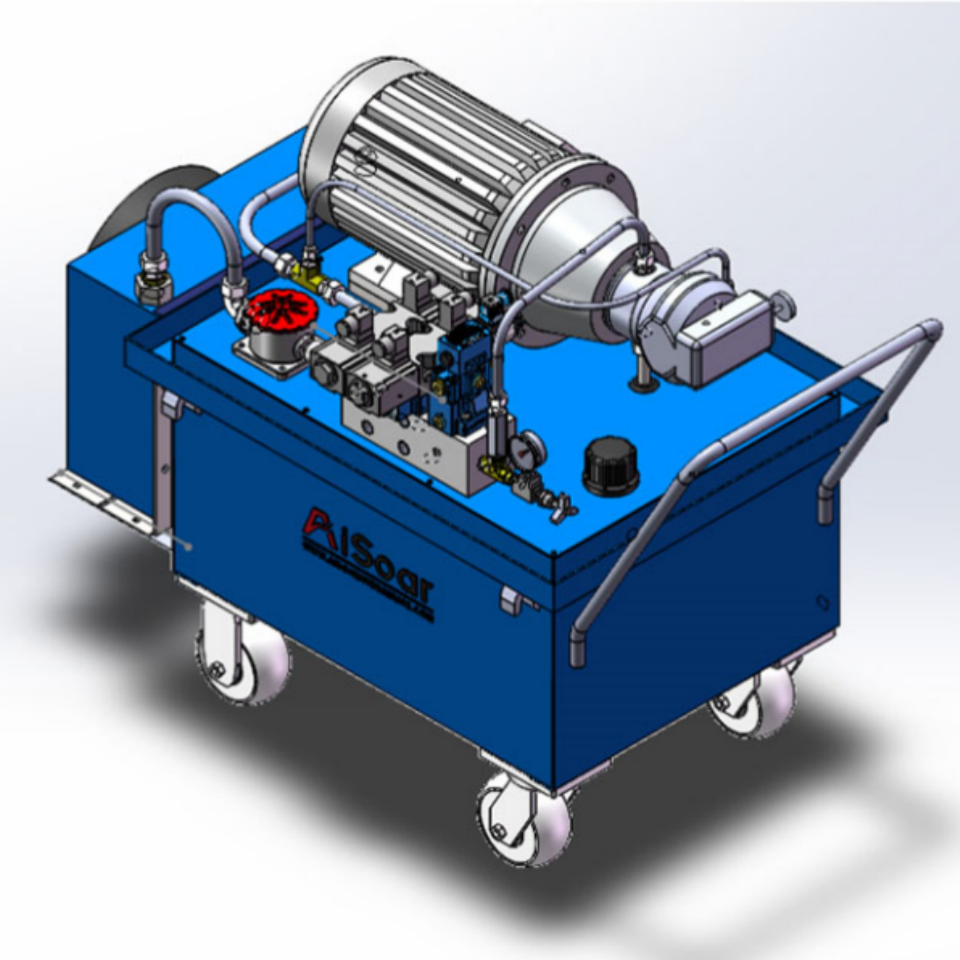
A hydraulic cylinder test bench is a hydraulic testing machine designed specifically for cylinder testing. It normally includes a hydraulic power unit, oil tank, pressure control valves, directional valves, pressure sensors, flow meters, temperature monitoring, test platform, cylinder mounting fixtures, hoses, quick couplings, and safety protection.
The tested cylinder is mounted on the test platform and connected to the hydraulic circuit. The test bench supplies controlled hydraulic oil to extend and retract the cylinder, apply test pressure, hold pressure, and check leakage. Depending on the configuration, the test bench can be manual, semi-automatic, PLC-controlled, or software-controlled.
For simple repair testing, a manual or semi-automatic test bench may be enough. For production quality control, batch testing, high-pressure testing, or export test reports, a PLC or software-controlled test bench is usually more suitable.
What Can a Hydraulic Cylinder Test Bench Test?
A hydraulic cylinder test bench can test several important items, including movement, pressure, leakage, stroke, sealing performance, and overall working condition.
The most common test items include:
- Cylinder extension and retraction testing
- Full stroke movement test
- Pressure testing
- Pressure holding test
- External leakage inspection
- Internal leakage or piston bypass test
- Rod seal and port sealing inspection
- Cushioning performance test
- Stroke verification
- Speed and smoothness observation
- Multi-cylinder synchronization test
- Test data recording and report export
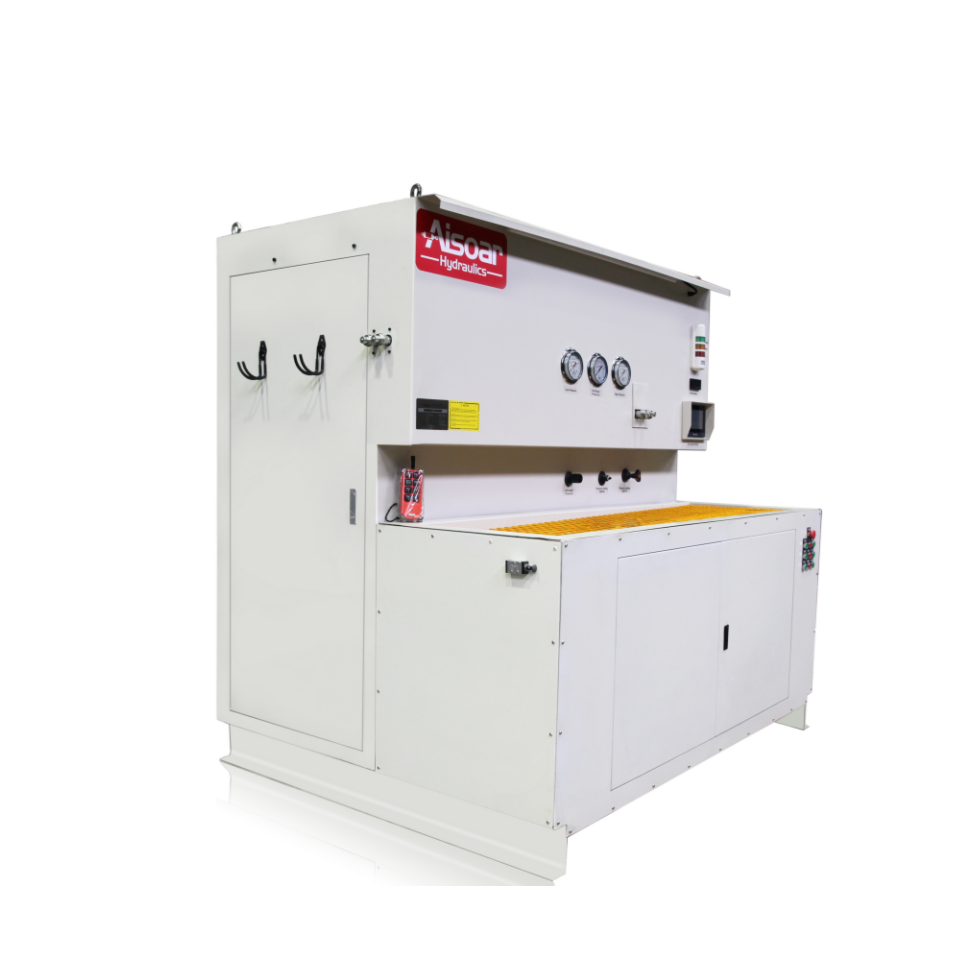
AiSoar’s hydraulic cylinder test bench series is designed for pressure testing, leakage inspection, cylinder extension and retraction testing, pressure holding, and optional PLC control, data recording, and report export.
Extension and Retraction Test
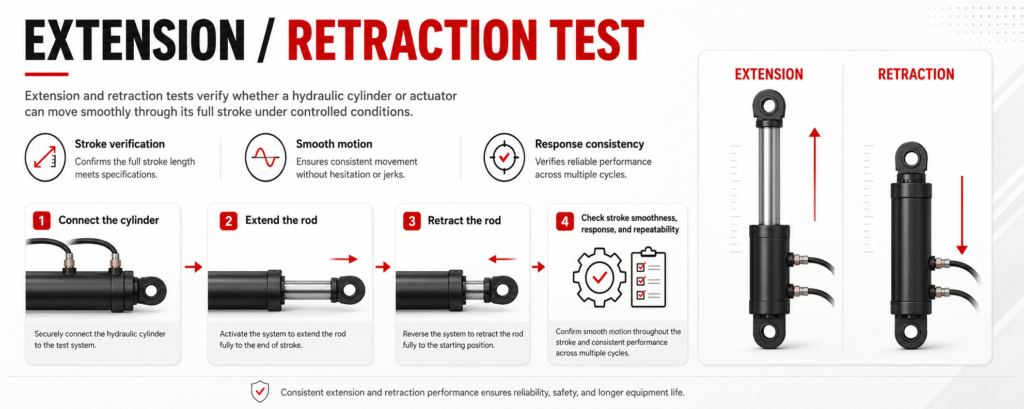
The extension and retraction test checks whether the cylinder can move smoothly through its full stroke. During this test, the operator connects the cylinder ports to the hydraulic test bench and operates the cylinder repeatedly.
This test helps identify problems such as abnormal friction, crawling, shaking, stalling, air inside the cylinder, poor assembly, rod bending, seal damage, or incorrect internal clearance. If the cylinder moves unevenly or produces abnormal noise, further inspection is needed.
For double-acting hydraulic cylinders, both extension and retraction directions are tested. For single-acting cylinders, the test method depends on the return method, such as gravity return, spring return, or external load return.
This is usually one of the first tests because it shows whether the cylinder can complete its basic movement before pressure holding or leakage testing is performed.
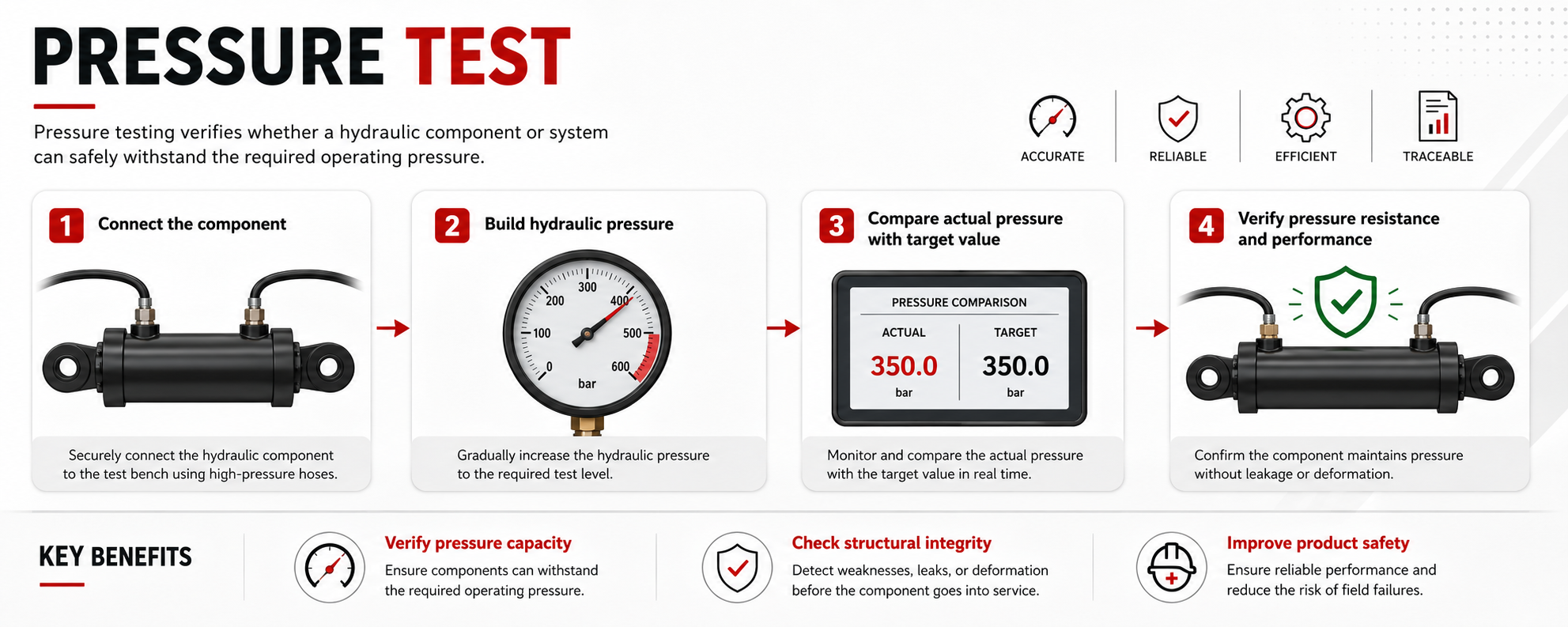
Pressure Test
Pressure testing checks whether the cylinder can withstand the required test pressure safely. The test pressure may be based on the working pressure, customer requirement, drawing specification, or internal quality standard.
During pressure testing, the hydraulic cylinder is pressurized at one or both chambers. The operator observes whether the cylinder body, welds, ports, seals, and end connections remain stable. If the cylinder shows external leakage, structural deformation, abnormal expansion, or unsafe behavior, it should not pass the test.
A hydraulic pressure test bench is commonly used to generate, control, and measure hydraulic pressure for proof pressure testing, leak testing, and functional testing of hydraulic components.
For cylinder manufacturers, pressure testing is an important final inspection step before shipment. For repair workshops, it confirms whether the repaired cylinder can safely return to service.
Pressure Holding Test
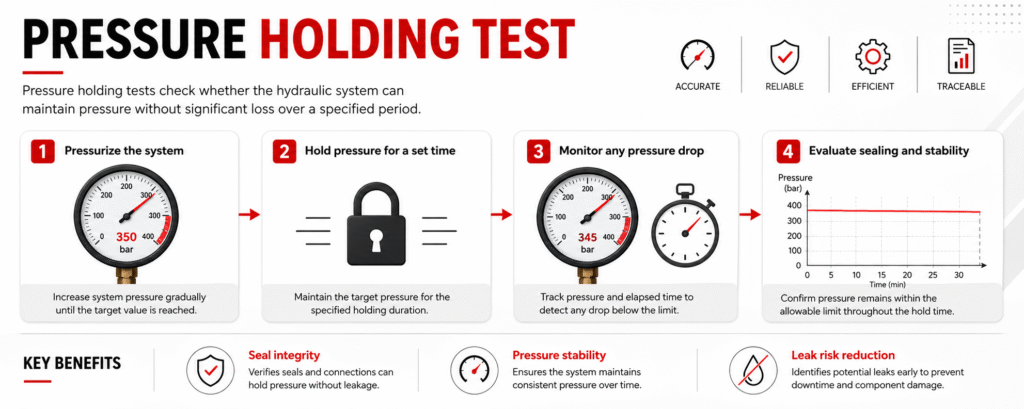
A pressure holding test checks whether the hydraulic cylinder can maintain pressure for a defined period of time. The cylinder is pressurized to the required level, and the pressure is held while the operator or control system monitors pressure stability.
If the pressure drops too quickly, it may indicate internal leakage, external leakage, seal failure, poor port sealing, valve leakage, or air trapped in the system. For double-acting cylinders, pressure holding is usually checked in both extension and retraction positions.
This test is especially important for cylinders used in lifting, clamping, pressing, supporting, or positioning applications. If the cylinder cannot hold pressure, it may drift under load or fail to maintain force during operation.
External Leakage Test
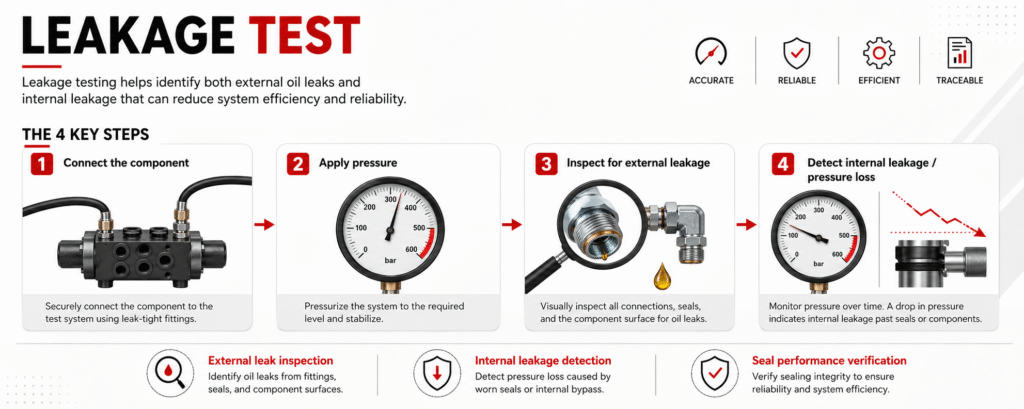
External leakage is visible leakage from the outside of the cylinder. It may appear around the rod seal, port connection, welded area, end cap, guide sleeve, or fitting connection.
During the test, the cylinder is pressurized and visually inspected. If oil appears outside the cylinder, the source of leakage should be identified and corrected.
External leakage may be caused by damaged seals, poor assembly, scratched sealing surfaces, loose fittings, welding defects, incorrect seal selection, or excessive pressure. A hydraulic cylinder test bench helps find these problems before the cylinder is delivered to the customer.
Internal Leakage or Piston Bypass Test
Internal leakage is different from external leakage. It happens inside the cylinder when oil passes across the piston seal from one chamber to the other. The oil may not leak outside, so the problem is harder to see.
A cylinder with internal leakage may still move, but it may lose force, drift under load, fail to hold pressure, or move slower than expected. Internal leakage is one of the most important problems a hydraulic cylinder test bench needs to detect.
In a typical internal bypass test for a double-acting cylinder, the cylinder is fully extended or retracted, pressure is applied to one side, and the opposite port is checked for bypass flow. Excessive bypass flow indicates piston seal leakage.
This test is very useful for both new cylinder inspection and repaired cylinder verification.
Stroke and Movement Quality Test
A hydraulic cylinder test bench can also verify whether the cylinder stroke matches the required specification. If the stroke is too short or too long, the cylinder may not fit the machine or may cause mechanical interference.
The movement quality should also be checked. A good hydraulic cylinder should move smoothly without obvious vibration, crawling, sudden speed changes, or abnormal sound. Poor movement may be related to air in the system, seal friction, poor surface finish, rod bending, contamination, or incorrect assembly.
For long-stroke cylinders, the test bench should have enough platform length and support points to prevent unsafe movement or rod deflection during testing.
Cushioning Performance Test
Some hydraulic cylinders include cushioning at the end of stroke to reduce impact. A test bench can help check whether the cushion works correctly during extension or retraction.
If the cushioning is too weak, the cylinder may hit the end position too hard. If the cushioning is too strong, the cylinder may slow down too early or fail to complete movement efficiently.
Cushioning performance is especially important for cylinders used in equipment with frequent cycling, heavy load, or high-speed movement.
Multi-Cylinder Synchronization Test
Some machines use two or more cylinders working together. In these applications, synchronization is very important. If the cylinders move at different speeds, the machine may tilt, jam, or generate uneven force.
A hydraulic cylinder test bench can be designed to test two, three, or more cylinders at the same time. The system can monitor whether the cylinders extend and retract consistently under controlled pressure and flow conditions.
This type of test is useful for lifting equipment, platforms, presses, agricultural machinery, and special vehicles.
How Does a Hydraulic Cylinder Test Bench Work?
A typical hydraulic cylinder testing process includes several steps.
First, the cylinder is mounted on the test platform. The mounting brackets or supports should match the cylinder size, stroke, weight, and connection type. Large-bore or long-stroke cylinders may require heavy-duty support frames and additional safety protection.
Second, the hydraulic hoses are connected to the cylinder ports. Quick couplings can improve testing efficiency, especially in batch production or repair workshops where cylinders need to be changed frequently.
Third, the operator fills the circuit with oil and removes air from the system. Air inside the cylinder or pipeline can affect movement stability and test accuracy.
Fourth, the cylinder is cycled through extension and retraction. This checks basic movement and helps remove trapped air.
Fifth, the test bench applies the required pressure and performs pressure holding, leakage inspection, internal bypass testing, and other required tests.
Finally, the test result is recorded. On a manual test bench, the operator may record the data manually. On a PLC or software-controlled test bench, pressure, flow, temperature, leakage, time, and other parameters can be recorded automatically. Advanced systems can also export test reports for quality traceability.
Manual vs PLC-Controlled Hydraulic Cylinder Test Bench
A manual hydraulic cylinder test bench is suitable for simple inspection, maintenance workshops, and low-frequency testing. It is easier to operate and usually requires a lower investment.
A PLC-controlled hydraulic cylinder test bench provides better repeatability. It can run fixed test procedures, reduce operator error, and improve testing efficiency.
A software-controlled hydraulic cylinder test bench is more suitable for manufacturers that need data recording, real-time curves, automatic test processes, report export, user permissions, and quality traceability.
For companies producing or repairing large quantities of cylinders, automation can improve consistency and reduce manual workload.
How to Choose a Hydraulic Cylinder Test Bench
Before choosing a hydraulic cylinder test bench, customers should confirm several key parameters:
- Maximum cylinder bore
- Maximum rod diameter
- Maximum stroke
- Maximum retracted and extended length
- Maximum test pressure
- Required flow rate
- Cylinder weight
- Single-acting or double-acting cylinder
- Required test items
- Manual, PLC, or software control
- Data recording and report export requirements
- Space and layout in the workshop
A small integrated test bench may be suitable for standard cylinders and repair testing. A larger split-type test bench may be better for heavy-duty, large-bore, or long-stroke cylinders. AiSoar’s product range includes integrated and split-type hydraulic cylinder test bench solutions, with options for different pressure ranges, flow rates, automation levels, and testing processes.
AiSoar Hydraulic Cylinder Test Bench Solutions
AiSoar Hydraulics provides standard and customized hydraulic cylinder test bench solutions for cylinder manufacturing, repair workshops, maintenance centers, and quality inspection departments. The test bench can be configured according to cylinder size, stroke length, pressure range, flow rate, control method, testing process, safety requirements, and data recording needs.
Available configurations can include integrated design, split-type structure, PLC control, software monitoring, pressure testing, leakage inspection, cylinder extension and retraction testing, pressure holding, cooling, filtration, quick connections, and report export.
A properly designed hydraulic cylinder test bench helps detect cylinder problems before installation, reduce after-sales failure, improve production quality, and provide more reliable hydraulic cylinders to customers.
If you need to test hydraulic cylinders under controlled pressure, flow, stroke, and working conditions, AiSoar can help design a suitable hydraulic cylinder test bench according to your cylinder specifications and testing requirements.