When selecting a hydraulic power source, pressure and flow are only part of the specification. The manufacturer must also understand how long the equipment will operate, how frequently the motor will start, and how much rest time is available between operating cycles.
These operating conditions are described by the hydraulic power unit duty cycle.
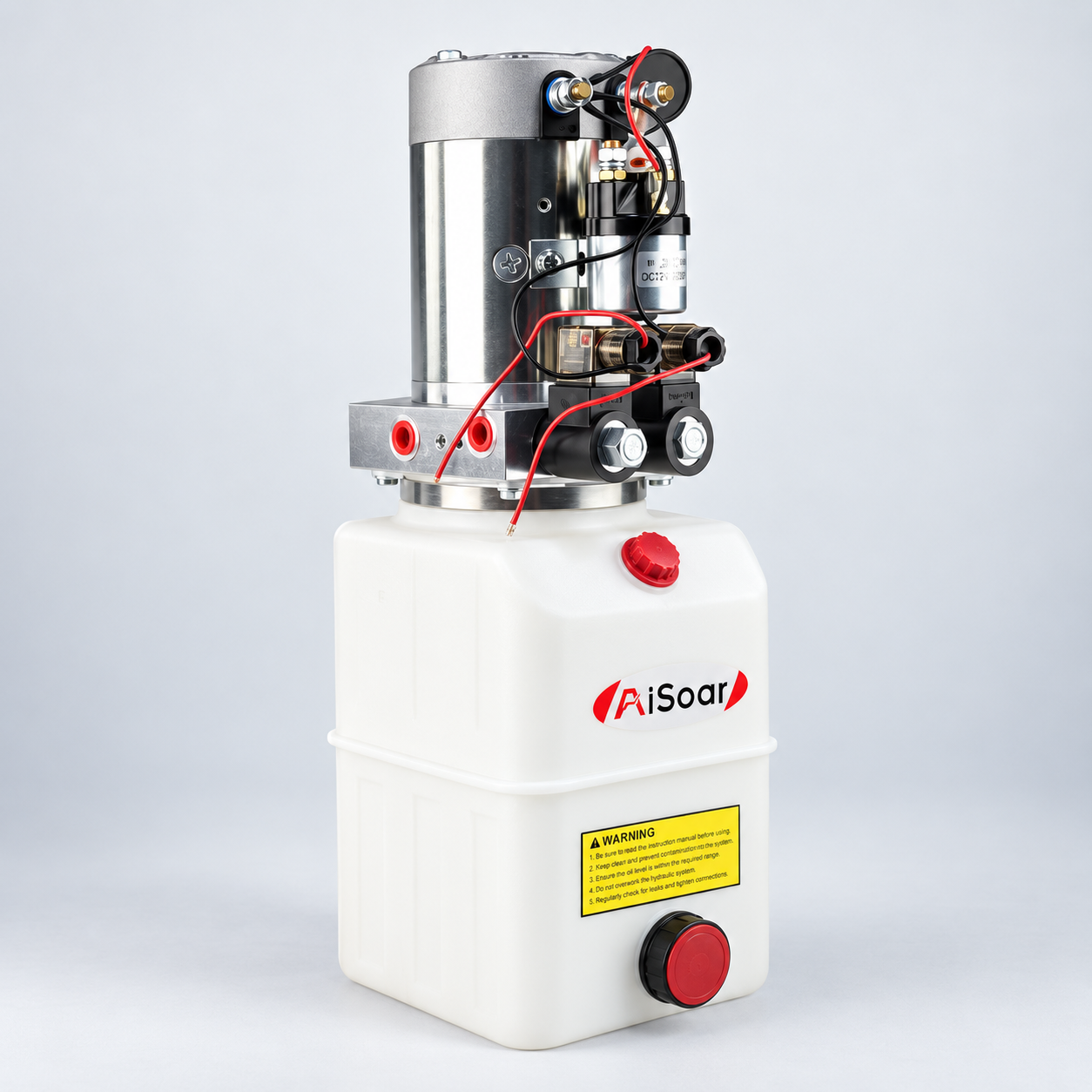
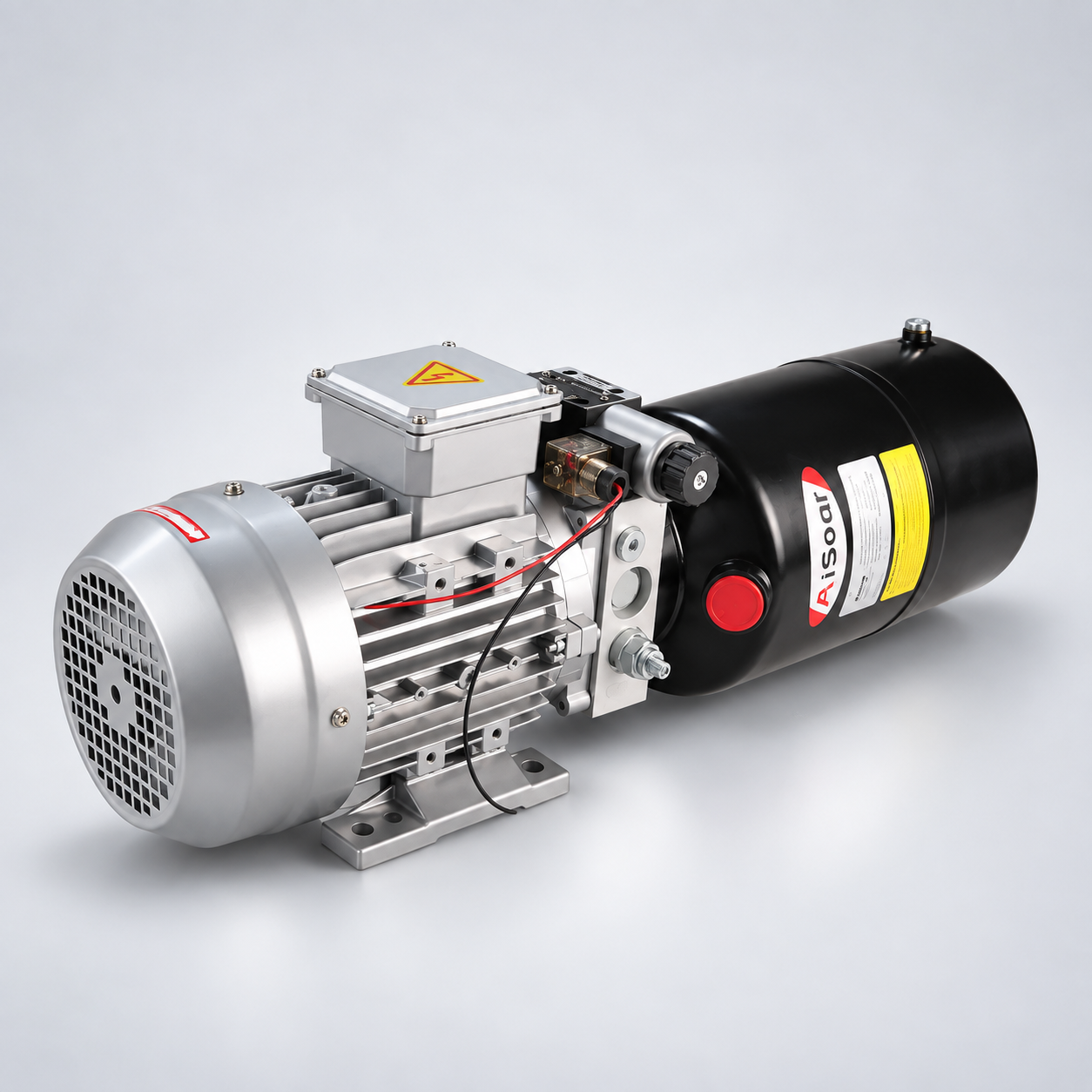
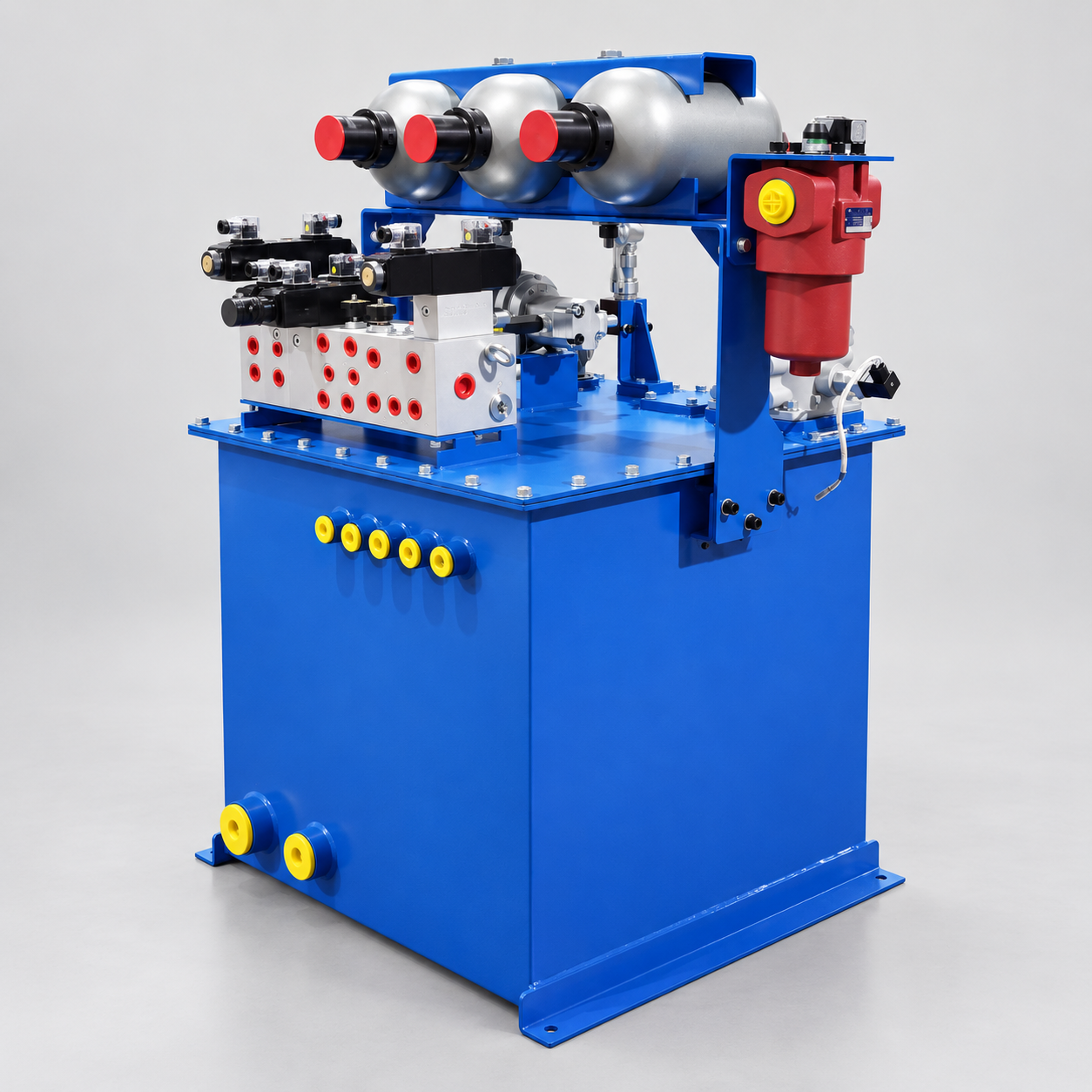
Duty cycle is especially important because different hydraulic power sources are designed for different operating patterns. A Mini Hydraulic Power Unit is commonly used for short, intermittent movements, while an Industrial Hydraulic Power Unit, also called a Hydraulic Station or Hydraulic Power Station, may be designed to operate for extended periods or throughout an entire production shift.
However, product size alone does not determine duty cycle. The motor, pump, reservoir, valves, cooling system, and control circuit must all be selected according to the actual machine sequence.
What Does Hydraulic Power Unit Duty Cycle Mean?
Hydraulic power unit duty cycle describes the relationship between operating time and the total duration of one complete working cycle.
It can be calculated as:
Duty Cycle (%) = Operating Time ÷ Total Cycle Time × 100
In this calculation, “operating time” must be clearly defined. It may refer to motor energized time, pump running time, or the period during which the pump is under hydraulic load. A motor running while the pump is unloaded does not create the same thermal load as operation at full pressure. For accurate selection, the manufacturer should review both the motor duty cycle and the hydraulic load profile.
For example, when a motor runs for one minute and then remains stopped for nine minutes, the duty cycle is:
1 ÷ 10 × 100 = 10%
This is a 10% intermittent duty cycle.
The percentage alone is not enough to select a motor or hydraulic system. A complete duty-cycle description should also include:
- Maximum running time during each cycle
- Resting time between cycles
- Number of motor starts per hour
- Pressure required during operation
- Time spent at maximum pressure
- Loaded and unloaded operating periods
- Daily operating hours
- Ambient temperature
For example, six seconds of operation every minute and six minutes of operation every hour both equal a 10% duty cycle. However, they create very different motor starting frequencies and thermal conditions.
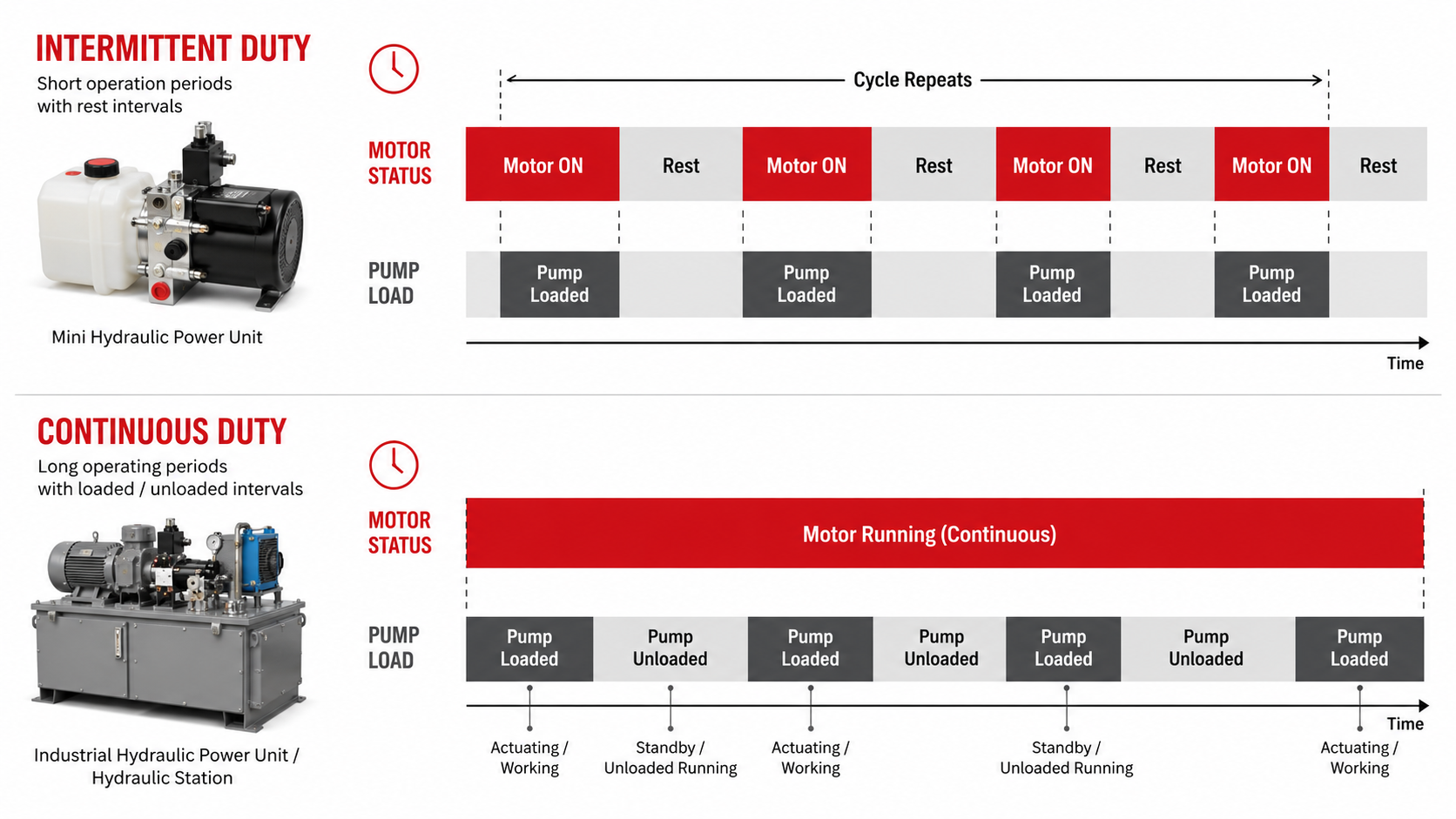
Motor duty classifications also distinguish between continuous and intermittent operation. Under IEC duty terminology, S1 refers to continuous operation at a constant load for long enough to reach thermal equilibrium. S3 refers to repeated periods of constant-load operation followed by de-energized rest, provided that starting does not significantly affect motor temperature rise. If frequent or prolonged starts contribute materially to heating, S4 or another applicable motor duty classification may need to be considered.
Intermittent Duty in a Mini Hydraulic Power Unit
A Mini Hydraulic Power Unit is a compact hydraulic power source commonly used when a machine requires hydraulic movement for a short period and then remains inactive.
Typical applications include:
- Dump trailers
- Tail lifts
- Dock levelers
- Scissor lifts
- Vehicle lifting equipment
- Hydraulic jacks
- Material-handling platforms
- Hydraulic gates
- Small clamping devices
The exact motor operating sequence depends on the hydraulic circuit. In many single-acting power-up and gravity-down applications, the motor runs only during lifting, while lowering is controlled through the return circuit with the motor stopped. In double-acting systems, the motor may operate during both extension and retraction. After completing the movement, the motor normally stops and has time to cool before the next cycle.
This intermittent operating pattern allows a Mini Hydraulic Power Unit to use a compact motor and relatively small reservoir. It can therefore provide high hydraulic power from a small installation space.
However, the permitted running time must not be exceeded.
A Mini Hydraulic Power Unit rated for short intermittent operation should not automatically be expected to run continuously. Extending the motor operating time may cause excessive winding temperature, reduced motor life, oil overheating, or electrical protection trips.
The following conditions should be confirmed when selecting an intermittent-duty Mini Hydraulic Power Unit:
- Motor voltage and power
- Maximum operating time per cycle
- Resting time between operations
- Starts per hour
- Pump displacement
- Peak and normal working pressure
- Reservoir capacity
- DC motor current demand
- Ambient temperature
- Installation ventilation
A 10% or 20% duty rating must always be connected to a defined operating cycle. It should not simply be interpreted as permission to operate for 10% or 20% of an hour in any pattern.
Continuous Duty in an Industrial Hydraulic Power Unit
An Industrial Hydraulic Power Unit or Hydraulic Station is generally used for machinery that operates for longer periods, performs frequent cycles, or remains available throughout a production shift.
Typical applications include:
- Hydraulic presses
- Industrial production lines
- Hydraulic test benches
- Machine tools
- Recycling and waste-processing equipment
- Metal-forming machinery
- Process equipment
- Large material-handling systems
A continuous-duty Industrial Hydraulic Power Unit requires more than a continuous-duty electric motor. The pump, reservoir, filtration system, valves, hoses, manifold, cooler, and control system must also be suitable for extended operation.
Hydraulic pump specifications normally distinguish between continuous working pressure and intermittent or peak pressure. The maximum or peak pressure rating should not be treated as the normal continuous operating pressure. Continuous operation at excessive pressure can increase wear, internal leakage, noise, oil temperature, and the risk of premature pump failure.
For continuous operation, the Hydraulic Station should be evaluated according to:
- Motor continuous-duty rating
- Pump continuous pressure and speed
- Average and peak hydraulic power
- Reservoir heat-dissipation capacity
- Return and pressure filtration
- Hydraulic oil temperature
- Valve pressure losses
- Cooler capacity
- Noise requirements
- Standby operating condition
Continuous duty does not necessarily mean that the pump must remain fully loaded at maximum pressure all the time.
During waiting, clamping, or pressure-holding stages, the system may use an unloading circuit, pressure-compensated pump, accumulator, or variable-speed pump drive to reduce unnecessary energy consumption.
Variable-speed control can reduce motor speed when full flow is not required. This limits excess flow across relief valves and can reduce heat generation during pressure-holding or partial-load periods.
Mini Hydraulic Power Unit vs Industrial Hydraulic Power Unit
| Selection Factor | Typical Intermittent-Duty Mini Hydraulic Power Unit | Typical Continuous-Duty Industrial Hydraulic Power Unit |
|---|---|---|
| Operating pattern | Short operating periods with defined rest time | Frequent cycling or extended operation |
| Common motor type | Compact DC or AC motor | Industrial AC motor |
| Motor duty | Often intermittent and application-specific | Usually S1 or another engineered duty rating |
| Reservoir | Compact, application-sized reservoir | Engineered according to flow and heat balance |
| Cooling | Often natural cooling for short cycles | Thermal analysis; active cooling may be required |
| Control method | Start-stop or simple valve control | Unloading, pressure compensation or variable-speed control |
| Typical applications | Trailers, lifts, jacks and compact equipment | Presses, production lines and hydraulic test benches |
| Main design risk | Excessive operating time or frequent starts | Continuous heat generation and standby losses |
This table represents common applications rather than an absolute rule.
A Mini Hydraulic Power Unit can be engineered for longer operating periods when the motor, pump, tank, and cooling arrangement support them. An Industrial Hydraulic Power Unit may also operate intermittently when used in a machine with low production frequency.
The correct classification should therefore be based on both product construction and actual operating conditions.
How Duty Cycle Affects Hydraulic System Design
Motor Selection
The motor must be selected according to running time, load, starting frequency, voltage, ambient temperature, and available cooling.
A motor may be capable of producing the required peak power but still be unsuitable if it cannot dissipate heat during the actual machine cycle.
For Mini Hydraulic Power Units using DC motors, current draw and battery capacity must also be checked. Frequent starts or extended high-pressure operation can create high electrical demand.
For an Industrial Hydraulic Power Unit, the motor should normally be rated for the required continuous or periodic operating condition.
Pump Selection
The pump must match both the hydraulic output and operating duration.
Important pump data include:
- Continuous pressure
- Intermittent or peak pressure
- Rated speed
- Maximum speed
- Fluid viscosity range
- Inlet pressure requirement
- Expected service life
- Hydraulic fluid compatibility
Using the pump’s peak pressure rating as its normal operating pressure can increase wear, leakage, noise, and temperature.
Reservoir and Oil Temperature
A reservoir does more than store hydraulic oil. It also supports heat transfer, air separation, contamination settlement, and stable pump inlet conditions.
A compact reservoir may be suitable for a short-cycle Mini Hydraulic Power Unit because the system stops before significant heat accumulates.
An Industrial Hydraulic Power Unit requires a thermal evaluation based on generated heat, reservoir surface area, ambient temperature, hydraulic efficiency, and daily operating hours.
A larger tank does not automatically solve an overheating problem. When continuous energy losses exceed the natural heat-dissipation capacity, an air-oil or water-oil cooler may be required.
High oil temperature can reduce viscosity and accelerate oil deterioration. When full motor speed and pump flow are required for only part of the machine cycle, an unloading circuit or variable-speed pump control can reduce standby losses and unnecessary heat generation.
Standby and Pressure-Holding Control
Some machines require the actuator to hold pressure for a long period without movement.
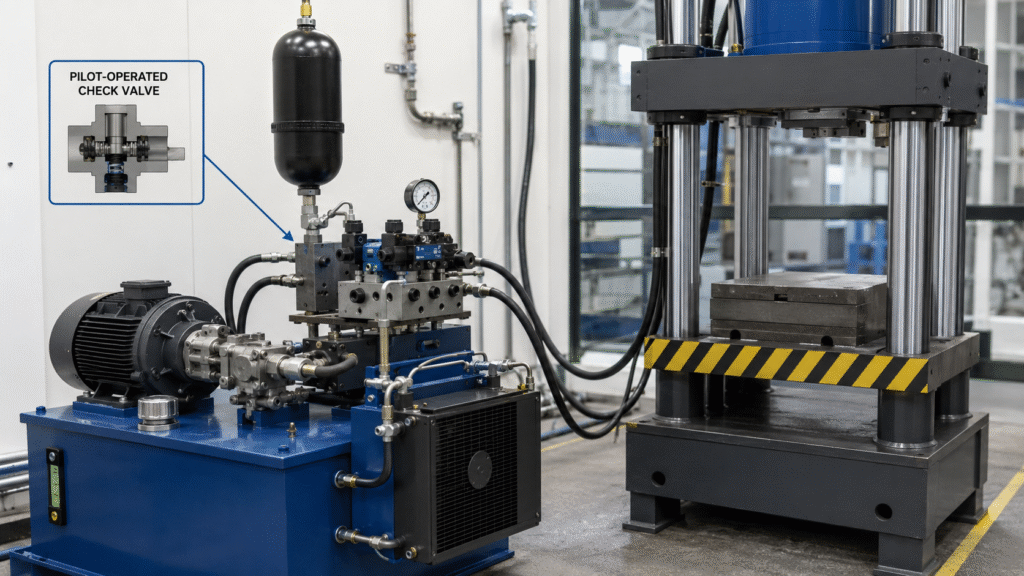
In this condition, the pump should not necessarily remain continuously loaded against the relief valve.
Depending on the application, the circuit may use:
- Pilot-operated check valves
- Low-leakage cartridge valves
- Hydraulic accumulators
- Pump-unloading valves
- Pressure-compensated pumps
- Variable-speed pump control
These solutions can maintain the required machine condition while reducing energy use and heat generation.
Example: Calculating a Mini Hydraulic Power Unit Duty Cycle
| Machine Step | Duration | Motor Condition | Hydraulic Condition |
|---|---|---|---|
| Lift the platform | 8 seconds | Running | Pump loaded |
| Hold the platform | 20 seconds | Stopped | Pressure held by valve |
| Gravity lowering | 12 seconds | Stopped | Return valve open |
| Waiting time | 60 seconds | Stopped | System at rest |
Information Needed to Select the Correct Duty Cycle
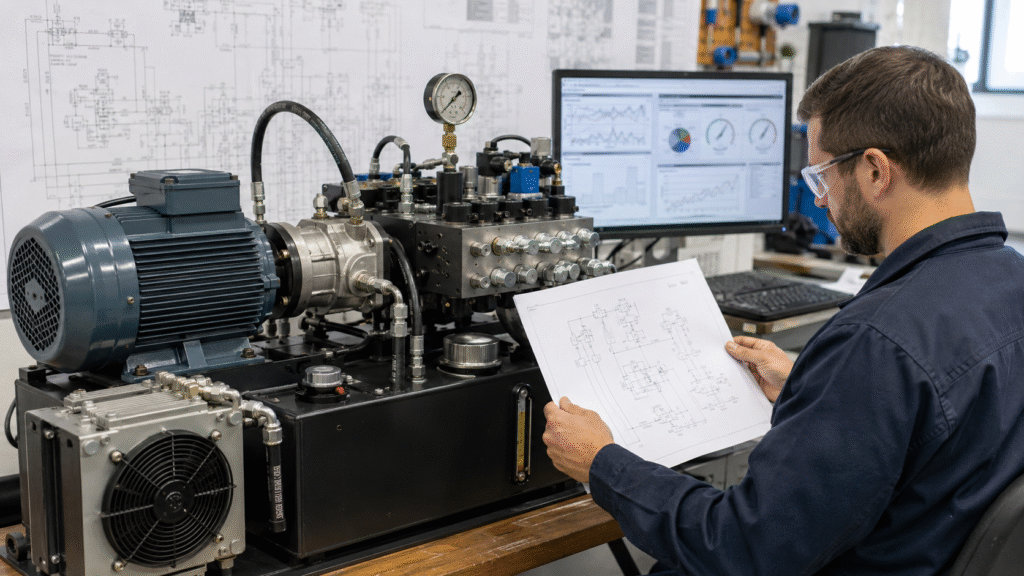
Before requesting a Mini Hydraulic Power Unit or Industrial Hydraulic Power Unit, provide the following information:
- Working pressure
- Maximum pressure
- Required flow rate
- Motor voltage and frequency
- Operating time per cycle
- Resting time per cycle
- Cycles per hour
- Maximum consecutive running time
- Daily operating hours
- Time spent at maximum pressure
- Pressure-holding requirements
- Ambient temperature
- Hydraulic oil type
- Installation space
- Cooling requirements
- Preferred control method
A written machine sequence is often more useful than a single duty-cycle percentage.
For each machine step, identify the required pressure, flow, duration, and whether the pump is loaded, unloaded, or stopped.
Common Duty-Cycle Selection Mistakes
Common mistakes include:
- Using a Mini Hydraulic Power Unit continuously without checking its motor rating
- Selecting an Industrial Hydraulic Power Unit based only on peak pressure and flow
- Ignoring the number of motor starts per hour
- Using pump peak pressure as continuous pressure
- Keeping the pump loaded during long standby periods
- Assuming a large reservoir will prevent all overheating
- Ignoring pressure losses through valves and filters
- Failing to consider high ambient temperature
- Describing duty cycle only as a percentage
These errors can result in motor overheating, unstable oil viscosity, premature pump wear, seal damage, high energy consumption, and unplanned machine shutdowns.
How to Select a Mini or Industrial Hydraulic Power Unit
Selecting the correct hydraulic power source starts with the actual machine cycle. A Mini Hydraulic Power Unit is generally suitable for compact equipment requiring short hydraulic movements with defined rest periods. An Industrial Hydraulic Power Unit or Hydraulic Station is more appropriate when the machine requires frequent cycling, extended operation, higher flow, advanced filtration, or active cooling.
When requesting a quotation, provide the operating time, rest time, starts per hour, pressure and flow required at each machine step, pressure-holding period, ambient temperature, and maximum consecutive running time. This information allows the motor, pump, reservoir, valves, and cooling arrangement to be selected according to the actual operating condition.
Frequently Asked Questions
Can a Mini Hydraulic Power Unit Run Continuously?
A standard intermittent-duty Mini Hydraulic Power Unit should not run continuously unless its motor, pump, reservoir, electrical system, and thermal capacity have been specifically designed or verified for continuous operation.
What Is a Typical Mini Hydraulic Power Unit Duty Cycle?
There is no single duty cycle for every Mini Hydraulic Power Unit. The permitted operating time depends on the motor, load, pressure, reservoir, ambient temperature, and rest period. The rated cycle should be confirmed for each model.
Can an Industrial Hydraulic Power Unit Operate Continuously?
Yes. An Industrial Hydraulic Power Unit can be designed for continuous operation when its motor, pump, reservoir, filtration, cooling system, and controls are correctly selected.
Does a Continuous-Duty Hydraulic Station Always Need a Cooler?
Not always. The need for a cooler depends on the system’s heat generation and natural heat-dissipation capacity. A thermal calculation or operating temperature test should be used to determine whether active cooling is required.
Is Duty Cycle Only Related to the Electric Motor?
No. Duty cycle also affects the pump, valves, solenoid coils, reservoir, hydraulic oil, filters, cooler, electrical controls, and overall system temperature.
Conclusion
Hydraulic power unit duty cycle must be evaluated before selecting the motor, pump, reservoir, and control circuit.
A Mini Hydraulic Power Unit is usually suited to short, intermittent operations in compact lifting and mobile equipment. An Industrial Hydraulic Power Unit or Hydraulic Station is more suitable for machinery requiring frequent cycles, long operating periods, or continuous production.
However, the product name alone does not determine the correct duty cycle.
The manufacturer should review operating time, resting time, starts per hour, pressure, flow, ambient temperature, standby conditions, and maximum consecutive running time. A clearly defined machine sequence makes it possible to design a hydraulic power source that is reliable, energy-efficient, and properly matched to the application.