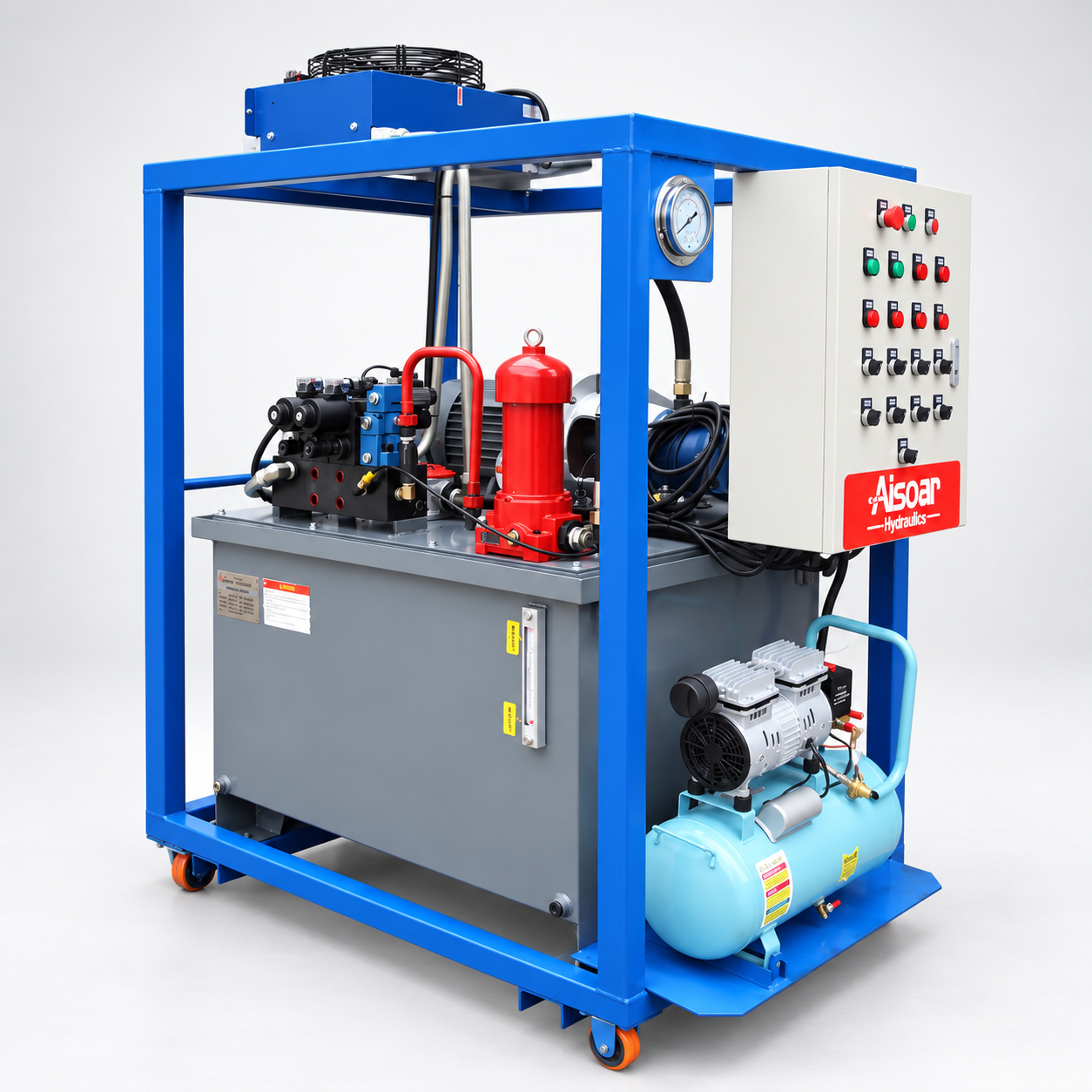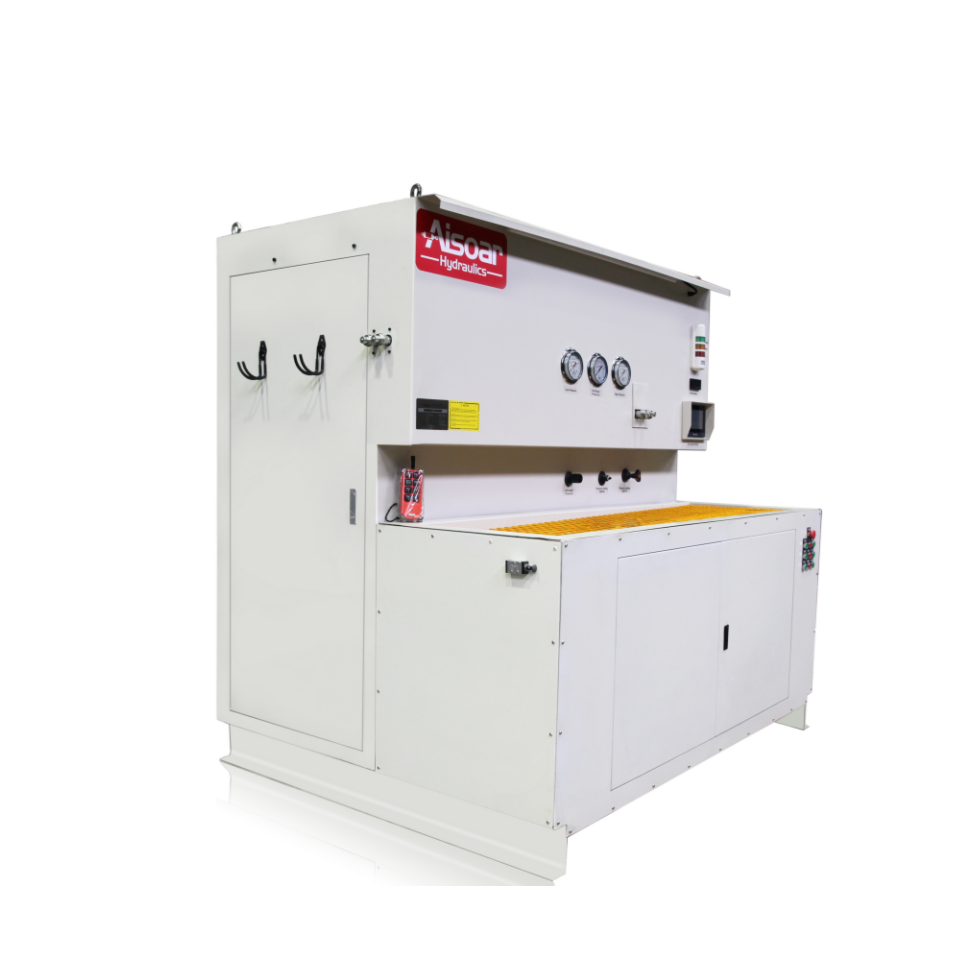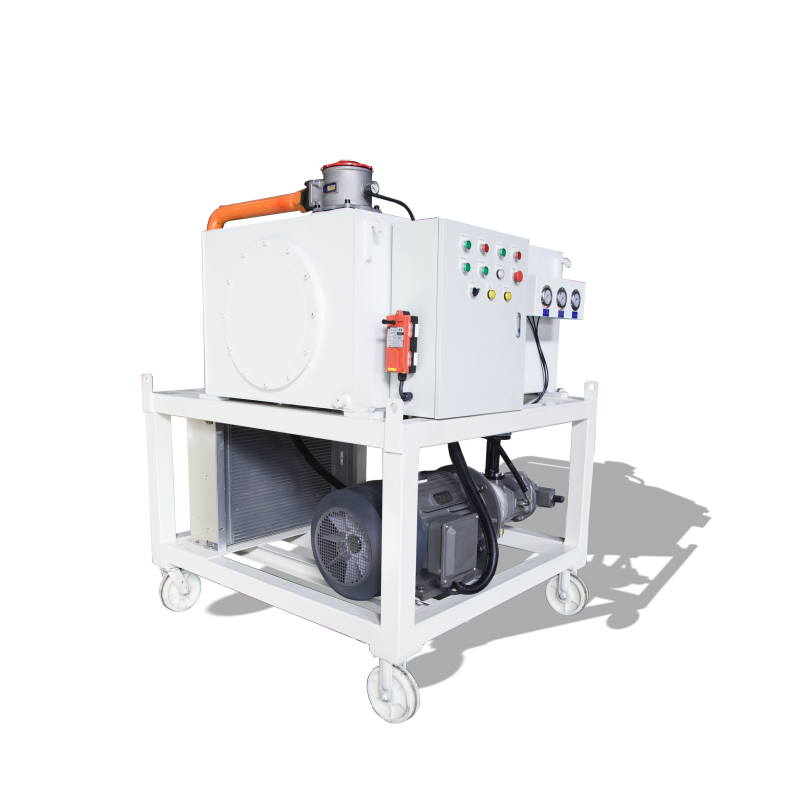
A hydraulic test bench used in a repair workshop and one used for production testing may perform many of the same basic functions, such as pressure testing, leakage testing and functional cycling. However, the way these test benches are configured can be very different.
Repair workshops usually need flexibility because they handle cylinders, pumps or valves from different manufacturers and with different dimensions. Production environments, by contrast, normally test repeated product types and place greater emphasis on cycle time, automation, data consistency and traceability.
Choosing the right hydraulic test bench therefore depends not only on maximum pressure or flow, but also on what is being tested, how often it is tested and how the results need to be recorded.
Why Repair and Production Testing Need Different Hydraulic Test Benches
The main difference is the testing objective.
A repair workshop needs to answer a practical question: Has the repaired hydraulic component been restored to acceptable working condition? The test bench must therefore be able to adapt to different component sizes, mounting arrangements and test requirements.
A manufacturer performing production testing has a different objective. The question is usually: Does every finished product meet the same defined test standard before shipment? This requires repeatability, standardized procedures and reliable test records.
Because the objectives are different, the ideal fixture design, automation level, software and reporting functions can also be different.
Hydraulic Test Bench Requirements for Repair Workshops
Repair workshops often test a wide variety of hydraulic cylinders, pumps, valves or other components. One cylinder may be relatively small, while the next may have a different stroke, port configuration or mounting type.
For this reason, fixture flexibility is usually one of the most important requirements. Adjustable supports, interchangeable adapters, flexible hose connections and multiple mounting options can make it easier to test different repaired components without repeatedly modifying the machine.
Manual or semi-automatic operation may also be suitable for many repair facilities. The technician often needs to observe the repaired component closely, adjust the test sequence according to the component type and respond to unexpected behavior during testing.
Typical testing may include low-pressure cycling, functional checks, working-pressure testing, pressure holding and internal or external leakage evaluation. The exact sequence may vary from one repair job to another.
Repair workshops may still require test reports, especially when customers request evidence that a repaired cylinder or pump has passed testing. However, the reporting system normally needs to remain flexible because the products being tested are not always identical.
Hydraulic Test Bench Requirements for Production Testing
Production testing usually involves higher repetition.
A hydraulic cylinder manufacturer, for example, may test dozens or hundreds of cylinders from the same product family. In this situation, manually adjusting every test parameter can reduce efficiency and create inconsistencies between operators.
A PLC-controlled hydraulic test bench can automate predefined sequences such as cycling, pressure increase, pressure holding and leakage evaluation. Test parameters can be stored as recipes so that operators can select the correct program for each cylinder model.
Automation also improves consistency. The same pressure ramp, holding time and acceptance criteria can be applied to every product in the batch.
Data recording becomes more important as production volume increases. Pressure, temperature, leakage values and test duration may need to be linked with a serial number, job number or batch number. The software can then generate a standardized result or PASS/FAIL decision.
This type of traceability is particularly useful when test results must be reviewed later for quality control, customer documentation or warranty investigation.
Repair Workshop vs Production Hydraulic Test Bench
The most important differences can be summarized as follows:
| Design Factor | Repair Workshop | Production Testing |
|---|---|---|
| Main goal | Verify repaired component condition | Verify every finished product consistently |
| Product variety | Usually high | Usually lower and more repetitive |
| Fixtures | Flexible and adjustable | Standardized or product-specific |
| Test sequence | Often varies by job | Usually predefined |
| Automation | Manual or semi-automatic often sufficient | PLC / automatic testing more valuable |
| Test frequency | Variable | High and repetitive |
| Data recording | Basic or job-specific | Detailed and standardized |
| Test reports | Repair/service evidence | Production quality record |
| Traceability | Useful but not always essential | Often important |
| Main priority | Flexibility | Consistency and productivity |
Neither configuration is automatically better. The correct test bench depends on the user’s actual workflow.
A repair shop with many different cylinder sizes may gain more value from adjustable fixtures and flexible controls than from a highly automated fixed test sequence. A manufacturer testing one cylinder family repeatedly may gain much more from automation, standardized fixtures and automatic reporting.
How Much Automation Does the Hydraulic Test Bench Need?
Automation level is one of the most important decisions when configuring a hydraulic test bench.
A manual system gives the operator direct control over valves, pressure and test steps. This can be suitable for low-volume repair work where every test may be slightly different.
A semi-automatic system may automate pressure control or data acquisition while still allowing the operator to determine the overall sequence. This provides a useful balance between flexibility and repeatability.
A fully PLC-controlled test bench is more appropriate where the same procedures are repeated frequently. The operator can enter or scan the product information, select a stored test program and allow the machine to complete the predefined sequence.
However, automation should be selected according to the real production requirement. Adding complex automation to a workshop that only tests a few different components each week may increase cost without delivering significant operational benefit.
The same principle applies in reverse. A high-volume manufacturer relying heavily on manual operation may experience longer cycle times and greater variation between test results.
What Test Bench Features Matter in Both Applications?
Although repair and production testing have different priorities, several requirements remain important in both environments.
The test bench must provide sufficient pressure and flow for the components being tested. A system with adequate pressure but insufficient flow may cycle large cylinders too slowly, while a high-flow system without the required pressure cannot perform the necessary proof test.
Mechanical capacity also matters. For hydraulic cylinders, the test area must accommodate the cylinder’s bore, outside diameter, stroke, closed length, extended length, weight and mounting type.
Safety should be designed into the equipment. Pressure-relief protection, emergency stop, safe hose routing and appropriate guarding should be considered according to the test pressure and stored energy involved.
Measurement accuracy is another common requirement. Pressure sensors, flow meters, temperature sensors and leakage measurement devices should match the expected test range and required accuracy.
Whether the system is manual or automatic, the test result is only useful when the test conditions themselves are controlled and repeatable.
How to Choose the Right Hydraulic Test Bench
The easiest way to choose between a repair-focused and production-focused configuration is to begin with the actual testing workflow.
If the test bench will handle many different component types, sizes and mounting arrangements, flexibility should receive greater priority. Adjustable fixtures, interchangeable connections and operator-controlled test sequences are likely to be valuable.
If the test bench will repeatedly test the same or similar products, production efficiency becomes more important. Standard fixtures, recipe-based control, automatic pressure sequences, PASS/FAIL evaluation and report generation may deliver greater value.
Some facilities need both capabilities. A cylinder manufacturer may have high-volume standard products but also need to test prototypes, customized cylinders or warranty returns. In this case, a test bench can be designed with flexible fixtures while still providing PLC control and automated data recording.
The selection should therefore be based on the range of components, annual test volume, required procedures, automation level and reporting requirements rather than only on maximum technical specifications.
Conclusion
Hydraulic test benches for repair workshops and production testing can share the same basic hydraulic testing functions, but their priorities are different.
Repair workshops generally need flexibility, adjustable fixtures and adaptable test procedures, while production testing places more emphasis on repeatability, automation, cycle efficiency and traceability.
The basic selection logic is:
Repair Workshop → Flexibility & Adaptability
Production Testing → Repeatability & Automation
Understanding this difference helps avoid over-specifying a repair test bench or under-specifying equipment intended for high-volume production.
Need a Hydraulic Test Bench for Your Application?
AISOAR provides customized hydraulic test bench solutions for repair workshops, hydraulic cylinder manufacturers and industrial production facilities.
Test systems can be configured according to the components being tested, pressure and flow requirements, test procedures, fixture requirements, automation level and data-reporting needs.
For a new test bench project, providing the component types, size range, test pressure, annual test volume and required testing procedure can help our engineering team evaluate a suitable configuration.