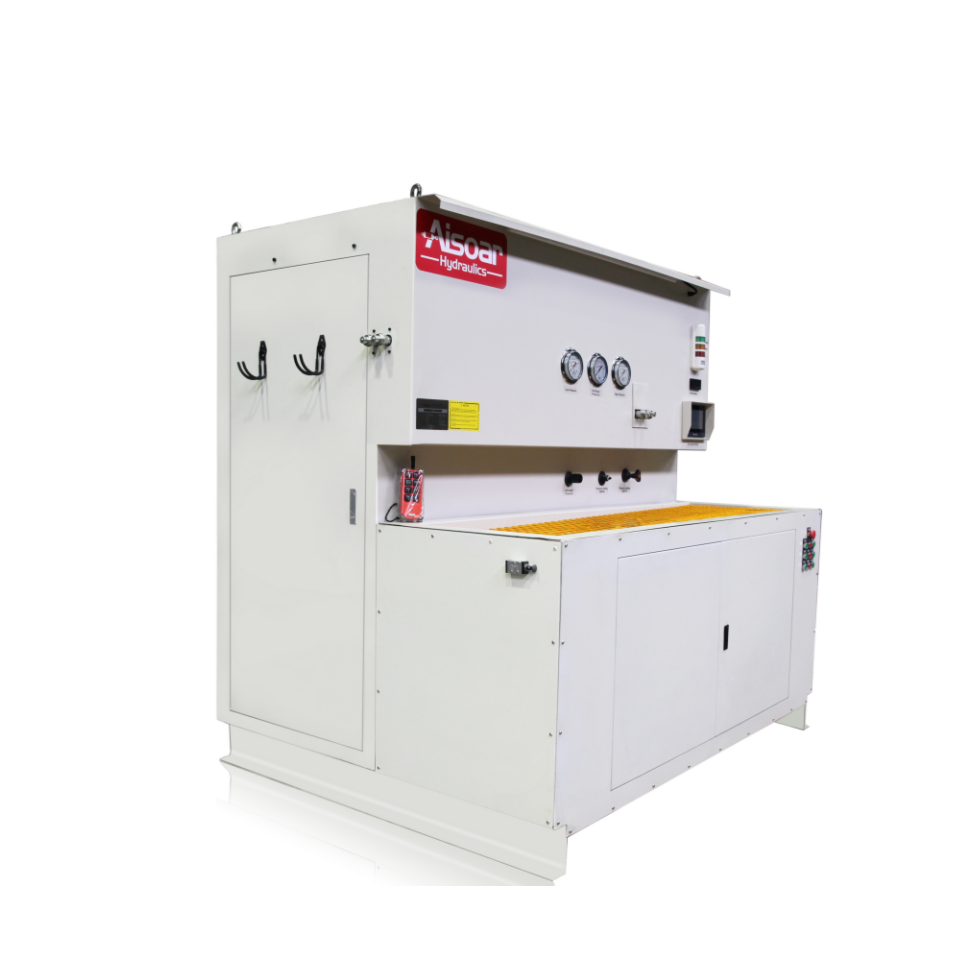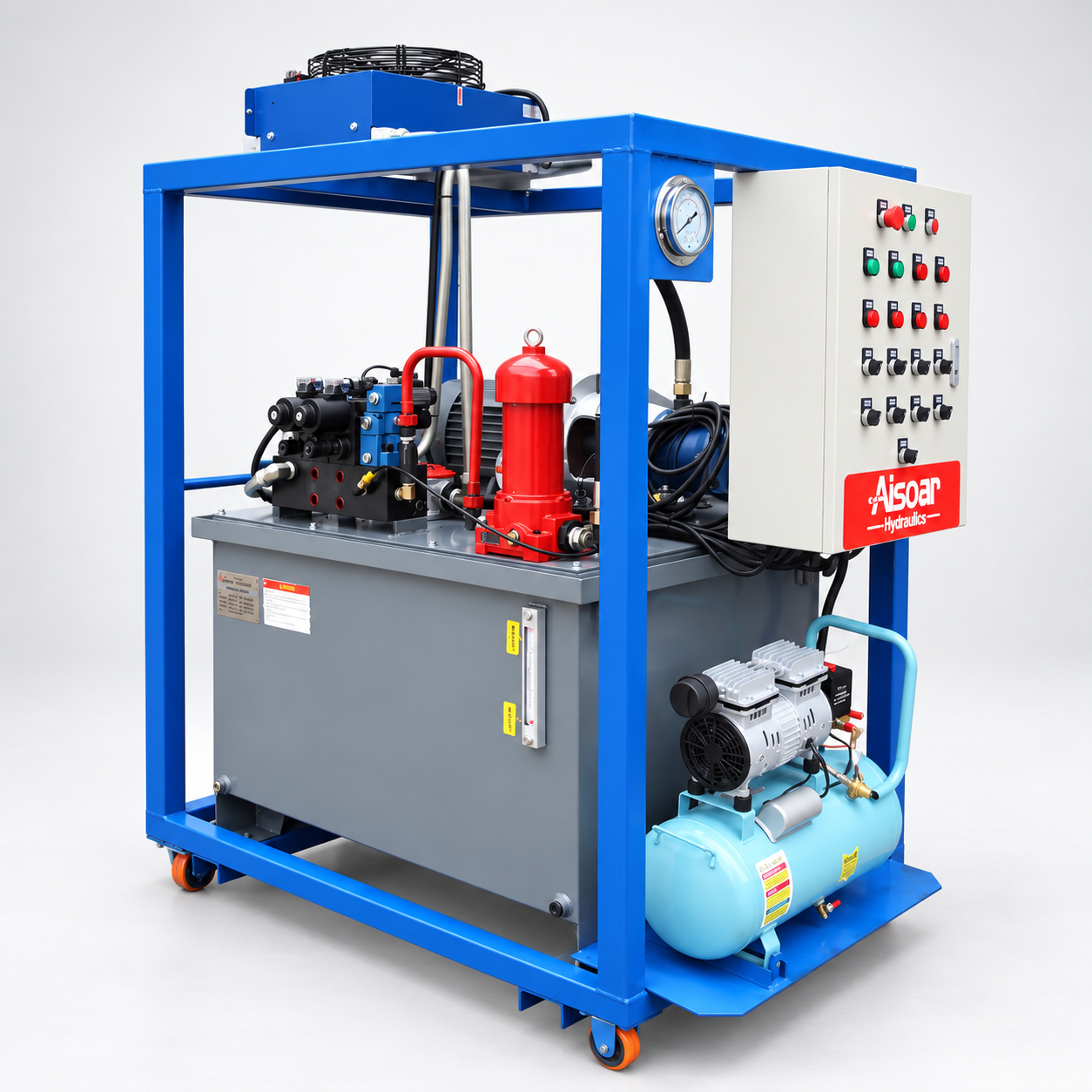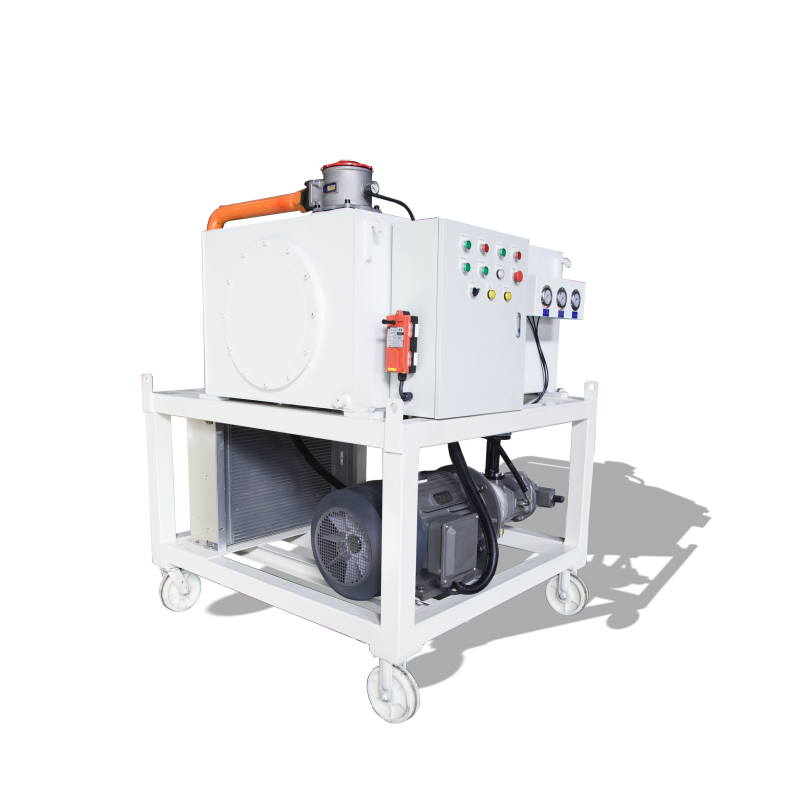
Hydraulic test benches can be designed with very different levels of operator involvement and automation. At one end, the operator manually adjusts pressure, switches valves, observes instruments, and records test results. At the other, a control system can automatically manage most repeatable test steps and record the results digitally.
These configurations are often described as manual, semi-automatic, and PLC-controlled hydraulic test benches.
However, these terms are not strict or mutually exclusive industry classifications. “Manual” and “semi-automatic” mainly describe the level of automation, while “PLC-controlled” describes the control architecture. A semi-automatic hydraulic test bench may still use a PLC for timing, pressure control, data acquisition, or safety interlocks.
For the purpose of this article, a PLC-controlled test bench refers to a system in which most repeatable test sequences are managed automatically by the control system.
Understanding these differences helps manufacturers, hydraulic repair workshops, OEMs, and test laboratories choose an automation level that matches their actual testing process.
What Is a Manual Hydraulic Test Bench?
A manual hydraulic test bench relies heavily on the operator to control the test.
The hydraulic circuit may still contain pumps, relief valves, directional valves, pressure gauges, flow meters, temperature sensors, and leakage measuring devices. The difference is that the operator decides when and how the test conditions are changed.
For example, when testing a hydraulic cylinder, the operator may manually switch the directional valve, gradually increase pressure, hold the pressure for a specified period, observe the cylinder for leakage or movement, and record the results.
This type of test bench is particularly useful when the tested components vary significantly.
A hydraulic repair workshop may handle cylinders with different bore diameters, strokes, mountings, port positions, and pressure ratings every day. Because the operator already needs to change fixtures and connections for each cylinder, full automation may not provide a major advantage.
Manual systems are also generally easier to understand and maintain because the control architecture is relatively simple.
The main limitation is that test consistency depends more heavily on the operator. Different operators may increase pressure at different rates, hold a test condition for slightly different periods, or record results in different ways.
For low-volume repair verification this may be acceptable. For repetitive production testing, however, operator variation can become an important issue.
How Does a Semi-Automatic Hydraulic Test Bench Work?
A semi-automatic hydraulic test bench combines manual setup with automated control of selected parts of the testing process.
The operator may still install the component, connect hoses, adjust fixtures, and select the required test. Once the test begins, however, the system can automatically control functions such as pressure holding, test timing, cycling, leakage monitoring, or data recording.
The exact level of automation varies from one machine to another.
For example, one semi-automatic test bench may only provide automatic pressure holding and digital data recording. Another may automatically complete several testing stages while still requiring manual loading and connection of the component.
This approach is useful when the mechanical setup must remain flexible but the actual test sequence needs better consistency.
Consider a hydraulic cylinder repair center. Different cylinders may require different mounting positions and hose connections, so component installation remains manual. After the cylinder is connected, the bench can automatically control low-pressure cycling, proof pressure, holding time, and measurement recording.
In this case, semi-automation reduces operator workload without sacrificing the flexibility required for mixed-product testing.
What Is a PLC-Controlled Hydraulic Test Bench?
A PLC-controlled hydraulic test bench uses a programmable logic controller to manage a significant part of the test sequence.
Sensors provide information such as pressure, flow, temperature, position, or leakage to the control system. Based on the programmed procedure, the PLC can control pumps, solenoid valves, proportional valves, motors, and other hydraulic or electrical components.
A typical PLC-controlled cylinder test could automatically perform low-pressure circulation, increase pressure to a target value, maintain that pressure for a defined period, monitor leakage, cycle the cylinder, and finally depressurize the circuit.
When an HMI or industrial computer is included, the operator may also be able to select test recipes, monitor real-time values, view alarms, and review stored test results.
An important point is that PLC-controlled does not necessarily mean fully automatic.
A PLC-controlled machine may still require manual loading, fixture adjustment, hose connection, visual inspection, or component removal. The actual level of automation should therefore be evaluated by examining the complete workflow rather than simply asking whether the machine contains a PLC.
Manual vs Semi-Automatic vs PLC-Controlled Test Benches
The practical differences become clearer when the three configurations are compared side by side.
| Comparison Item | Manual | Semi-Automatic | PLC-Controlled / Highly Automated |
|---|---|---|---|
| Operator involvement | High | Medium | Low to medium |
| Test sequence control | Mainly operator controlled | Partially automated | Primarily program controlled |
| Pressure control | Mainly manual | Manual or automatic | Can be automatically controlled |
| Test timing | Operator controlled | Usually automated | Automated |
| Data recording | Often manual | Usually digital | Commonly automated |
| Repeatability | More operator dependent | Good | High when properly programmed and controlled |
| Test recipes | Limited | Possible | Common |
| Automatic pass/fail | Uncommon | Optional | Can be integrated |
| Traceability | Limited | Moderate | High when data management is included |
| Production efficiency | Low to medium | Medium to high | Potentially high for repetitive testing |
| Flexibility | High | High | Depends on machine and fixture design |
| System complexity | Low | Medium | Higher |
| Initial investment | Lower | Medium | Higher |
These are general characteristics rather than fixed rules.
A manual test bench can still use digital pressure sensors and automated data logging. Likewise, a PLC-controlled machine may automate only a limited part of the overall test process.
For this reason, buyers should compare the actual functions rather than relying only on labels such as “manual,” “semi-automatic,” or “PLC-controlled.”
Which Automation Level Is More Suitable?
The appropriate automation level depends mainly on test volume, product variation, repeatability requirements, and the importance of data traceability.
A manual test bench is often suitable for repair workshops and low-volume testing where components vary considerably. In this environment, operator flexibility can be more valuable than a highly standardized automatic sequence.
Semi-automatic testing is often a good choice when production or repair volume increases but product variation remains high. The mechanical setup can remain flexible while repetitive test operations become more consistent.
PLC-controlled systems are particularly useful when the same test procedures are performed repeatedly. Manufacturers that test similar hydraulic cylinders, pumps, valves, or motors before shipment may benefit from automatic timing, standardized test sequences, alarm monitoring, and digital test records.
The goal should not be to maximize automation for its own sake.
A better question is:
Which parts of the testing process need to be automated to improve repeatability, productivity, safety, or traceability?
In many real applications, the most effective test bench combines automation where it creates value with manual operation where flexibility is still necessary.
Does PLC Control Make a Hydraulic Test Bench More Accurate?
PLC control primarily improves test consistency and repeatability. It does not automatically improve measurement accuracy.
A PLC can make sure that the same pressure ramp, holding time, cycle count, or acceptance condition is applied to each component. This reduces variation caused by different operating habits.
Measurement accuracy, however, depends on the instrumentation used in the system.
Pressure transducers, flow meters, leakage measurement devices, calibration methods, signal processing, and sensor range all influence the quality of the measured data.
A PLC-controlled test bench should therefore be evaluated in two separate ways: how consistently it controls the testing procedure, and how accurately the measurement system collects data.
The sensors and data acquisition system are an important subject on their own and should be considered separately when specifying a hydraulic test bench.
Automation Is Only One Part of Test Bench Selection
The control system is important, but it does not determine whether a test bench is technically suitable for a particular component.
The bench must first meet the required test pressure, flow, component size, test force, measurement range, accuracy, fixture, and functional testing requirements.
Once the required testing capacity has been defined, the automation level can then be selected according to test volume, operator involvement, repeatability, and data-management requirements.
A highly automated test bench with insufficient pressure or flow capacity is still the wrong machine for the application.
Conclusion
Manual, semi-automatic, and PLC-controlled hydraulic test benches represent different approaches to managing the testing process.
A manual hydraulic test bench provides high flexibility and relatively simple operation, making it well suited to low-volume testing and repair work involving many different components.
A semi-automatic test bench keeps much of that flexibility while automating repetitive steps such as pressure control, timing, monitoring, and data recording.
A PLC-controlled hydraulic test bench is particularly valuable where test procedures must be repeated consistently and where productivity, traceability, standardized testing, or digital test records are important.
The best solution is therefore not necessarily the test bench with the highest level of automation.
It is the test bench whose automation level matches the actual testing workflow while still providing the pressure, flow, measurement capability, fixture flexibility, and safety required for the components being tested.